Table Mountain Geography: Cape Town, Plateau & Atlantic Setting
Table Mountain is a flat-topped sandstone massif overlooking Cape Town, South Africa, and a widely recognized regional landmark.

Table Mountain, South Africa.
- Country
- South Africa
- Coordinates
- 33.9622° S, 18.4135° E
See the answer as a place
Why Table Mountain is easy to recognize on a map
The illustration highlights the relationship between the plateau, Cape Town, the peninsula, and the Atlantic coast.
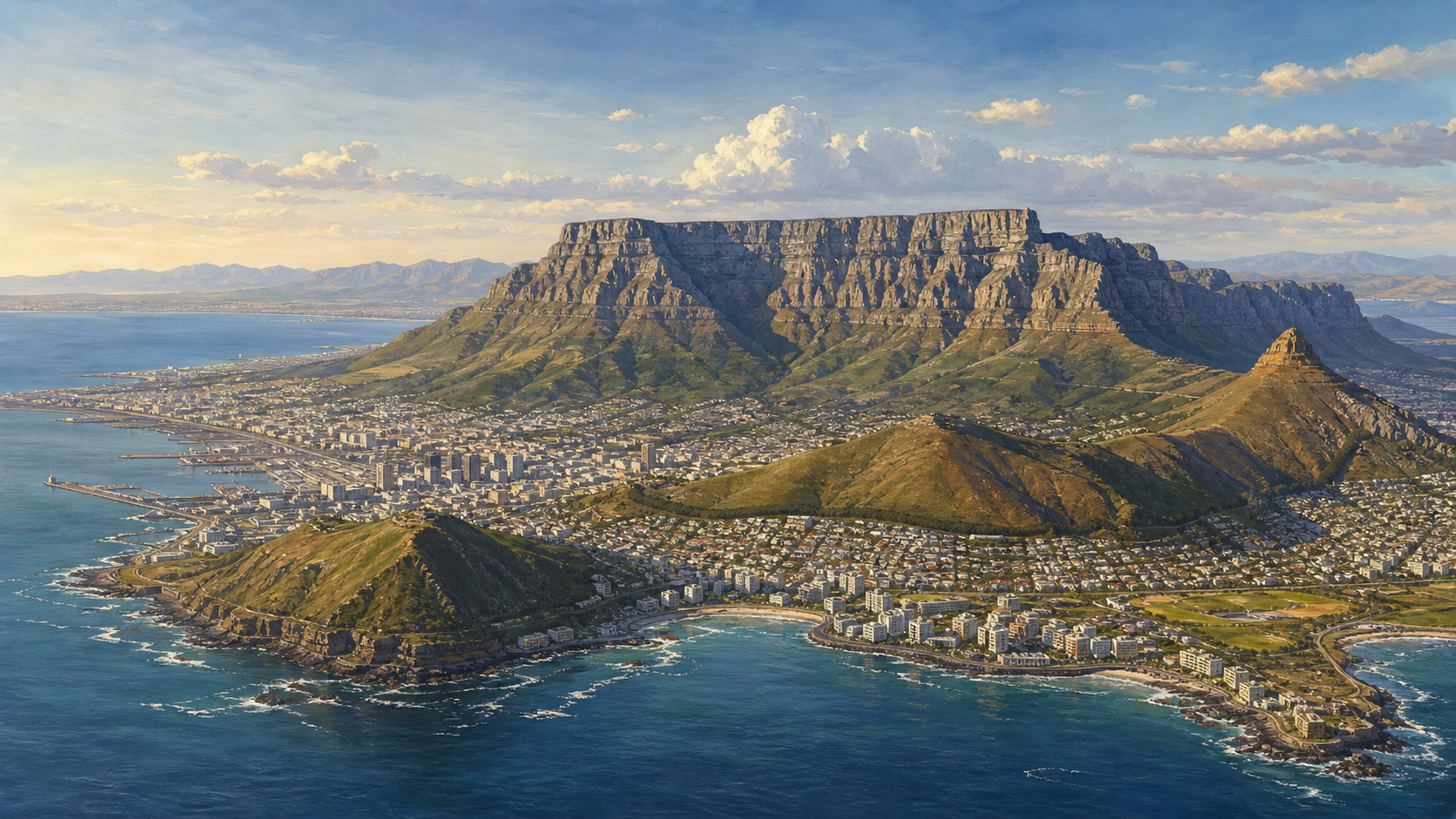
- The flat sandstone plateau above the city
- Cape Town and the peninsula around Table Bay
- The Atlantic coastline shaping the setting
Table Mountain overview
Table Mountain is a flat-topped sandstone massif overlooking Cape Town, South Africa, and a widely recognized regional landmark. The summit reaches 1,086 metres above sea level, a concrete topographic measurement. Its prominence defines local topography and contributes to scientific and cultural significance for the metropolitan area. Distinctive features of the site include a broad plateau, sheer sandstone cliffs, and geomorphology that has attracted geological and botanical study.
Table Mountain coordinates
Table Mountain is commonly mapped at approximately 33.9622° S, 18.4135° E, or -33.9622, 18.4135 in decimal degrees.
Degrees: 33.9622° S, 18.4135° E
Decimal: -33.9622, 18.4135
Where Table Mountain is located
Table Mountain sits on the central Cape Peninsula immediately south of Cape Town's central business district, within the City of Cape Town municipality in Western Cape province. Coordinates are approximately 33°57′45″ S, 18°24′36″ E, placing the plateau above Table Bay to the north and the Atlantic seaboard to the west. Neighboring peaks include Devil's Peak to the east and Lion's Head to the northwest, and the mountain forms the highest ground on the peninsula. Its location on the Cape Peninsula defines its urban and coastal context.
Why Table Mountain is important
Table Mountain's significance derives from its high botanical diversity, prominent skyline role, and long history of scientific investigation. The massif supports rich fynbos vegetation on thin, acidic sandstone soils, concentrating endemic plant species that have drawn botanical research. As a conspicuous coastal landmark, the mountain historically aided maritime orientation and later became a cultural emblem for Cape Town. Its flat-topped morphology and exposed rock also provide accessible examples for ongoing geological and ecological studies.
History of Table Mountain
Table Mountain originated as layers of quartzitic sandstone deposited in the Palaeozoic era, later folded and uplifted during regional tectonic events and sculpted by long-term erosion into a resistant, flat-topped massif. The sandstone unit commonly known as Table Mountain Sandstone forms the mountain's structural backbone and explains its steep cliffs. Indigenous Khoikhoi and San peoples associated the mountain with coastal resources and landscape identity prior to European settlement. The arrival of European ships and the establishment of a supply station at the Cape in the seventeenth century intensified mapping and maritime use of the feature. Scientific interest grew in the nineteenth century when geologists and botanists conducted systematic surveys, establishing the mountain as a subject for ongoing geological and ecological research.
Natural features of Table Mountain
Table Mountain presents a nearly level summit plateau bounded by dramatic sandstone cliffs and steep escarpments. The mountain's rock is predominantly hard, quartz-rich sandstone that weathers into vertical faces, blocky tors, and exfoliated slabs. Bedding planes and jointing patterns produce visible ledges, buttresses, and talus slopes at the cliff bases. Surface drainage on the plateau forms a network of shallow channels and small seasonal streams that feed lower catchments. Rock exposures reveal cross-bedding and quartzite lenses that record ancient depositional environments on the Cape coastline.
Environment, protection, and monitoring of Table Mountain
Table Mountain falls largely within Table Mountain National Park, a protected area managed under national park authority in cooperation with municipal agencies. The mountain is part of the Cape Floral Region World Heritage Area, a designation that frames conservation priorities and legal protections. Conservation efforts concentrate on maintaining fynbos biodiversity, controlling invasive alien plants, and managing fire regimes and erosion processes. Long-term stewardship involves national park staff, academic research teams, and biodiversity agencies such as the South African National Biodiversity Institute, which coordinate ecological monitoring and restoration initiatives.
Table Mountain facts
- Maclear's Beacon was established during a nineteenth-century trigonometrical survey as a marked summit reference for scientific mapping.
- The mountain's exposed quartzitic sandstone provides a reference section for geological studies of the Cape Supergroup sequence.
- The Khoikhoi name Hoerikwaggo, commonly translated as "mountain in the sea", records indigenous perspectives on the feature.
- The frog species Heleophryne rosei, known as the Table Mountain ghost frog, is endemic to streams on this mountain.
- An international campaign selected the site as one of the New7Wonders of Nature, increasing its profile in global conservation discourse.
Explore More in South Africa
More in South Africa
Related places to Table Mountain
Explore nearby pages and closely connected places to keep navigating within the same geography cluster.
Explore Places by Type
Browse structured collections of recently published places by institution, urban role, or transport type.
Frequently Asked Questions
What are the coordinates of Table Mountain?
Table Mountain is commonly mapped at approximately 33.9622° S, 18.4135° E, or -33.9622, 18.4135 in decimal degrees.