Yemen Guide
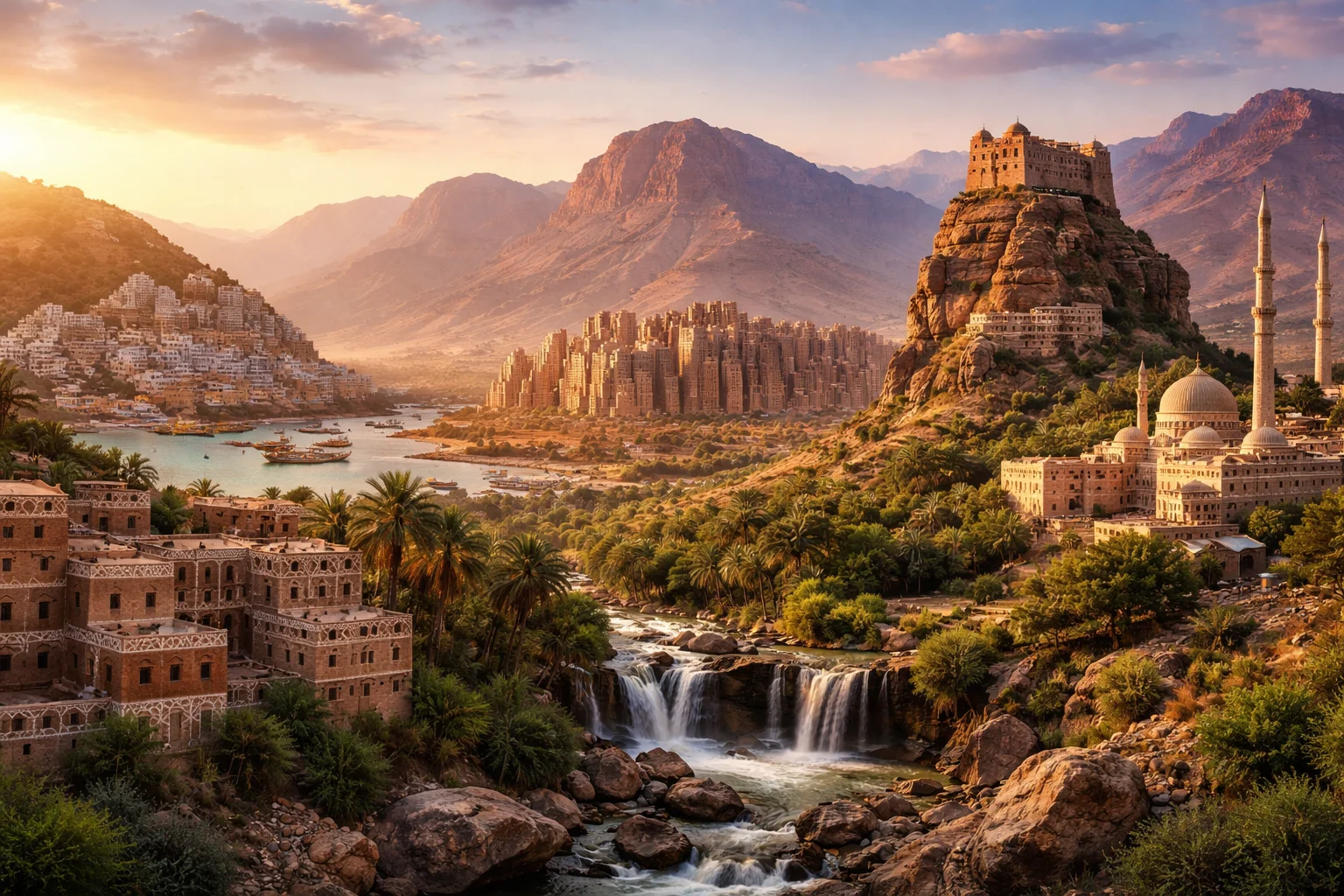
Yemen overview
Yemen is a sovereign state at the southwestern edge of the Arabian Peninsula, controlling coastal approaches to the Red Sea and the Gulf of Aden. The country's landscape mixes ancient highland settlements, an extended coastline and the Socotra archipelago, the latter renowned for endemic plant species and distinct island ecosystems. Historically a trading crossroads between Africa, Arabia and the Indian Ocean, Yemen’s built environment and agricultural practices reflect layers of pre-Islamic kingdoms, medieval maritime commerce and localized urban forms that persist in fortified towns and terraced valleys.
Common Geography Questions About Yemen
Where Yemen is located
Yemen occupies the southwestern corner of Asia on the Arabian Peninsula, centered near 15°N, 48°E. It shares a long land border with Saudi Arabia to the north and a shorter frontier with Oman to the east; its southern and western coasts meet the Gulf of Aden and the Red Sea. The state’s maritime domain fronts the Bab al‑Mandeb strait, a strategic chokepoint linking the Red Sea to the Indian Ocean. Across the narrow Red Sea lie Eritrea and Djibouti, while Yemen’s territory also includes offshore islands in the adjacent Indian Ocean waters.
Geography and landscape of Yemen
Yemen’s terrain extends from low, saline coastal flats to the Arabian Peninsula’s loftiest summits. Jabal an Nabi Shu'ayb rises above 3,600 meters, producing steep terraced agriculture on volcanic and limestone slopes; such altitude-driven cultivation supports unique mountain cropping systems. There are no perennial rivers in the conventional sense—drainage runs in seasonal wadis that sustain irrigated terraces. The Tihama plain along the Red Sea is notably hot and low-lying, while interior plateaus capture fog and cooler temperatures, creating sharply differentiated microclimates within a relatively confined territory.
Yemen culture and society
Arabic is the official language of Yemen, while Modern South Arabian languages such as Mehri and Jibbali survive in parts of the southeast and represent linguistic continuities distinct from mainstream Arabic dialects. Social life frequently revolves around tribal councils (majlis) and extended-family networks that mediate land use and local disputes. Qat chewing functions as a pervasive daily social ritual shaping hospitality and communal time use in ways rare outside the region. Islam is the dominant religion, with Zaydi jurisprudence historically influential in northern highlands and Shafi'i practice more common along coastal areas, producing a complex mosaic of legal and ritual practices.
History of Yemen
Yemen’s recorded past begins with South Arabian polities like Saba and Himyar; their inscriptions and hydraulic engineering—most notably the ancient Marib Dam—anchor the region’s early statecraft and long-distance incense trade. Coastal ports integrated into medieval Indian Ocean networks, while interior highland polities retained local autonomy. From the early modern era, Ottoman and British presences left administrative and infrastructural imprints, particularly along the littoral. In the late twentieth century distinct northern and southern state systems existed before diplomatic and political unification in 1990, a rare modern instance of two divergent post-colonial systems merging.
Yemen economy and government
Yemen is governed as a unitary republic with an executive presidency and a legislature; administrative authority is distributed through governorates led by appointed officials. The Yemeni rial is the national currency. The economy depends on extractive hydrocarbon receipts for fiscal revenue alongside limited industrial activity; agriculture comprises smallholder cereal and fruit cultivation and artisanal fisheries. Large informal remittance flows and a broad subsistence sector shrink the formal tax base, and small-scale manufacturing provides localized employment. This structural mix makes fiscal planning sensitive to commodity-price volatility and external cash flows.
Regions and major cities of Yemen
Yemen is divided into governorates that track the country’s geographic contrasts: highlands, coastal plains, eastern deserts and the southern island territory. The capital, Sana'a, functions as the political and historical center; Taiz is an important cultural and commercial hub in the western highlands, while Al Mukalla is a principal city on the eastern seaboard. In the Hadhramaut valley, the mudbrick town of Shibam is notable for densely packed multi‑storey tower houses—often cited as one of the earliest examples of planned vertical urbanism in the pre-modern world.
Distinctive characteristics of Yemen
Several concrete features tie Yemen to broader global histories. The port of Mocha historically lent its name to global coffee trade vocabularies, reflecting a centuries‑long highland cultivation-export link. The Hadhrami diaspora from eastern valleys established merchant communities across East Africa, the Persian Gulf and Southeast Asia, producing an unusually coherent transregional commercial network originating in a compact hinterland. The country also attracts scholarly attention for its corpus of South Arabian epigraphy and for a compact set of heritage sites that inform studies of architecture, urbanism and conservation.