Venezuela Guide
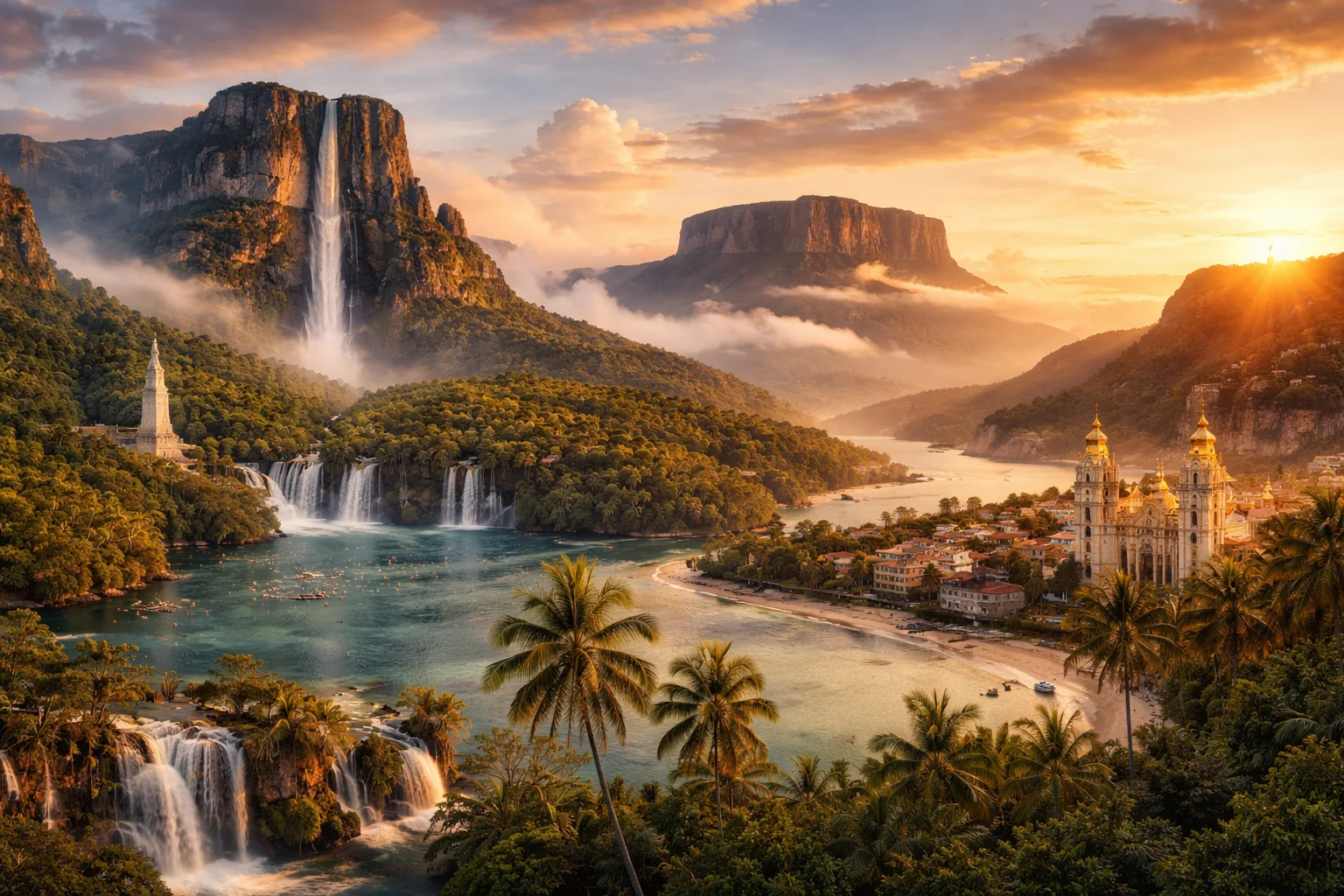
Venezuela overview
Venezuela is on the northern coast of South America, with Caracas as its capital. Caribbean shores give way to oil-bearing plains, Andean highlands and Amazonian rainforest. In the southeast, tabletop tepuis and Angel Falls—the world’s highest uninterrupted waterfall—underscore the country’s striking physical contrasts. Large hydrocarbon reserves have shaped the economy, while Indigenous traditions, Iberian colonial heritage and transatlantic migration have influenced Venezuelan music, food and political life.
Common Geography Questions About Venezuela
Where Venezuela is located
Venezuela occupies the northern edge of South America, between roughly 0.6°N and 12.2°N and 60°W and 73°W. Colombia borders it to the west and south-west, Brazil to the south and Guyana to the east, while the Caribbean Sea lies to the north. The coastline and Orinoco River delta open toward the Atlantic. Offshore territories include the coral and sand cays of the Los Roques archipelago.
Geography and landscape of Venezuela
The country encompasses four broad physical regions. The Andes include the Cordillera de Mérida and Pico Bolívar; farther east are the coastal ranges, Llanos plains and Orinoco River system. The ancient Guiana Shield dominates the southeast, where flat-topped sandstone tepuis such as Mount Roraima rise near Angel Falls, the world’s highest uninterrupted waterfall. Lake Maracaibo’s shallow, brackish basin and the Orinoco’s navigable reaches affect both transport and ecology. Conditions range from tropical rainforest in Guayana to alpine páramo above 3,000 meters.
Venezuela culture and society
Spanish is Venezuela’s official language, and the constitution also recognizes dozens of Indigenous languages, among them Warao, Pemon and Wayuu. Joropo music and dance are rooted in the Llanos, while gaita is associated with the Lake Maracaibo region. Arepas and pabellón criollo are widely recognized staples; Indigenous communities also prepare cassava-based dishes. Roman Catholicism predominates, alongside regional syncretic traditions such as the cult of María Lionza. The population includes a mestizo majority and sizable Indigenous and Afro-descendant communities.
History of Venezuela
Venezuela’s recorded history moves from pre-Columbian Arawak and Carib settlements to colonization by Spain in the 16th century, then to an independence movement that produced Simon Bolívar’s campaigns and the short-lived republic of Gran Colombia. After separation in the 19th century, the country experienced cycles of caudillo rule and oligarchic republics before the 20th-century transformation driven by commercial oil exploitation. Petroleum wealth reconfigured social structures and state institutions, making resource control a recurring pivot in Venezuela’s regional influence and domestic political development.
Venezuela economy and government
Venezuela is a presidential republic governed through a central executive and a unicameral National Assembly. Its official name reflects the Bolivarian legacy found in national symbols and constitutional reform. The economy remains heavily dependent on natural resources and state-managed enterprises, especially the state-centered oil industry. Hydrocarbons have historically supplied most export revenue and strongly influenced public finance. Mining in the Guiana Shield, coffee and cacao farming in particular micro-regions, and Caribbean fisheries form other parts of the economy. The currency is the bolívar.
Regions and major cities of Venezuela
Venezuela is divided into 23 states, a Capital District and Federal Dependencies that encompass offshore island chains. Together they span the Andean highlands, Llanos lowlands, Guiana Shield and Caribbean coastal zones. Caracas, the national capital and a political and financial hub, lies in a mountain valley near the Caribbean. Maracaibo is closely tied to its namesake lake and to oil production; Valencia serves as a manufacturing and logistics center in the north-central plains. Coastal, lacustrine and highland traditions continue to influence urban life.
Distinctive characteristics of Venezuela
Angel Falls and the tepuis of the Guiana Shield rank among Venezuela’s best-known natural landmarks. Lake Maracaibo is associated with the Catatumbo lightning phenomenon, and the Orinoco Belt holds some of the world’s largest proven petroleum reserves. Other points of distinction include joropo music, organized national pageant competitions and the niche international reputations of Criollo cacao and artisanal cheeses. The country’s varied environments also support studies of tropical biodiversity and geological antiquity.
Places in Venezuela
Angel Falls
Angel Falls is a plunging waterfall in southeastern Venezuela and the tallest uninterrupted waterfall on Earth, measured at 979 metres in total vertical drop. It descends from the Auyán-tepui table-top mountain within the Guiana Highlands and is notable for its dramatic single-drop plunge of about 807 metres. Its scale and setting make Angel Falls a defining natural landmark of the region and a subject of scientific, cultural, and conservation interest.
Caracas
Caracas is the capital city of Venezuela, located in northern Venezuela in a mountain valley at an altitude near 900 metres above mean sea level. It is the nation’s principal seat of government and economic activity and serves as Venezuela’s largest urban agglomeration by many administrative measures. Caracas hosts national political institutions and is a primary point of reference for Venezuelan geography, history, and national significance.
Caricuao Zoo
Caricuao Zoo is a municipal zoological park in Caracas, Venezuela. It is located within the Caricuao parish and functions as a principal city-managed collection of living animals and curated plantings. The facility is formally registered with Caracas municipal authorities as a public zoological institution responsible for animal husbandry and botanical stewardship. Caricuao Zoo supports educational and conservation activities administered through city agencies and institutional partners.
Central University of Venezuela
Central University of Venezuela is the national public university of Venezuela, centered on a flagship campus in Caracas. The institution traces formal roots to the Royal and Pontifical University of Caracas and was reconstituted in the nineteenth century; its principal campus, Ciudad Universitaria de Caracas, is a designated World Heritage cultural landscape. Central University of Venezuela functions as a major center for higher education, research, and public collections, and it is governed as an autonomous university with a rector and collegiate bodies responsible for academic and institutional oversight.