United States Guide
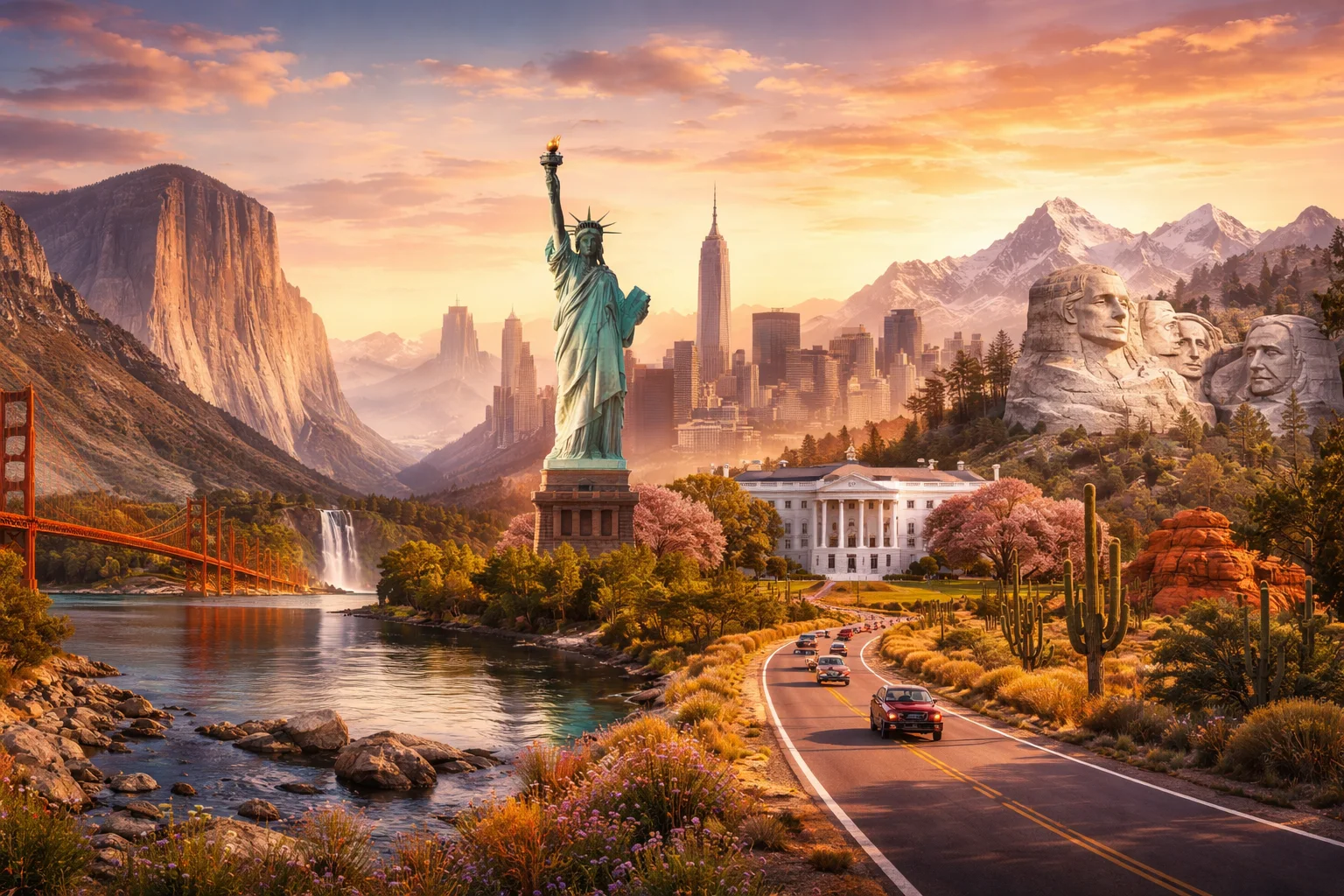
United States overview
United States is a federated constitutional republic occupying much of the North American continent and extending into the Arctic and tropical Pacific through Alaska and island territories. The country is notable for its continental breadth—from the Atlantic seaboard to the Pacific coast—and for a political system that combines a written constitution with strong state governments. Its significance stems from a large, diversified economy, a history of rapid territorial expansion, and a global cultural footprint shaped by industries such as film, technology, and higher education.
Common Geography Questions About United States
Where United States is located
United States lies primarily in central North America, roughly between 24°N and 71°N latitude and 66°W to 172°W longitude when Alaska and Hawaii are included. It shares the world’s longest bilateral land border with Canada to the north and a southern land border with Mexico; maritime boundaries sit with Russia across the Bering Strait and with several Caribbean and Pacific states near its territories. The country fronts the Atlantic and Pacific Oceans, contains large interior seas like the Great Lakes, and reaches into Arctic waters via Alaska.
Geography and landscape of United States
The United States displays a range of terrain from Arctic tundra in northern Alaska to tropical volcanic islands in Hawaii. Major mountain systems include the Cascades and Sierra Nevada on the West Coast, the Rocky Mountains running north–south through the interior West, and the ancient Appalachian chain in the East; Denali in Alaska is the highest peak in North America. The Mississippi River system drains a vast continental interior to the Gulf of Mexico, and the country uniquely hosts the first national park—Yellowstone—within a federal conservation framework that shaped global park practice.
United States culture and society
Cultural life in the United States is shaped by English as the de facto national language alongside a large Spanish-speaking population and numerous Indigenous languages; the country recognizes hundreds of federally acknowledged Native American and Alaska Native nations with distinct legal statuses. Social customs range from federal holidays such as Thanksgiving—observed nationwide on a specific Thursday in late November—to locally rooted traditions like New England town meetings. Demographically, continued immigration and internal migration have produced high ethnic and linguistic diversity concentrated in metropolitan areas, with religion and civic volunteerism playing notable public roles.
History of United States
The United States emerged from a set of British colonies that declared independence in 1776 and later adopted a written constitution in 1787 to create a national federal government. Expansion across the continent in the 19th century—through purchases, treaties and conflict—reoriented indigenous societies and set the stage for the Civil War, a decisive conflict that resolved secession and led to the abolition of slavery. Industrialization, mass immigration and 20th-century military and economic engagement overseas transformed the nation into a major actor in global diplomacy and commerce while provoking recurring domestic debates about rights and federal authority.
United States economy and government
United States operates as a presidential federal republic with separation of powers among an elected executive, a bicameral legislature, and an independent judiciary; its Senate gives equal representation to subnational units regardless of population, a design feature with distinctive political consequences. The national currency is the United States dollar, issued by the Federal Reserve System, and the economy combines large service sectors—finance centred in New York, technology clusters such as Silicon Valley—and extensive agricultural and energy production (notably the U.S. Corn Belt and major shale oil regions). Securities markets including the NYSE and NASDAQ play global roles in capital formation.
Regions and major cities of United States
Administratively the country comprises fifty states plus a federal district and several territories with varied constitutional statuses, producing multiple layers of law and governance unique to its structure. The capital, Washington, D.C., is a federal district rather than a state. Major cities include New York City, a global financial and media hub; Los Angeles, the center of film and entertainment production; and Chicago, a historic transportation and commercial core. Broad regions—Northeast, Midwest, South and West—contain distinct economic bases and cultural identities, from the industrial Midwest to the Sun Belt’s rapid urbanization.
Distinctive characteristics of United States
Conspicuous features often associated with the United States include the First Amendment tradition of protected speech, the Interstate Highway System created to facilitate national mobility, and NASA’s Apollo program that landed humans on the Moon—achievements that have specific institutional origins. The country’s universities, notably large public research campuses and private institutions, form a global magnet for postgraduate study. Technological origins such as ARPANET and cultural exports from Hollywood films to popular music have made U.S. institutions and products internationally recognizable across politics, science and entertainment.
Places in United States
Acadia National Park
Acadia National Park is a United States national park located on the Atlantic coast of Maine. It encompasses about 49,075 acres concentrated on Mount Desert Island and adjacent islands, protecting coastal granite domes, forested ridges, freshwater ponds, and intertidal shoreline. The park’s designation preserves a contiguous complex of marine and terrestrial landscapes that illustrate northeastern coastal geology. Its combination of exposed bedrock, island-dominated coastline, and conserved cultural features gives it distinctive significance within the U.S. national park system.
Akaka Falls
Akaka Falls is a plunge waterfall in the United States, located on the island of Hawaiʻi. It lies within Akaka Falls State Park on the windward Hamakua Coast and has an approximately 442-foot (135-meter) vertical drop, a measurable physical attribute that defines its hydrologic and geomorphological profile. The waterfall functions as a regional landmark and a defined natural feature within Hawaiʻi state-managed park lands.
American Museum of Natural History
American Museum of Natural History is a museum in the United States focused on natural science collections, research, and public exhibitions. It occupies a complex of interconnected exhibition and research buildings along Central Park West in Manhattan, spanning the block between West 77th and West 81st Streets. The institution operates as a private non-profit museum with formal research departments and a large, curated scientific collection that supports taxonomy, paleontology, and public display.
Antelope Canyon
Antelope Canyon is a water-carved slot canyon in Navajo Sandstone on land administered by the Navajo Nation near Page in northern Arizona. Upper and Lower Antelope Canyon have different internal forms, though both feature steep, narrow passages and sculpted walls. In places, the canyon is roughly 120 feet (37 meters) deep, revealing a substantial vertical range of sandstone layers.
Arches National Park
Arches National Park is a protected area in eastern Utah notable for its concentration of natural sandstone arches and related formations. The park covers approximately 76,679 acres and contains more than 2,000 documented natural arches. It is significant for its geological formations, cultural symbolism, and scientific study of rock weathering and salt-related deformation. Researchers and land managers recognize the site for measurable features such as arch counts and formally mapped geological units.
Art Institute of Chicago
Art Institute of Chicago is an art museum in the United States located in Chicago, Illinois. The institution functions as both a collecting museum and an affiliated school and occupies a multi-building campus that includes a classical Beaux-Arts main building and a modern wing addition. The Art Institute of Chicago maintains permanent collections, a research library, and conservation facilities as part of its institutional structure and public mission.
Audubon Zoo
Audubon Zoo is a zoological park in the United States located in New Orleans and operated by the Audubon Nature Institute. The complex occupies grounds within Audubon Park and functions as a curated collection emphasizing animals from Gulf Coast and subtropical environments. Its formal governance by the Audubon Nature Institute defines collection policy and long-term stewardship. The zoo combines public zoological collections with institution-level conservation, education, and species-management programs administered by a city-based nonprofit.
Beaver Stadium
Beaver Stadium is a collegiate football stadium in the United States. It is located on the Pennsylvania State University University Park campus in State College, Pennsylvania, and has a seating capacity of over 100,000. The facility functions as the primary outdoor athletics venue for Penn State’s football program and serves as a visible institutional landmark for the university. The stadium’s formal association with Pennsylvania State University defines its governance, maintenance responsibilities, and primary public uses.
Black Canyon of the Gunnison
Black Canyon of the Gunnison is a steep-walled canyon in the United States, carved by the Gunnison River in western Colorado. It is located roughly at 38.57°N, 107.72°W and contains sheer walls that reach approximately 2,700 feet in depth, with the Painted Wall cliff rising about 2,250 feet. The site is federally protected as Black Canyon of the Gunnison National Park and is significant for its extreme vertical relief, narrow inner gorge, and exposed Precambrian bedrock.
Boston Logan International Airport
Boston Logan International Airport is an international airport in the United States serving the Boston metropolitan region. It is classified by the United States Federal Aviation Administration as a commercial service airport, the formal designation that governs its certified passenger and cargo operations. The airport functions as the primary aviation facility for metropolitan Boston, connecting regional institutions, ports, and research centers with domestic and international air services. This article emphasizes the airport’s built form, materials, and long-term significance.
Boston University
Boston University is a private research university in the United States. It is located principally in Boston, Massachusetts, with a main linear campus along Commonwealth Avenue and comprises seventeen schools and colleges. The institution is formally chartered as a university and is classified among U.S. doctoral research universities. Boston University maintains multiple specialized campuses and identifiable collections, including a major archival research center and a dedicated medical campus. Its governance structure includes a board of trustees and university-wide administrative offices responsible for academic policy, finance, and campus planning. This combination of institutional breadth and an urban riverfront campus defines its measurable public footprint.
Bridalveil Fall
Bridalveil Fall is a waterfall in the United States located within Yosemite National Park, California. The waterfall is a near-single free plunge that descends roughly 620 feet from a glacially carved cliff into Yosemite Valley, a measurable physical fact used in geological descriptions. Bridalveil Fall functions as a prominent geomorphic feature of the valley wall and as an identified landmark within the park’s natural inventory. Its flow regime and plume behavior have been subjects in regional hydrology and geomorphology accounts.