United Kingdom Guide
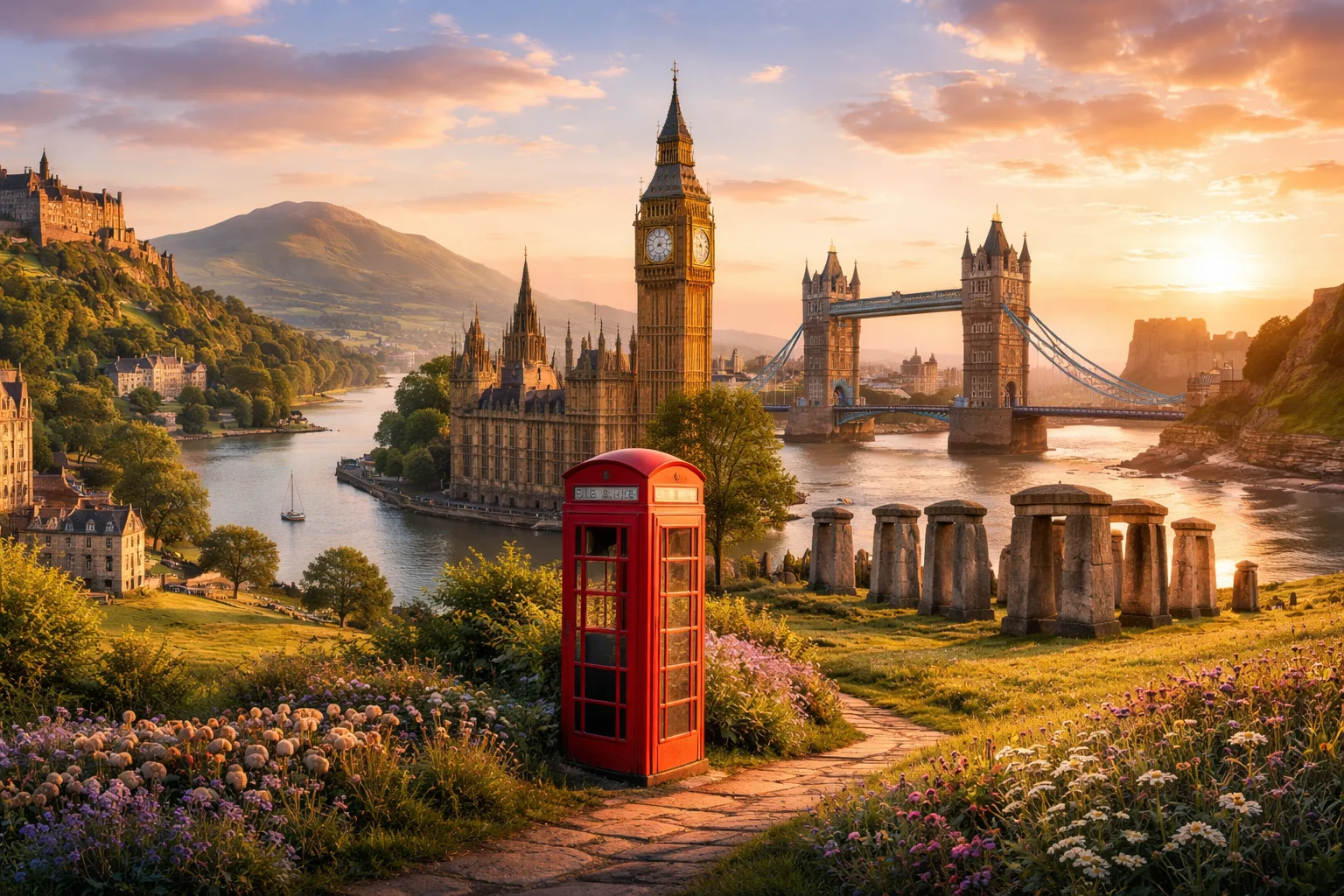
United Kingdom overview
United Kingdom is a sovereign state made up of four distinct constituent countries—England, Scotland, Wales and Northern Ireland—linked by shared institutions and mixed legal traditions. Located on islands off north‑west Europe, it has disproportionate global influence through language, finance and historical institutions. The country is notable for hosting the original Industrial Revolution, a parliamentary system with an uncodified constitution, and a capital city that has long been a world financial and cultural hub. These characteristics shape its role in regional and global networks of trade, law and culture.
Common Geography Questions About United Kingdom
Prepaid mobile data
Mobile data costs in United Kingdom
EE's Pay As You Go 1 GB Pack lists 1 GB for £10.00 over 30 days. The derived unit cost is £10.00 per GB.
Where United Kingdom is located
United Kingdom sits off the north‑western coast of continental Europe in the North Atlantic, bordered on land only by the Republic of Ireland to the west of the island of Ireland. Seas that define its position include the North Sea to the east, the English Channel to the south and the Irish Sea between Great Britain and Ireland. The archipelago includes the island of Great Britain plus thousands of smaller islands; Crown dependencies such as the Isle of Man and the Channel Islands lie nearby but are not part of the country’s sovereign territory.
Geography and landscape of United Kingdom
United Kingdom’s landscape ranges from the Scottish Highlands and fjord‑like sea lochs to lowland plains in eastern England; the Pennines run as a spine through northern England and the Lake District contains Britain’s highest concentration of glaciated mountains. Major rivers—the Thames, Severn and Clyde—shape regional trade and settlements, while Ben Nevis stands as the highest peak. A distinctive feature is the deeply indented Scottish west coast and the preservation of ancient peatland and blanket bogs that differ markedly from England’s chalk downs and Wales’s compact mountain ranges.
United Kingdom culture and society
United Kingdom’s dominant language is English, but Welsh, Scots Gaelic, Irish and regional Scots have official recognition in areas where they are used; bilingual signage in parts of Wales and Gaelic-medium schooling in parts of Scotland are institutionalized. Social life reflects four overlapping national identities, three separate legal jurisdictions and longstanding established institutions such as the Church of England in England. Cultural exports—from the literature of Shakespeare and Austen to the collegiate traditions of Oxford and Cambridge—coexist with modern multicultural urban societies, especially visible in London’s dense ethnic and linguistic diversity.
History of United Kingdom
United Kingdom’s history threads Roman, Anglo‑Saxon and Norman layers into a state forged by union and empire: the 1707 Acts of Union created a single parliament for England and Scotland, and the later eighteenth‑ and nineteenth‑century Industrial Revolution transformed production and global trade. The country built an extensive overseas empire whose governance practices and legal systems influenced many regions. Twentieth‑century wars, decolonization and internal reforms—such as the extension of parliamentary democracy and the development of national welfare institutions—recast its global role and prompted devolved political arrangements within the state.
United Kingdom economy and government
United Kingdom is a constitutional monarchy operating under parliamentary sovereignty rather than a single written constitution; governance combines an elected House of Commons with a partly appointed House of Lords, and devolved parliaments or assemblies for Scotland, Wales and Northern Ireland. The economy is service‑led with a large financial sector centered in the City of London, which has its own ancient municipal corporation and policing arrangements separate from Greater London. Currency is the pound sterling and the Bank of England, established in 1694, functions as the country’s central bank and lender of last resort.
Regions and major cities of United Kingdom
United Kingdom is administratively divided into four constituent countries, while England also uses regions and counties for local administration; Scotland, Wales and Northern Ireland maintain distinct parliaments or assemblies for devolved matters. The capital, London, concentrates national institutions, major corporate headquarters and international transport hubs. Other major cities include Birmingham and Manchester in England and Glasgow in Scotland, each historically rooted in industrialization but now centers for services, higher education and regional governance. Crown dependencies and overseas territories remain constitutionally separate from domestic regions.
Distinctive characteristics of United Kingdom
United Kingdom is strongly associated with the origins of the Industrial Revolution, the development of English common law and one of the world’s oldest parliamentary systems at Westminster. The global spread of the English language, university models such as Oxford and Cambridge’s collegiate system, and legal and financial services tied to the London market are specific legacies. The country’s constitutional oddities—an uncodified constitution, an established church in England, and continued personal union of the Crown with several other sovereign realms—create institutional patterns recognized internationally.
Places in United Kingdom
Anfield
Anfield is a football stadium in the United Kingdom that serves as the principal match venue for professional club football in its city. It functions as the home ground of Liverpool Football Club and comprises four principal spectator stands, a natural grass playing surface, and dedicated matchday infrastructure. The stadium’s formal role as a club ground and its arrangement of four main stands are measurable, defining elements of Anfield’s identity and public function.
Ashmolean Museum
Ashmolean Museum is a public museum of art and archaeology in the United Kingdom affiliated with the University of Oxford. It is the university’s principal museum for archaeology and fine art, occupying a purpose-built institutional site on a principal street in central Oxford. The museum holds systematic collections spanning antiquities, coins, paintings, and material culture assembled for teaching and research under university governance.
Banham Zoo
Banham Zoo is a zoological park in the village of Banham in the county of Norfolk, England. It operates as a licensed zoo under United Kingdom zoo regulations and maintains a curated collection of mammals, birds and reptiles held for conservation, husbandry and scientific record-keeping. The institution functions as a regional zoological collection with purpose-built enclosures, on-site animal husbandry facilities, and a formal licence that frames its animal welfare and reporting obligations.
Belfast Zoo
Belfast Zoo is a municipal zoological collection in Northern Ireland, United Kingdom. It occupies a hillside site on Cave Hill above the city and is managed by Belfast City Council as part of the city’s parks portfolio. The site functions as a curated collection of captive mammals, birds, reptiles and amphibians arranged into habitat-focused zones. The zoo serves as a civic scientific collection with a formal governance relationship to municipal authorities.
Big Ben
Big Ben is the nickname of the Great Bell in the clock at the north end of the Palace of Westminster, London. It denotes the bell itself and, by extension, the clock and the Elizabeth Tower that houses it, a significant national symbol. The Great Bell weighs about 13.76 tonnes, and the tower stands roughly 96 metres tall, providing a measurable physical presence used in architectural descriptions and technical records.
Blackpool Zoo
Blackpool Zoo is a zoological collection in Blackpool, England. It is located within the municipal borough of Blackpool in Lancashire and functions as a licensed public zoo under United Kingdom zoo regulations, serving a regional role in animal display, education, and species management. The site combines curated outdoor enclosures and indoor exhibits across a landscaped park setting, and its physical layout is organized into distinct themed enclosures and planted woodlands.
Brands Hatch Circuit
Brands Hatch Circuit is a motor racing circuit in the United Kingdom. It is located in Kent and comprises two formally recognised track configurations, the shorter Indy layout and the extended Grand Prix layout, which define its usable length and event grading. The circuit has hosted national and international competition classes and is characterised by its bowl-like spectator areas and a paved racing surface with purpose-built pit and paddock facilities.
British Museum
British Museum is a public museum in the United Kingdom located in central London that collects and displays objects from human history, art and culture. It was established by an Act of Parliament to hold a foundation collection assembled from private bequests, and it is governed by a board of trustees responsible for the institution's collections and research. The building complex includes a covered central courtyard with a glazed roof that forms a measurable interior plaza within the campus.
Brixton
Brixton is a district in the London Borough of Lambeth in the United Kingdom. It functions as an inner-urban district and an electoral ward within Greater London and is widely recognised for its role as a focal point of post-war Caribbean settlement and civic organisation. The area contains formal municipal institutions that serve the borough and a complex of covered market arcades that together define a measurable commercial footprint within the district’s central streets.
Buckingham Palace
Buckingham Palace is the official London residence and administrative headquarters of the United Kingdom's sovereign, used for many state functions. Located in central London, it stands as a principal symbol of the British monarchy and national ceremony. The building contains 775 rooms, providing a concrete metric for its scale and complexity. The palace combines residential apartments, offices, and ceremonial spaces within a single urban complex that represents both private household and public representation.
Camden Town
Camden Town is a district in London, United Kingdom. It lies within the London Borough of Camden and is administered by Camden London Borough Council. The district is widely recognised for its concentration of market areas and for being adjacent to the Regent's Canal, a measurable urban waterway that crosses the neighbourhood. Camden Town also contains a mixture of Victorian industrial structures and later cultural reuse, and its principal postal district is commonly identified as NW1.
Chester Zoo
Chester Zoo is a zoological collection in the United Kingdom. It is located in Upton on the outskirts of Chester in Cheshire and is regulated under the national framework for zoo licensing. The site is noted for its combination of planted, walk-through habitats and captive-breeding programmes that link managed enclosures with field conservation. The institution functions as a scientific collection with formal conservation and research responsibilities under national inspection regimes.
Explore Natural Landmarks in United Kingdom
Browse islands and mountains connected with United Kingdom to keep exploring related geography clusters.