Ukraine Guide
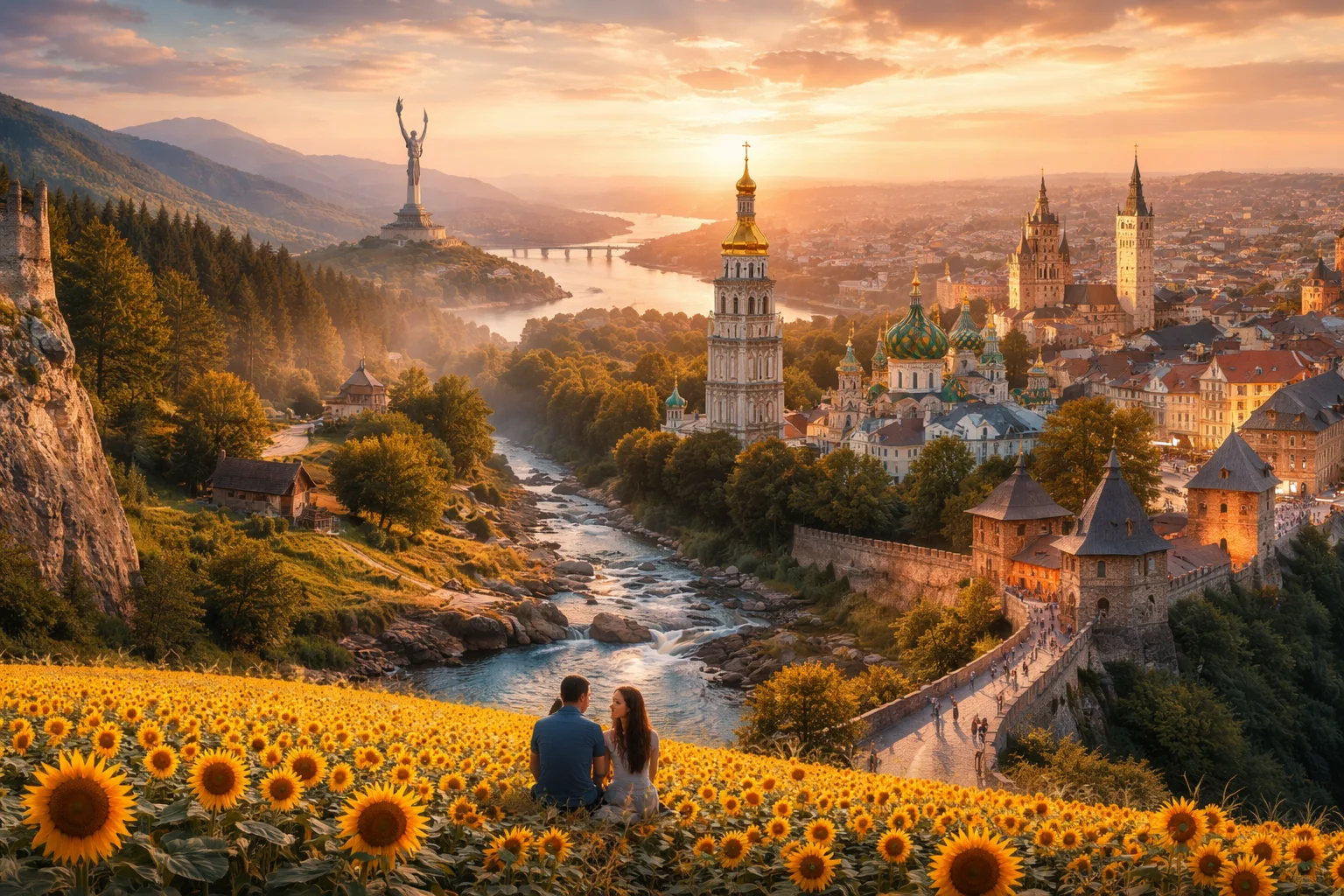
Ukraine overview
Ukraine is a sovereign state in Eastern Europe, the largest country entirely within the European continent. Straddling broad fertile plains and a long Black Sea coastline, Ukraine combines an agricultural base built on extensive chernozem soils with industrial regions that grew from the Soviet-era heavy industry network. Its historical capital, Kyiv, served as the political and spiritual center of Kievan Rus', shaping East Slavic identity. Ukraine’s geography, layered historical influences, and distinctive cultural practices make it a focal point of European agricultural production and engineering expertise.
Common Geography Questions About Ukraine
Where Ukraine is located
Ukraine lies in Eastern Europe, roughly between 44° and 52° north latitude and 22° to 40° east longitude. It borders Poland, Slovakia and Hungary to the west; Romania and Moldova to the southwest; Belarus to the north; and the Russian Federation to the east and northeast. The country fronts the Black Sea and the smaller Sea of Azov to the south, with the Crimean peninsula projecting into those waters. The Dnipro River runs from the north to the south, creating a major internal axis that anchors navigation and settlement patterns in Ukraine.
Geography and landscape of Ukraine
Much of Ukraine is lowland steppe and fertile plain interrupted by distinct uplands. The Carpathian Mountains in the west rise to alpine meadows and forested slopes, while the Crimean Mountains form a shorter coastal range on the southern peninsula. The Dnipro River bisects the country and feeds a system of reservoirs and fertile floodplains unique to Ukraine’s interior. Northern Polissia contains extensive peat bogs and marshes, and the southern coast is steppe with a warmer, more maritime climate. Ukraine is notable for some of Europe’s largest areas of chernozem, the dark, humus-rich soil that underpins its high agricultural productivity.
Ukraine culture and society
Ukrainian is the official language and the core of national identity, while Russian, Crimean Tatar, Romanian and Hungarian are also spoken in regional communities. Folk traditions—pysanka egg decoration, vyshyvanka embroidered shirts and kobzar ballad singing—remain visible in modern civic life; Vyshyvanka Day, an annual celebration of embroidered national dress, is a uniquely Ukrainian civic custom. Predominantly Eastern Orthodox and Ukrainian Greek Catholic in religious affiliation, Ukrainian society reflects layered rural and urban patterns: strong village ritual continuity, large Soviet-era cities, and a substantial global diaspora that sustains linguistic and cultural ties.
History of Ukraine
Ukraine’s recorded political life began with Kyiv as the center of Kievan Rus', a medieval polity that spread Orthodox Christianity and Cyrillic literacy across the region. Over centuries the territory fragmented under Mongol, Polish-Lithuanian and Ottoman influences; a Cossack Hetmanate emerged as a distinct polity in the 17th century. By the 19th and early 20th centuries, Ukrainian lands were split between empires, setting the stage for mass industrialization under the Russian Empire and later the Soviet Union. The 20th century brought forced collectivization and famine, large wartime devastation, and the 1986 Chernobyl nuclear accident—events that profoundly reshaped demography and state structures in what is now Ukraine.
Ukraine economy and government
Ukraine is organized as a unitary state with a semi-presidential system: a directly elected president shares executive responsibilities with a cabinet accountable to a single-chamber parliament, the Verkhovna Rada. The economy combines intensive grain and oilseed agriculture—supported by extensive chernozem—with legacy heavy industries in metallurgy, coal and machinery inherited from Soviet development. A dynamic private IT and services sector has grown alongside state-owned enterprises in energy and metals. The national currency is the hryvnia; export routes historically depend on Black Sea ports and inland river transport tied to the Dnipro.
Regions and major cities of Ukraine
Administratively, Ukraine is divided into 24 oblasts plus the city of Kyiv and other local units; geographic regions include the Carpathian highlands, the forested Polissia, the central steppe belt and the Donbas industrial plain. Kyiv, the capital, is a historical and political center; Lviv represents the western cultural and architectural heritage; Odesa is the principal Black Sea port and trade hub; Kharkiv is a northeastern industrial and academic city. The Donbas region is notable for its concentrated coalfields and a dense network of mining towns, a landscape shaped by 19th–20th-century industrialization.
Distinctive characteristics of Ukraine
Concrete features closely associated with Ukraine include its role as a major global grain producer supported by some of the world’s most extensive chernozem soils; the Antonov aircraft design bureau in Kyiv, known for producing the world’s largest strategic airlifters; and the Chernobyl exclusion zone, a focal point for nuclear safety study and ecological research. Ukraine is also internationally recognized for its rich folk arts—pysanky and vyshyvanka—and UNESCO-listed sites such as Kyiv-Pechersk Lavra and the historic center of Lviv, underscoring a cultural heritage distinct within Europe.
Places in Ukraine
Kyiv
Kyiv is the capital and largest city of Ukraine, serving as the country's principal political and cultural center. The city occupies approximately 839 square kilometers as an administrative unit that hosts national institutions. Its significance derives from long-standing urban development, concentrations of higher education, and a role as a major regional economic hub. The city's location at crossroads of East European plains has shaped its enduring national and international importance.
Kyiv Pechersk Lavra
Kyiv Pechersk Lavra is a historic Eastern Orthodox monastic complex in Kyiv, Ukraine, recognized for its religious, cultural, and architectural importance. The ensemble comprises churches, monastic buildings, and an extensive underground cave system that formed the basis of its spiritual life. The complex contains a prominent masonry bell tower and a network of catacombs linked to long-standing burial practices. It is inscribed on the UNESCO World Heritage List as part of Kyiv's primary historic ensemble.
Kyiv Zoo
Kyiv Zoo is a municipal zoological garden in Ukraine that maintains a curated collection of wild and domestic species for scientific, conservation, and educational purposes. It is located within the urban area of Kyiv and formally operates as a city-managed zoological institution under Kyiv municipal administration, occupying a defined zoological campus with indoor pavilions and outdoor enclosures. The facility functions as an organized scientific collection with veterinary and management structures typical of institutional zoos.
Lviv University
Lviv University is a state-founded higher education institution in Ukraine formally known as Ivan Franko National University of Lviv. It occupies a continuous institutional lineage that traces institutional origins to a Jesuit academy established in 1661, a measurable founding artifact used in official university histories. Lviv University functions as a national research and teaching university with formal designation in Ukrainian higher-education law and maintains a central historic campus in Lviv city that hosts core administrative offices, long-standing academic faculties, and a scientific library with historic collections.
Mykolaiv Zoo
Mykolaiv Zoo is a zoological park located in Mykolaiv, Ukraine, that houses a curated collection of captive mammals, birds, and reptiles. The institution functions as the city’s primary public zoo and contains purpose-built facilities including an administrative complex and an on-site veterinary facility. Its measurable, observable fact is the presence of distinct compound enclosures and a veterinary unit sited within the zoo grounds, which together define its operational footprint. The article explains the zoo’s location, history, significance, and features.
National Art Museum of Ukraine
National Art Museum of Ukraine is the principal state museum for Ukrainian fine art, located in Ukraine. The institution serves as the formal national repository for paintings, sculpture, and sacred icons and maintains the central state collection of Ukrainian visual heritage. The museum occupies a purpose-built public building with coordinated exhibition halls and specialist conservation facilities, and it functions as a research and curatorial center for scholarship on Ukrainian art.
Podil
Podil is a historic district of Kyiv in Ukraine and a formal part of the city's urban structure. It occupies the lower river terrace beside the Dnieper and functions as a clearly defined urban quarter within Kyiv's municipal administration. The district contains established heritage ensembles, a city square known for historical commercial contracts, and retains a low-lying riverside profile that distinguishes it from Kyiv's upper town.
Taras Shevchenko National University of Kyiv
Taras Shevchenko National University of Kyiv is a national public university in Ukraine, centered on a historic central campus in the capital city of Kyiv. The university occupies a coordinated campus area around Volodymyrska Street, with central building coordinates commonly given near 50.4447°N, 30.5142°E, and it holds formal status as a national university under Ukrainian higher-education law. Founded in 1834, Taras Shevchenko National University of Kyiv serves as a comprehensive research and teaching institution with faculties, institutes, a large academic library, and named institutional responsibility for higher education and scholarship in Ukraine.