Tunisia Guide
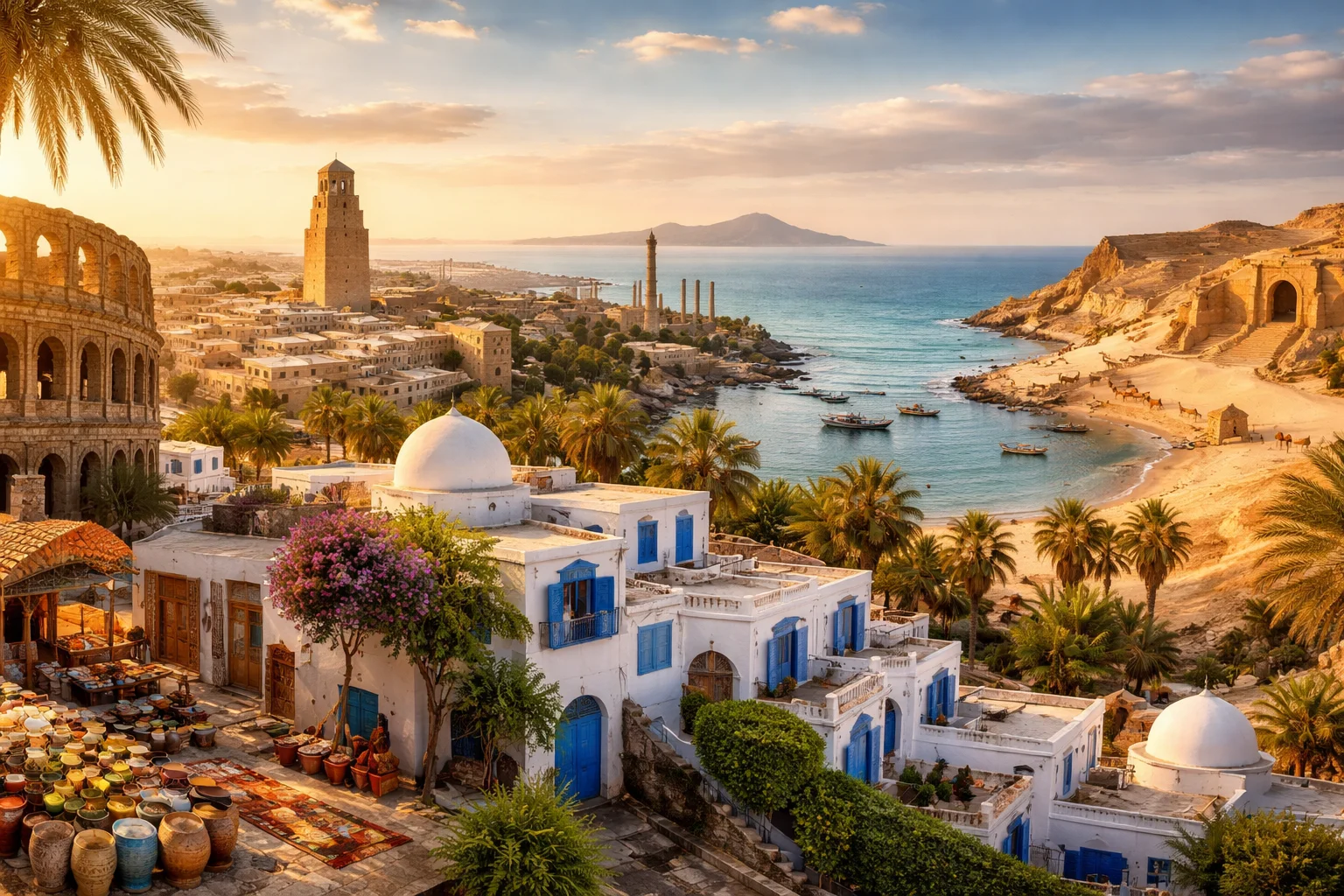
Tunisia overview
Tunisia is a North African republic on the southern shore of the Mediterranean Sea. Occupying the northeastern corner of the Maghreb, Tunisia combines a narrow fertile coastal plain, a mountainous central spine and an encroaching Sahara margin; it also contains Africa’s northernmost point at Ras ben Sakka. The country’s significance rests on its long Mediterranean façade, dense archaeological record from Carthage to Roman mosaics, and a decades-long role as a regional crossroads of Arabic, Berber and European influences. This profile highlights physical geography, culture, history, economy and major cities that define Tunisia’s distinct presence.
Common Geography Questions About Tunisia
Where Tunisia is located
Tunisia sits in North Africa, bounded to the west by Algeria and to the southeast by Libya, with the Mediterranean Sea on its northern and eastern edges; across the sea lies Italy’s island of Sicily. Its position makes Tunisia a bridge between the central Mediterranean shipping lanes and the interior Sahara trade routes. The modern state concentrates settlement along the narrow coastal strip that faces the Gulf of Tunis and the Gulf of Hammamet; farther inland the land rises toward the Atlas foothills before dropping into salt flats and desert basins unique to Tunisia’s geography.
Geography and landscape of Tunisia
Tunisia’s terrain ranges from the Tell Atlas foothills in the north, through a central limestone Dorsal ridge, down to the southern Sahara fringe punctuated by salt pans known locally as chotts (notably Chott el Jerid). The Medjerda River is the country’s principal watercourse, feeding Lake Ichkeul — a UNESCO wetland crucial for migratory birds. Unlike many neighbors, Tunisia’s fertile coastal plain is unusually narrow yet densely populated, producing most export crops. The south includes rocky hamada plateaus and dune chains used historically as caravan corridors; these sharply contrasting zones define Tunisia’s internal geographic divisions.
Tunisia culture and society
Arabic is Tunisia’s official language, while Tunisian Arabic (Derja) is the everyday vernacular; French persists as a lingua franca in administration and education, and small Amazigh-speaking communities maintain Berber traditions. Islam is the dominant religion, yet Tunisia’s legal history includes the 1956 Personal Status Code that abolished polygamy and reformed family law — a reform uncommon in the region. Musical forms such as Malouf (Andalusian-derived) and the island of Djerba’s long-standing Jewish community with the El Ghriba synagogue are cultural markers that distinguish Tunisia’s societal fabric from many neighboring countries.
History of Tunisia
Tunisia’s historical trajectory begins with Phoenician settlement at Carthage, which grew into Rome’s principal western Mediterranean rival; Carthaginian encounters with Rome, including Hannibal’s campaigns, left a lasting imprint. Successive eras—Roman provincial rule, Vandal and Byzantine interludes, Arab conquest and later Ottoman administration—layered institutions and urban forms. French protectorate governance from 1881 reshaped infrastructure and economy before independence in 1956. Post-independence modernization under Habib Bourguiba and the sociopolitical transformations that culminated in mass protests and a democratic transition in the early 21st century have made Tunisia a frequent reference point in modern regional history.
Tunisia economy and government
Tunisia is a unitary republic whose constitution sets out executive, legislative and judicial branches; the political model blends a directly elected head of state with a parliamentary apparatus and regional governorates. The economy mixes agriculture (notably olives and olive oil), phosphate mining, petroleum extraction, light manufacturing (textiles and electrical components) and a Mediterranean tourism sector concentrated on coastal resorts. The national currency is the Tunisian dinar. Tunisia’s export profile is notable for olive oil and phosphates, and Sfax functions as a significant export and industrial node within the national economy.
Regions and major cities of Tunisia
Administratively, Tunisia is divided into 24 governorates that reflect coastal, central and southern zones with distinct economic roles. The capital, Tunis, anchors the northern coastal plain and hosts the Bardo Museum’s extensive Roman mosaics and government institutions. Sfax is the principal industrial and export center, while Sousse combines historic medina fabric with a long tourism coastline; Kairouan is central to Tunisia’s religious heritage as an early Islamic scholarly city. The island of Djerba and the Saharan towns of Tozeur and Douz mark cultural and geographic contrasts among major cities and regions.
Distinctive characteristics of Tunisia
Tunisia is widely associated with the ancient port of Carthage and its Roman-era mosaics, Lake Ichkeul’s status as a biodiversity hotspot, and the El Ghriba synagogue on Djerba as evidence of one of North Africa’s oldest continuous Jewish communities. The country’s legal reforms in the mid-20th century regarding family law and the prominence of Malouf music give Tunisia cultural particularity. Tunisia also has a visible global profile as a filming location for desert sequences in major films, a significant olive-oil exporter in the Mediterranean market, and as a catalyst state in modern regional political developments.
Places in Tunisia
Bardo National Museum
Bardo National Museum is Tunisia’s national archaeological museum located in the capital city of Tunis. It occupies a former beylical palace complex and functions as the principal state institution for archaeological collections from across Tunisia. The museum presents purpose-built mosaic galleries and palace rooms that collectively house material ranging from Punic and Roman archaeology to Islamic-era artifacts. Its formal status as a national museum establishes a central role in the preservation and study of Tunisia’s ancient material culture.
Belvedere Zoo
Belvedere Zoo is a public zoological park in Tunisia located within the municipal Belvédère Park in the city of Tunis. The site sits as a dedicated zoological enclosure inside that urban park and serves as the principal public zoo and curated animal collection for the Tunis municipality. The facility comprises purpose-built animal enclosures, landscaped visitor promenades, and a documented institutional role in local conservation and natural-history display.
Carthage
Carthage is an ancient city and modern suburb on Tunisia's northern coast, significant for its archaeological remains and historical role. It lies within the Tunis metropolitan area and contains visible structures from Phoenician, Punic and Roman occupations. The archaeological zone covers several square kilometers of coastal terrain and is recorded under international heritage frameworks as a protected cultural landscape. Carthage represents a focal point for studies of Mediterranean trade, colonial networks, and imperial confrontation.
Tunis
Tunis is the capital city of Tunisia and its principal political and cultural centre. Situated on the northern Mediterranean coast, the urban area includes a historic medina and modern administrative districts. The metropolitan region encompasses more than one million residents according to formal population classifications used by national authorities. As the seat of national government and many cultural institutions, the city plays a central role in Tunisia's administration.
Tunis El Manar University
Tunis El Manar University is a public university in Tunisia, formally established as an independent institution in 2000. The university serves as a major centre of higher education and research in the Tunis metropolitan area, operates under the national higher-education framework, and maintains an official website at utm.rnu.tn for institutional and academic notices. This institution aggregates multiple faculties and professional schools concentrated in the El Manar district and is formally designated as one of Tunisia’s state universities created during a reorganisation of the University of Tunis.