Taiwan Guide
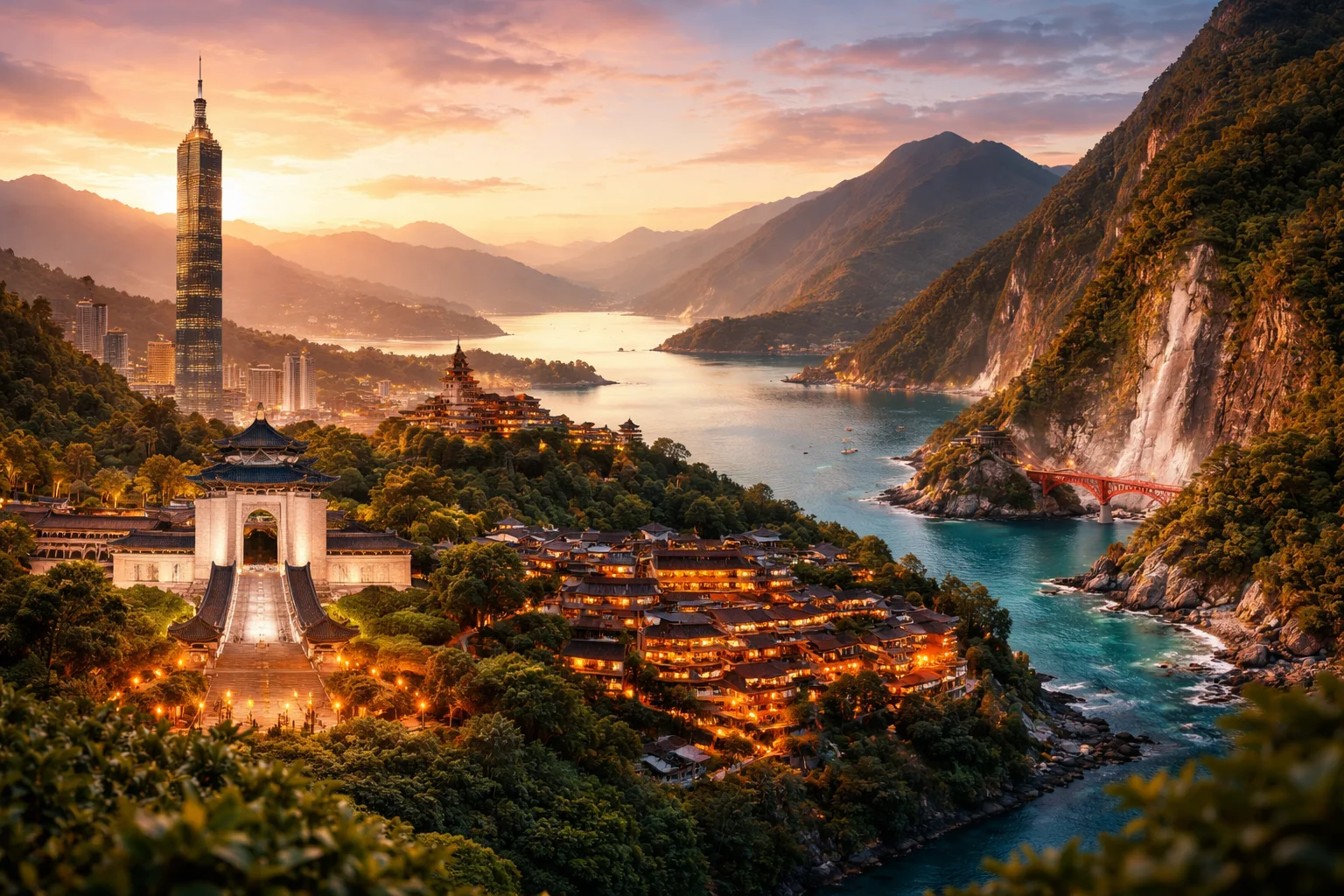
Taiwan overview
Taiwan is an island polity in East Asia formally known as the Republic of China that administers the main island plus several offshore archipelagos. Situated on a tectonic boundary, it combines high-altitude peaks, dense urban plains, and a highly export-oriented economy centered on high-tech manufacturing. Taiwan’s political status—governed independently since 1949 but claimed by the People’s Republic of China—gives it an unusual position in international diplomacy. The island is also notable for its preservation of traditional Chinese characters and a layered cultural mix of Han Chinese, Austronesian indigenous peoples, and Japanese-era influences.
Common Geography Questions About Taiwan
Where Taiwan is located
Taiwan lies in the western Pacific, off the southeast coast of the Asian continent; its main island spans roughly 21.9°–25.3°N latitude and 119.3°–122.0°E longitude. It faces the East China Sea to the north and the South China Sea to the southwest, with the Taiwan Strait separating it from mainland China across a narrow maritime gap. To the south, the Bashi Channel separates Taiwan from the Philippines, while Japan’s Ryukyu Islands lie to the northeast. Taiwan has no land borders; some of its offshore counties—Kinmen and Matsu—are located within sight of the mainland Chinese coast.
Geography and landscape of Taiwan
Taiwan’s terrain is dominated by a spine of mountain ranges running north–south, the most prominent being the Central Mountain Range with Yushan (Jade Mountain) rising to 3,952 meters—the highest point on the island. Roughly two-thirds of Taiwan is steep, forested highland intersected by deep gorges such as Taroko Gorge and fast-flowing rivers like the Zhuoshui and Gaoping. The western side contains broad alluvial plains where most population and agriculture concentrate, while the climate shifts from subtropical in the north to tropical in the south. Taiwan’s location at the collision of the Philippine Sea and Eurasian plates makes it unusually earthquake-prone for an island of its size.
Taiwan culture and society
Taiwan’s linguistic landscape includes Mandarin as the lingua franca alongside Taiwanese Hokkien, Hakka, and a range of Austronesian indigenous languages; multilingual signage and radio programming reflect that mix. Temple festivals, Mazu sea-processions, and night-market food culture are social staples; Taiwan also retains traditional Chinese characters in writing, unlike neighboring mainland China. The island recognizes multiple indigenous groups and has active programs for language revitalization—an uncommon formal recognition of Austronesian heritage. Civil society in Taiwan is marked by high civic participation and was the first in Asia to legalize same-sex marriage, a feature that distinguishes its social policy profile.
History of Taiwan
Taiwan’s history blends Austronesian settlement, European colonial episodes, Chinese migration, imperial rule, Japanese colonization, and 20th-century political realignment. Indigenous Austronesian communities populated the island millennia before Dutch and Spanish outposts in the 17th century. The Ming loyalist Zheng Chenggong (Koxinga) established a Han Chinese polity, which was later incorporated into Qing China; after the 1895 Treaty of Shimonoseki Taiwan was ceded to Japan and underwent intensive modernization. Post-1945, governance transferred to the Republic of China; following the Chinese civil-war exodus in 1949 the island became the ROC’s seat, then transitioned through land reform, export-led industrialization, and democratization to its current political form.
Taiwan economy and government
Taiwan operates a semi-presidential democratic system with an elected president and a unicameral Legislative Yuan; its official designation remains the Republic of China, a fact that shapes its international relations and exclusion from certain multilateral bodies. Economically, Taiwan is export-driven with a distinctive emphasis on high-value electronics and precision manufacturing. A defining industrial strength is its dominant position in advanced semiconductor foundries and contract chip manufacturing, concentrated in a small number of global suppliers. The local currency is the New Taiwan dollar (NT$), and services, manufacturing, and a dense supply-chain ecosystem characterize the economy’s structure.
Regions and major cities of Taiwan
Administratively Taiwan is divided into 22 units including six special municipalities, three cities, and 13 counties; this setup concentrates governance in large urban centers while retaining county jurisdiction for outlying islands. The capital, Taipei, functions as the political and financial hub; Kaohsiung serves as a major port and industrial center; Taichung is a central manufacturing and cultural node. Geographically the island is often described in four regions—north, central, south, and east—with offshore groups such as Penghu, Kinmen, and Matsu having distinct historical ties and shorter sea lanes to neighboring coasts than the main island.
Distinctive characteristics of Taiwan
Taiwan is widely associated with a few concrete global roles: it hosts world-leading semiconductor foundries that underpin modern electronics; it is the birthplace of bubble tea and an intensive night-market food culture that shapes culinary tourism; and it supports a high density of 24-hour convenience stores per capita. Biodiversity on the island includes endemic species such as the Formosan black bear, reflecting a conservation profile tied to steep montane terrain. Taiwanese firms in bicycles and precision optics also have disproportionate global market shares, linking the island’s industrial identity to specialized manufacturing niches.
Places in Taiwan
Chimei Museum
Chimei Museum is a private museum institution in Tainan, Taiwan. It is located in Rende District on Taiwan’s western coastal plain and organizes its holdings into four principal collection categories: Western fine arts, musical instruments, arms and armor, and natural history. The museum is administered by the Chimei Cultural Foundation and functions as a research and preservation center for those collections. The site combines exhibition galleries, concert and conservation facilities, and landscaped grounds.
National Palace Museum
National Palace Museum is a national museum in Taiwan that houses a major holding of Chinese imperial art and historical objects. The museum sits in Taipei's Shilin District and is formally designated as a national cultural institution responsible for preservation, research, and public display of art originating from imperial palace collections. Its campus occupies a landscaped hillside site and includes multiple exhibition halls, conservation laboratories, and climate-controlled storage facilities as part of its mandate.
National Taiwan University
National Taiwan University is a national research university in Taiwan. The main campus sits in Taipei and the institution was reconstituted as National Taiwan University in 1945 following its predecessor, Taihoku Imperial University. It is administered under Taiwan’s Ministry of Education and functions as a comprehensive university with faculties in medicine, engineering, science, agriculture, and the humanities. The university’s role as a primary state research and teaching institution and its formal status as a national university are central, verifiable elements of its institutional identity.
National Tsing Hua University
National Tsing Hua University is a national research university in Taiwan, formally re-established in Hsinchu in 1956 from the pre-1949 Tsinghua lineage. The campus serves as a major scientific and engineering education center within Taiwan’s higher education system, administered under the Ministry of Education and organized into multiple colleges and graduate institutes. The university maintains a formal designation as a comprehensive research institution focused on science, engineering, and interdisciplinary studies, and it participates in national research projects and industry partnerships that produce measurable research output and doctoral degrees.
Taipei Zoo
Taipei Zoo is a public zoological garden in Taiwan that functions as a municipal collection and conservation institution. It is located in Taipei’s Wenshan District and is operated by the Taipei City Government, defining its formal administrative status. The zoo comprises multiple themed exhibition zones, including a Formosan Animal Area and greenhouse-based tropical houses, which together form its primary collections and exhibition framework and support its roles in animal care, research, and public education.
Ximending
Ximending is a commercial and cultural district in Taipei, Taiwan, officially located within Wanhua District of Taipei City. It functions as a defined urban precinct that combines entertainment, retail, and heritage architecture, and it contains municipally recognized historic buildings such as the Red House theatre complex. The district occupies a formally recognized neighborhood area used in city planning and municipal administration and serves as a concentrated example of Taipei’s entertainment and pedestrian commercial development.