Switzerland Guide
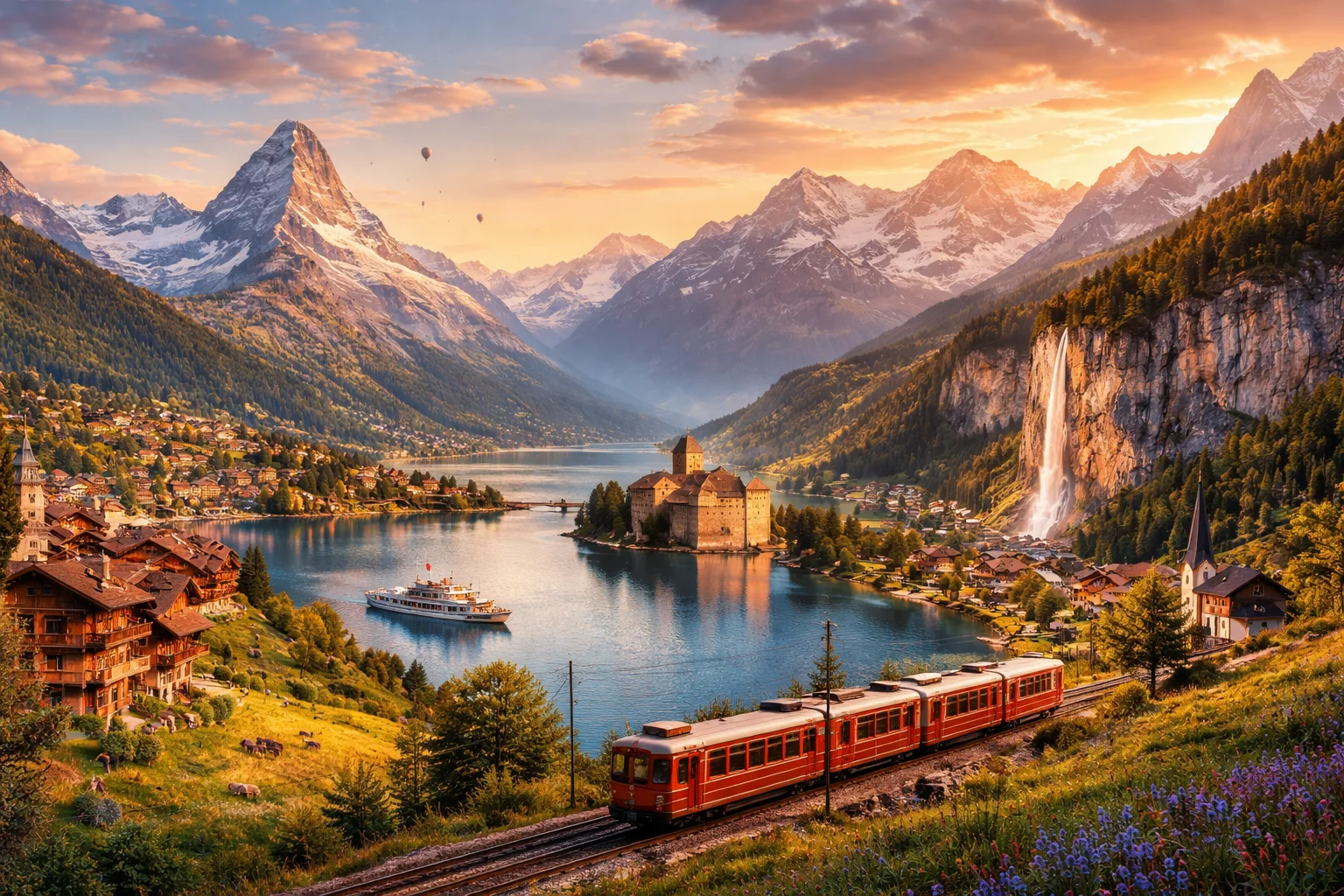
Switzerland overview
Switzerland is a sovereign federal republic in Central Europe occupying a compact, topographically varied territory. The country’s global significance stems from a concentrated combination of high-value exports, diplomatic hosting, and a distinctive system of popular participation in government. Four national languages and a layered federal structure produce strong local variation in law, education and signage within a single national framework. Switzerland’s small size belies its outsized role as a connector across Alpine north–south routes and as a specialized producer of precision goods.
Common Geography Questions About Switzerland
Where Switzerland is located
Switzerland lies in the heart of Europe, roughly between latitudes 45°N and 48°N and longitudes 5°E and 10°E, placed at the crossroads of northern and southern Europe. It is bordered by Germany to the north, France to the west, Italy to the south, and Austria plus Liechtenstein to the east. Major transboundary lakes—Lake Geneva (Lac Léman) to the southwest and Lake Constance (Bodensee) to the northeast—form part of international frontiers. Switzerland is also notable for forming a continental watershed: precipitation falling in different parts drains to the North Sea via the Rhine, to the Mediterranean via the Rhône, or to the Black Sea via the Inn.
Geography and landscape of Switzerland
Switzerland’s geography is dominated by three distinct physiographic zones: the high Alps with summits such as Dufourspitze in the Monte Rosa massif, the Jura mountains, and the Swiss Plateau between them. Glaciers originating in the High Alps give rise to major rivers—the Rhône flows from a glacier near the Furka Pass; the Rhine begins from headwaters in the canton of Graubünden—so the country is a source region for several European river systems. Microclimates are pronounced: the Föhn wind produces warm, dry spells in Alpine valleys; steep terraced vineyards of Lavaux on Lake Geneva’s shores exemplify landscape adaptations unique to Swiss slopes. The presence of perennial glaciers and many north–south mountain passes shapes transport, settlement and land use patterns.
Switzerland culture and society
Switzerland recognises German, French, Italian and Romansh at the national level; Romansh is concentrated in the canton of Graubünden and has protected-status mechanisms that most countries lack. Cultural life is heavily regionalized: cantonal school curricula, signage and media operate in different official languages and local festival calendars diverge sharply. Social customs reflect persistent communal institutions—examples include the open-air Landsgemeinde assemblies that still occur in a few cantons—and a civic practice of negotiated compromise across language regions. Religiously, historical Catholic–Protestant divisions remain visible in cantonal holidays and church architecture, and mountain dairy husbandry traditions continue to structure summer alpine transhumance and cheese-making communities.
History of Switzerland
The polity that became Switzerland emerged from a medieval confederation of Alpine valleys and city-states seeking mutual defence; early military successes such as at Morgarten and Sempach consolidated that loose alliance. The Reformation split cities and cantons in the 16th century under figures like Zwingli and Calvin, producing a durable religious patchwork. The modern federal state took shape after 1848 when a written constitution created a central government while preserving cantonal autonomy. The 19th-century settlement at the Congress of Vienna placed Switzerland’s neutrality on the diplomatic map, and 19th–20th century developments—industrialization in textile and watchmaking centres and Geneva’s emergence as a hub for humanitarian institutions—shifted the country into international networks far beyond its borders.
Switzerland economy and government
Switzerland’s political system combines federalism and direct democracy: 26 cantons exercise substantial autonomy, and citizens can trigger nationwide referendums and constitutional initiatives—an institutional feature that materially shapes policy outcomes. Executive power sits with a collegial seven-member Federal Council; legislation requires negotiation between a lower house (National Council) and an upper chamber representing cantons. On the economic side, Switzerland specialises in high-value, export-led sectors: precision watchmaking concentrated in the Jura, a globally integrated financial and insurance cluster around Zurich, and pharmaceuticals and life sciences with major research and production sites in Basel. The national currency is the Swiss franc (CHF), and agricultural output remains regionally specialized, often tied to mountain pasture systems.
Regions and major cities of Switzerland
Administratively, Switzerland is divided into 26 cantons, some historically designated as “half-cantons” for certain representational purposes; each canton has its own constitution and tax-levying powers. The federal city of Bern houses the principal federal institutions and functions as the de facto capital, while Zurich is the largest urban centre and financial hub. Geneva is a principal site for international diplomacy and multilateral organisations, and Basel anchors the country’s chemical and pharmaceutical manufacturing cluster on the Rhine. Notably, several cantons are officially bilingual or trilingual—Fribourg, Valais, and Graubünden among them—so a short train trip can cross significant legal and linguistic boundaries.
Distinctive characteristics of Switzerland
Concrete traits strongly associated with Switzerland include its world-class watchmaking clusters in the Jura Mountains, the origin of the International Committee of the Red Cross in Geneva, and major engineering feats such as the Gotthard Base Tunnel that altered trans-Alpine freight and passenger routes. Switzerland’s legal framework for cantonal autonomy and citizen initiatives is often cited in comparative studies of direct democracy. In cultural terms, UNESCO-listed sites—like the Old City of Bern and the Lavaux vineyard terraces—illustrate how historical urban planning and steep-slope viticulture are integrated into national identity. These specific institutions, industries and infrastructures together form the elements most commonly invoked when the name Switzerland appears in global contexts.
Places in Switzerland
Aletsch Glacier
Aletsch Glacier is a glacier in Switzerland and the principal ice mass of the high Bernese Alps. It is the largest glacier in the Alps, forming a continuous ice stream that has served as a measurable reference for Alpine glaciology. The glacier’s size and ice dynamics have made it a focal point for scientific measurement, long-term environmental records, and formal landscape designation within the Swiss high mountains.
Basel Zoo
Basel Zoo is a zoological garden in Switzerland. Located within the city of Basel, it was founded in the 19th century and functions as a managed scientific collection. The institution holds a formally designated zoological park on an urban campus and retains a persistent living collection across vertebrate groups. Basel Zoo is significant for its long-term role in species maintenance, ex situ conservation efforts, and structured public science programs that link animal husbandry with institutional research priorities.
Bern
Bern is the federal city of Switzerland and the capital of the canton of Bern, located in west-central Switzerland. It serves as the seat of the Swiss federal government and hosts national legislative institutions. The municipality covers 51.62 square kilometres, defining a formal administrative area with an identifiable urban boundary. The city's contiguous medieval core provides a measurable historic fabric that underpins its administrative and cultural significance within the Swiss Confederation.
Bernina Express
Bernina Express is a named panoramic rail service operating on the Rhaetian Railway network in southeastern Switzerland. It links high alpine landscapes in the canton of Graubünden with valleys descending toward the Italian border, and it is significant for its engineering and scenic integration. The railway reaches a maximum altitude of 2,253 metres at the Bernina Pass summit station, making it one of the highest adhesion railway routes in Europe. The route functions as both a transport corridor and a preserved example of alpine railway engineering.
CERN Science Gateway
CERN Science Gateway is a museum operated by CERN in Switzerland. It is located on the Meyrin campus near Geneva and serves as CERN's formal on-site exhibition and outreach facility, designated to present particle-physics research and accelerator technology. The museum houses permanent and temporary exhibitions that incorporate decommissioned technical equipment from CERN experiments, and its governance by CERN provides a formal institutional role linking collections to active research programmes.
Château de Chillon
Château de Chillon is a medieval island castle located on the shores of Lake Geneva in the canton of Vaud, Switzerland. It is a fortified complex that combines military, residential, and religious architecture on a single rocky outcrop. The site illustrates regional control of lake transport and hinterland routes and holds extensive built fabric and archaeological evidence. The castle’s mapped position is approximately 46.4144°N, 6.9273°E, providing a concrete geographic reference for its location.
EPFL
EPFL is the École polytechnique fédérale de Lausanne, a Swiss federal research university located in Lausanne, Switzerland. It is one of two Swiss Federal Institutes of Technology and functions as a consolidated research and teaching institution with a large urban campus and an adjacent technology park. The university confers undergraduate and graduate degrees across engineering, natural sciences, and architecture and operates recognized research laboratories and centralized facilities under federal oversight.
ETH Zurich
ETH Zurich is a public research university in Switzerland. It is one of the two Swiss Federal Institutes of Technology, founded in 1855 and organized under the Federal Department of Economic Affairs, Education and Research. The institution maintains multiple campuses in the city of Zurich, including the central ETH Zentrum and the Hönggerberg campus, and hosts a wide range of science and engineering departments. The university awards undergraduate and graduate degrees, conducts laboratory and field research, and manages specialized collections and facilities that support applied and theoretical sciences. Its academic structure comprises sixteen departments that cover natural sciences, engineering, architecture, mathematics, and management.
Fondation Beyeler
Fondation Beyeler is a museum and private foundation in Switzerland that preserves and displays modern and classical modern art. It is located in the municipality of Riehen in the Canton of Basel-Stadt, adjacent to the city of Basel and close to the Swiss–German border. The institution holds a purpose-built campus and operates as a registered foundation under Swiss law, founded to house the collection assembled by dealer and collector Ernst Beyeler.
Interlaken
Interlaken is a Swiss town and municipality located at the narrow land bridge between two major Alpine lakes, known for its geographic prominence. The settlement stands at an elevation of 568 metres, and it serves as a local administrative centre with municipal governance. Interlaken’s significance derives from its location between Lake Thun and Lake Brienz and from its long association with alpine transport hubs, hotel architecture, and scientific interest in mountain environments.
Jungfrau Region
Jungfrau Region is a high-alpine area in the Bernese Alps of Switzerland defined by the massif surrounding the Jungfrau peak. It lies within the Bernese Oberland and is significant for its concentrated collection of glaciated peaks, deep glacial valleys, and scientific stations. The Jungfrau summit reaches 4,158 metres above sea level, providing a measurable reference for the region's high-elevation environment. The Jungfrau Region is a focal point for alpine research and landscape science in Switzerland.
Jungfraujoch
Jungfraujoch is a high Alpine saddle in the Bernese Alps of Switzerland, noted for its railway infrastructure, scientific facilities, and extensive glaciated terrain. It sits at an elevation of 3,466 meters above sea level and forms a natural col between the peaks Jungfrau and Mönch. The location's significance derives from its engineering role linking mountain valleys, its history in Alpine science, and its distinctive high-elevation features.
Explore Natural Landmarks in Switzerland
Browse islands and mountains connected with Switzerland to keep exploring related geography clusters.