Sri Lanka Guide
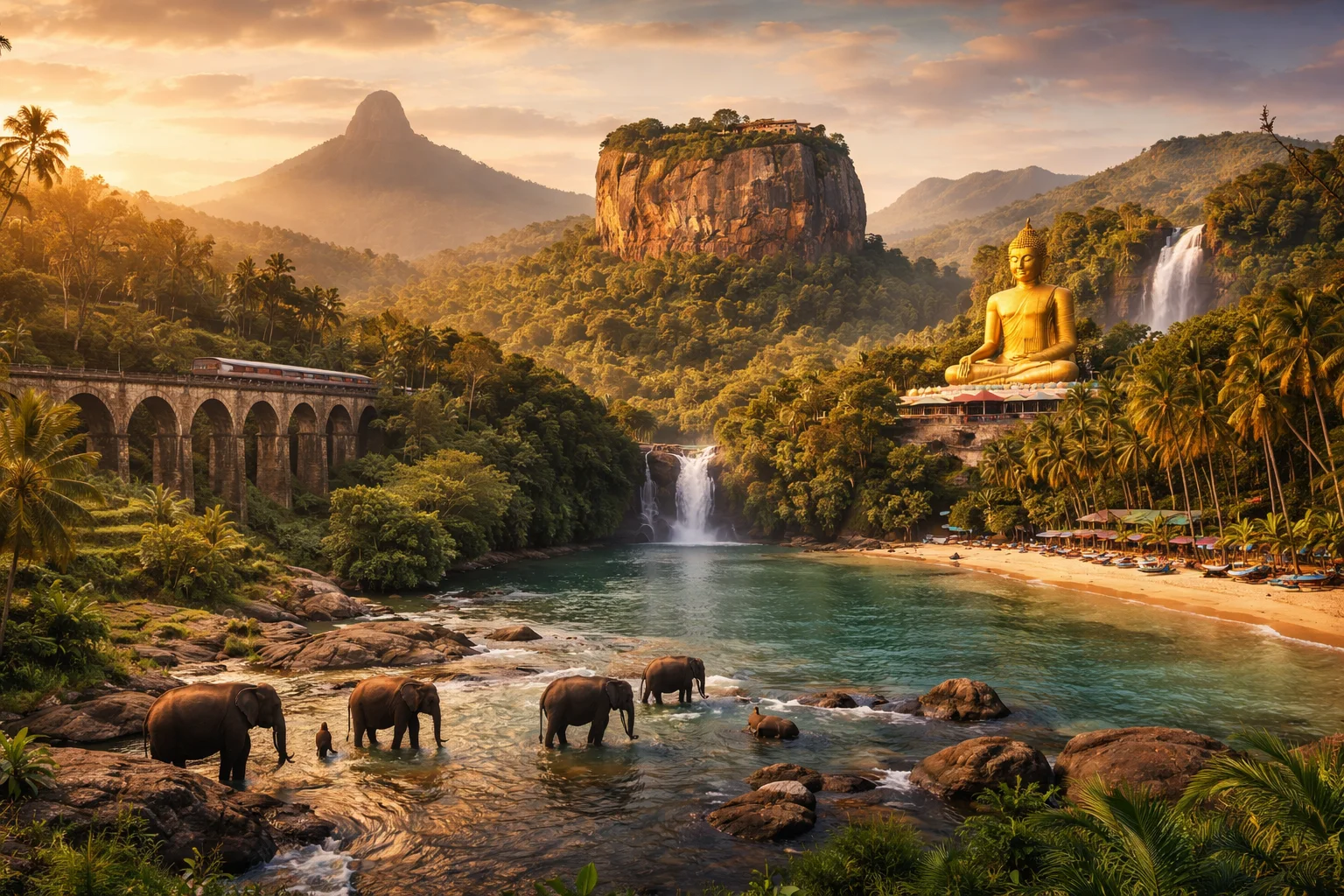
Sri Lanka overview
Sri Lanka is an island nation in the Indian Ocean off the southeastern coast of the Indian subcontinent. Its compact territory combines a central highland massif, lowland plains, and a long tropical coastline that historically anchored independent Sinhalese kingdoms and a maritime trade network. The country is especially known for Ceylon tea plantations rooted in the British colonial era and for ancient hydraulic engineering—elaborate reservoirs and canals still visible around Anuradhapura. The blend of biodiversity, Buddhist monuments, and port geography shapes its regional significance.
Common Geography Questions About Sri Lanka
Where Sri Lanka is located
Sri Lanka lies in South Asia, situated between roughly 5°55′ and 9°51′ north latitude and 79°41′ and 81°53′ east longitude. The island sits about 50 km off the southeastern tip of India, separated by the shallow Palk Strait and the line of shoals and limestone cays known locally as Adam’s Bridge (Rama’s Bridge). Surrounded by the Laccadive Sea to the southwest and the Bay of Bengal to the northeast, the island's maritime position commands sea lanes of the northern Indian Ocean. As an island state, the country has no land borders, a geographical fact that shaped its distinct maritime and cultural links with South Asia.
Geography and landscape of Sri Lanka
Sri Lanka’s geography compresses tropical lowlands and a central highland plateau into a compact island. The central massif rises to Pidurutalagala, the country’s highest peak, and feeds the Mahaweli River, the island's longest watercourse that supplies historic irrigation reservoirs. The western and southwestern wet zone supports rainforests such as the Sinharaja Wildlife Sanctuary, a biodiversity hotspot, while a pronounced rain shadow produces dry plains and thorn scrub across the northeast. Tea estates carpet the hill country above 1,000 metres, a landscape uniquely tied to colonial-era plantation topology.
Sri Lanka culture and society
Sri Lanka’s culture is defined by two principal linguistic-religious communities—Sinhala-speakers who practice Theravada Buddhism and Tamil-speakers with Hindu traditions—coexisting alongside Muslim and Christian minorities. Sinhala and Tamil are official languages; English functions as a link language. The island preserves living indigenous Vedda communities with distinct hunter-gatherer customs, and Kandyan ritual dance and elaborate "poruwa" wedding rites are cultural forms tied to Kandy’s courtly heritage. Buddhist observances such as Vesak shape public life in ways unique on the island, where many ancient temples remain active pilgrimage centers integrated with village administration and agricultural calendars.
History of Sri Lanka
Sri Lanka’s history begins with early Iron Age societies that built expansive reservoir systems and gave rise to the Anuradhapura and later Polonnaruwa kingdoms, recorded in the island’s long-standing chronicle tradition such as the Mahavamsa. Buddhism arrived in the 3rd century BCE and shaped statecraft and law for centuries. From the 16th century, European powers—Portuguese, Dutch and then British—transformed coastal trade, introduced plantation agriculture and reoriented the island’s economy around cinnamon and later Ceylon tea. Independence from Britain in 1948 ended colonial rule, and the late 20th century saw ethno-political conflict that significantly altered demographics and governance.
Sri Lanka economy and government
Sri Lanka operates as a unitary republic with an executive president alongside a parliamentary legislature; provincial councils provide subnational administration under a central legal system. The currency is the Sri Lankan rupee. The economy combines plantation exports—notably Ceylon tea and cinnamon—with apparel manufacturing, remittance income from overseas workers, gem mining around Ratnapura and a services sector anchored on Colombo’s port and shipping services. Tourism has been important for coastal and cultural heritage sites. Sri Lanka’s maritime position on major Indian Ocean sea lanes amplifies its economic role beyond its land area, influencing port investments and logistics-oriented industry.
Regions and major cities of Sri Lanka
Sri Lanka is divided into nine provinces and 25 administrative districts, a structure that groups diverse landscapes from the central hill province to the northern Jaffna peninsula. The de jure administrative capital for parliament is Sri Jayawardenepura Kotte, while Colombo remains the island’s commercial and largest urban agglomeration—an uncommon dual-capital arrangement. Other major cities include Kandy, a hill-city retaining the Temple of the Tooth; Galle, noted for its Dutch-era fortified harbor; and Jaffna, the principal urban center of the Tamil-speaking north. Provincial identities in Sri Lanka often align with ethnic, linguistic and ecological differences.
Distinctive characteristics of Sri Lanka
Sri Lanka is internationally associated with Ceylon tea and Ceylon cinnamon—products that reshaped its landscape and trade networks—and with Ratnapura gemstones, especially sapphires extracted from island alluvium. The country boasts multiple UNESCO World Heritage Sites, including the Sigiriya rock fortress and the ancient irrigation complexes of Anuradhapura, linking Sri Lanka to early hydraulic engineering scholarship. Its national cricket team’s 1996 World Cup triumph cemented a global sports profile unusual for a small island. Coastal stilt fishing and high levels of plant and amphibian endemism in places like Sinharaja exemplify cultural and natural traits frequently identified with Sri Lanka.
Places in Sri Lanka
Adam's Peak
Adam's Peak is a conical mountain in Sri Lanka's central highlands and a site of major religious and ecological importance. The mountain rises to 2,243 meters (7,359 feet) above sea level, dominating surrounding ridgelines. Adam's Peak combines a distinctive summit rock formation revered by multiple faiths with montane forest ecosystems that support endemic species, making it significant for cultural heritage and biodiversity conservation.
Colombo National Museum
Colombo National Museum is the national museum of Sri Lanka and the principal state institution for the country’s material cultural heritage. It is located in central Colombo and functions as the principal repository for archaeological objects, royal regalia, and state-held historical collections administered by the Department of National Museums. The institution occupies a purpose-built museum campus that consolidates national collections and long-term conservation facilities under a single administrative authority.
Dambulla Cave Temple
Dambulla Cave Temple is a Buddhist cave-temple complex in central Sri Lanka, located at Dambulla in Matale District. It is significant as a large, continuously used ensemble of rock-cut shrines that preserves painted interiors and statue groups spanning many centuries. The complex comprises five main caves with painted surfaces covering approximately 2,100 square metres. Scholars recognize the Dambulla Cave Temple for its exceptional concentration of mural painting and sculpture within a single rock-shelter complex.
Dehiwala Zoo
Dehiwala Zoo is a zoological garden in Sri Lanka and is formally designated as the National Zoological Gardens of Sri Lanka. The site serves as the country's central institutional collection for living animals and zoological records, holding organized collections of mammals, birds, reptiles and fish and maintaining an institutional role in conservation, captive‑care standards, and species documentation under national responsibility.
Ella Rock
Ella Rock is a prominent rocky ridge and named landmark in Sri Lanka's central highlands, located near the town of Ella in Uva Province. It reaches roughly 1,041 metres above sea level and overlooks the broad Ella Gap and adjacent plantation landscapes. The site is significant as a clear geological exposure and as a visual emblem of the hill-country escarpment of Sri Lanka. Ella Rock serves as a fixed reference point in regional geography and mapping.
Galle Fort
Galle Fort is a fortified colonial-era urban complex on the southwest coast of Sri Lanka centered on Galle harbour. It is a compact historic town defined by masonry ramparts, bastions, and a shoreline lighthouse, and it retains a continuous residential and commercial core. The site is designated a UNESCO World Heritage Site as an exceptional example of European trading fortifications integrated with South Asian urban form. Its designation represents a formal recognition of cultural and architectural value.
Horton Plains
Horton Plains is a high-elevation protected plateau in the central highlands of Sri Lanka notable for its montane ecosystems. The site encompasses approximately 3,160 hectares and rises broadly between two thousand and twenty-three hundred meters in elevation. It is significant for its mosaic of cloud forest and montane grassland vegetation that supports distinctive biodiversity and important watershed functions. The introduction summarizes the location, ecological significance, and a measurable area figure for reference.
Nine Arches Bridge
Nine Arches Bridge is a nine-arched masonry railway viaduct located near Ella in Uva Province, Sri Lanka. The structure carries a single-track section of the Colombo–Badulla railway across a forested gully, and it serves as a representative example of hill-country railway engineering from the colonial period. One concrete measurable fact is intrinsic to its name: the bridge comprises nine consecutive masonry arches that form the primary load-bearing system for the rail line through this part of the upcountry landscape.
Nuwara Eliya
Nuwara Eliya is a hill town in central Sri Lanka and the principal urban center of Nuwara Eliya District. It occupies a highland basin at approximately 1,868 meters above sea level, making it one of the highest-altitude towns on the island. The town is significant for its extensive tea plantations, colonial-era architecture, and concentrated high-altitude agriculture. Nuwara Eliya serves as a regional hub for horticultural research, municipal administration, and the secondary processing of tea leaves.
Polonnaruwa
Polonnaruwa is an ancient urban center in Sri Lanka that became a major medieval capital and administrative hub. It is located in the island’s north-central region and is significant for its extensive stone architecture and irrigation works. The site includes the Gal Vihara group of four large rock-cut Buddha statues, a concrete measurable feature that exemplifies its sculptural achievements. Polonnaruwa represents a concentrated ensemble of royal, religious, and hydraulic constructions from a single historical urban program.
Sigiriya
Sigiriya is an ancient rock fortress and archaeological site in central Sri Lanka, defined by a massive exposed rock and associated palace complex. It occupies a solitary column of rock rising approximately 200 meters above the surrounding plain, and it is notable for surviving mural paintings and extensive engineered gardens. The significance of Sigiriya derives from its integrated urban layout, monumental architecture, painted frescoes, and well-preserved hydraulic features that illustrate sophisticated ancient planning.
Sigiriya Rock Fortress
Sigiriya Rock Fortress is an ancient fortified palace complex built atop a prominent rock column in central Sri Lanka. The site combines archaeological ruins, painted rock art, and landscaped gardens, making it a major example of early urban design in South Asia. The rock rises roughly two hundred metres above the surrounding plain, and its surviving terraces and hydraulic works represent measurable engineering achievements from the medieval period. The complex is archaeologically and culturally significant for Sri Lankan heritage.
Explore Natural Landmarks in Sri Lanka
Browse islands and mountains connected with Sri Lanka to keep exploring related geography clusters.