South Korea Guide
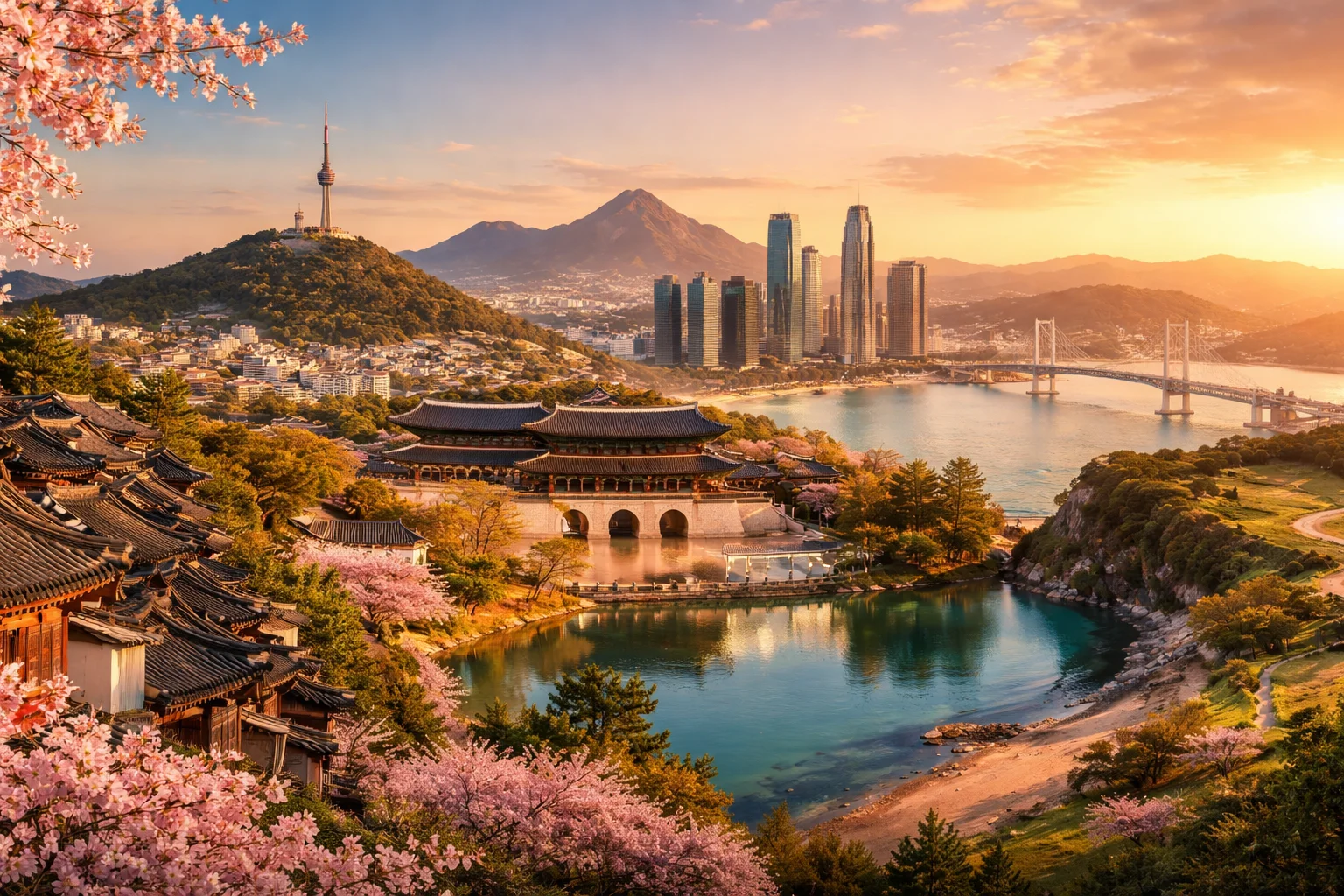
South Korea overview
South Korea is a sovereign state occupying the southern portion of the Korean Peninsula in East Asia. It sits at a geopolitical crossroads between China, Japan and the Pacific, and combines dense coastal megacities with a mountainous interior. The country is notable for a rapid, state-guided industrial transformation that produced globally prominent electronics and shipbuilding firms alongside a distinctive popular-culture export industry. As a democratic republic that emerged from a divided peninsula, South Korea plays an outsized role regionally in trade, technology and cultural influence.
Common Geography Questions About South Korea
Where South Korea is located
South Korea lies in northeast Asia on the southern half of the Korean Peninsula, approximately between 33° and 39° N latitude and 124° to 131° E longitude. It shares a single land border to the north with the Democratic People’s Republic of Korea; that division followed mid-20th-century political settlement rather than natural features. Flanked by the Yellow Sea to the west, the Korea Strait to the south and the East Sea (Sea of Japan) to the east, South Korea occupies a strategic position on major shipping lanes linking Northeast and Southeast Asia.
Geography and landscape of South Korea
Mountainous terrain dominates South Korea: the Taebaek mountain chain runs along the east coast while the Sobaek ranges cross the interior, leaving narrow coastal plains and river basins for agriculture. Major rivers such as the Han and Nakdong irrigate these lowlands. The country includes roughly 3,000 offshore islands and one volcanic island province, Jeju, whose central shield volcano forms the nation’s highest natural point. Climatically, South Korea experiences East Asian monsoon patterns with colder winters in the northwest and milder, maritime conditions on southern islands.
South Korea culture and society
Korean is the national language, written in Hangul—the phonetic alphabet promulgated under King Sejong in the 15th century, a script intentionally designed for high literacy. Social life in South Korea retains strong Confucian legacies manifest in language honorifics, family-line emphasis and ancestral rites (jesa); communal kimjang, the seasonal collective preparation of kimchi, remains a pervasive practice in many communities. Male citizens are subject to compulsory military conscription, and the society is highly urbanized with pronounced generational and regional cultural distinctions.
History of South Korea
The territory now called South Korea experienced state formation under ancient polities such as Goguryeo, Baekje and Silla and later centralized rule under Goryeo—the dynasty that lent its name to “Korea.” The Joseon dynasty institutionalized Confucian governance and commissioned Hangul. In the 20th century, Japanese colonial rule ended with World War II, followed by partition of the peninsula and a 1950s war that resulted in an armistice rather than a formal peace. The post-war era saw a transition from agrarian society to export-led industrialization and later democratization amid intense social mobilization.
South Korea economy and government
South Korea is a unitary presidential republic with an elected head of state and a unicameral legislature, the National Assembly, complemented by an active Constitutional Court. The national currency is the South Korean won. Its economy is export-driven and concentrated in manufacturing clusters: semiconductor fabrication, automotive assembly, shipbuilding and consumer electronics form core sectors. Large family-controlled conglomerates known as chaebol—examples include Samsung and Hyundai—play a central role in corporate governance and export capacity, a structure shaped by coordinated state industrial policy in the post-war decades.
Regions and major cities of South Korea
Administratively, South Korea is divided into 17 first-level entities: one special city (Seoul), six metropolitan cities, eight provinces, one special self-governing province (Jeju) and one special self-governing city (Sejong). Seoul is the national capital and primary political and financial center; Busan functions as the country’s largest port and a logistics hub; Incheon hosts a major international gateway and port infrastructure. Sejong was developed as a planned administrative city to decentralize government offices, while Jeju serves as an island province with a separate self-governing status and distinct volcanic landscape.
Distinctive characteristics of South Korea
South Korea is widely associated with several concrete global profiles: leading-edge semiconductor manufacturing and memory-chip production; large-scale shipbuilding yards that serve global energy and cargo fleets; and internationally exporting cultural industries often referred to as the “Korean Wave” (Hallyu), encompassing popular music, film and television. The country’s Hangul alphabet is a frequently cited example of a consciously designed writing system. South Korea’s model of chaebol-driven industrialization, combined with early mass adoption of high-speed digital infrastructure, makes its development trajectory highly recognizable on the world stage.
Places in South Korea
Bukchon Hanok Village
Bukchon Hanok Village is a district of traditional Korean houses in Seoul, South Korea. It lies within the Jongno-gu administrative district, occupying a ridge between the Gyeongbokgung and Changdeokgung palace compounds and functioning as a concentrated area of hanok architecture and urban heritage. The district appears in municipal planning as a distinct area of traditional housing fabric within central Seoul and serves as a measurable element of the city's built heritage matrix.
Everland Zootopia
Everland Zootopia is a zoological exhibition area within the Everland resort in South Korea. It is a curated zoo section sited on the Everland grounds in Yongin, Gyeonggi Province, and functions as a managed landscape combining themed animal enclosures with the park's broader leisure facilities. The facility is formally organized as a zoological collection under the Everland operator and occupies landscaped terraces integrated into the resort's east‑west topography. The site serves a regional role in public education, species display, and managed animal husbandry.
Gamcheon Culture Village
Gamcheon Culture Village is a district in Busan, South Korea. It is an administratively defined neighborhood within Gamcheon-dong, Saha-gu, notable for densely clustered, terraced housing built on a steep hillside and for a municipal cultural regeneration program that altered its public art and built environment. The district is formally recognized within Busan's local administration and presents a measurable urban fabric of narrow alleys and stepped residential blocks that rise above nearby port districts.
Gangnam
Gangnam is an administrative district (gu) of Seoul, South Korea. It lies immediately south of the Han River and serves as an important commercial and residential sector within Seoul's municipal structure. The district holds formal status under Seoul's local-government system and is administered by a district office charged with municipal services, urban planning, and local regulation. Distinctive built forms in the district include concentrated high-rise office buildings and large apartment complexes that define its urban profile.
Gyeongju National Museum
Gyeongju National Museum is a national museum in South Korea that preserves and displays material from the ancient Silla kingdom. The museum is located in the city of Gyeongju, adjacent to the Daereungwon tumuli field, at approximate coordinates 35.84°N, 129.21°E. The institution holds purpose-built indoor galleries and an outdoor exhibition yard designed to accommodate large stone monuments recovered from nearby archaeological sites. Its formal status as a national museum defines its role in preserving regional cultural heritage.
Hongdae
Hongdae is an urban district in South Korea centered on the campus of Hongik University in Seoul. It functions as an informal neighborhood defined by a dense cluster of arts education, live-music venues, and small creative enterprises anchored around the university campus. The area is identifiable as a distinct urban sector by its concentration of art faculties and student-oriented cultural institutions adjacent to the university grounds, forming a measurable institutional anchor in central Seoul.
Insadong
Insadong is a district in central Seoul, South Korea. It is administratively a neighbourhood within Jongno-gu and functions as Seoul’s principal traditional arts and antiques district. The area is centered on a defined commercial axis known locally as Insadong-gil, which serves as the district’s core streetscape. Insadong’s significance derives from its sustained concentration of art galleries, antique dealers, traditional craft workshops, and cultural organizations that maintain collections and commercial activity tied to Korea’s material culture.
Itaewon
Itaewon is a district in Seoul, South Korea, known for its concentrated international commerce and mixed urban functions. It lies within Yongsan District and is administered as the neighborhood commonly referred to as Itaewon-dong, a formal municipal unit under Seoul governance. The district covers the commercial corridor centered on Itaewon-ro and the adjacent hill slopes that together form a measurable urban unit inside central Seoul.
KAIST
KAIST is the Korea Advanced Institute of Science and Technology, a national research university in the Republic of Korea. Its principal campus is located in Daejeon, and the institution was established in 1971 by the national government to accelerate scientific and technological capacity. KAIST functions as a government-chartered research university with a formal mandate to conduct advanced research, educate graduate and undergraduate students in science and engineering, and transfer technology into industry. The university maintains organized schools and research units dedicated to core disciplines in engineering, natural sciences, and interdisciplinary fields.
Korea University
Korea University is a private research university in South Korea with formal origins as Bosung College, established in 1905. The institution is located in the capital city of Seoul and is notable as one of the country’s oldest modern higher-education foundations. Korea University maintains a multi-campus structure and operates an affiliated medical center, and it is formally classified among South Korea’s leading private universities by national academic reference sources. The campus is also identified by its historic red-brick architecture and an institutional charter governed by a board of trustees.
Leeum Museum of Art
Leeum Museum of Art is a museum in South Korea operated by the Samsung Foundation of Culture. The institution is located in the Hannam-dong neighborhood of Seoul and functions as a dual-profile museum holding both traditional Korean art and modern and contemporary art collections. Its formal status as a privately governed foundation museum defines its collection stewardship and institutional role. The museum occupies purpose-built buildings that separate historical and contemporary displays within one campus.
Myeongdong
Myeongdong is a commercial and administrative district of South Korea located within the Jung District of central Seoul. The district occupies a defined urban area in central Seoul and is commonly referenced by coordinates near 37.56°N, 126.98°E, which place it in the city core; it holds formal status as part of Jung-gu under the municipal hierarchy. The area is significant for its dense retail economy and its role in Seoul's twentieth-century urban transformation.