Sierra Leone Guide
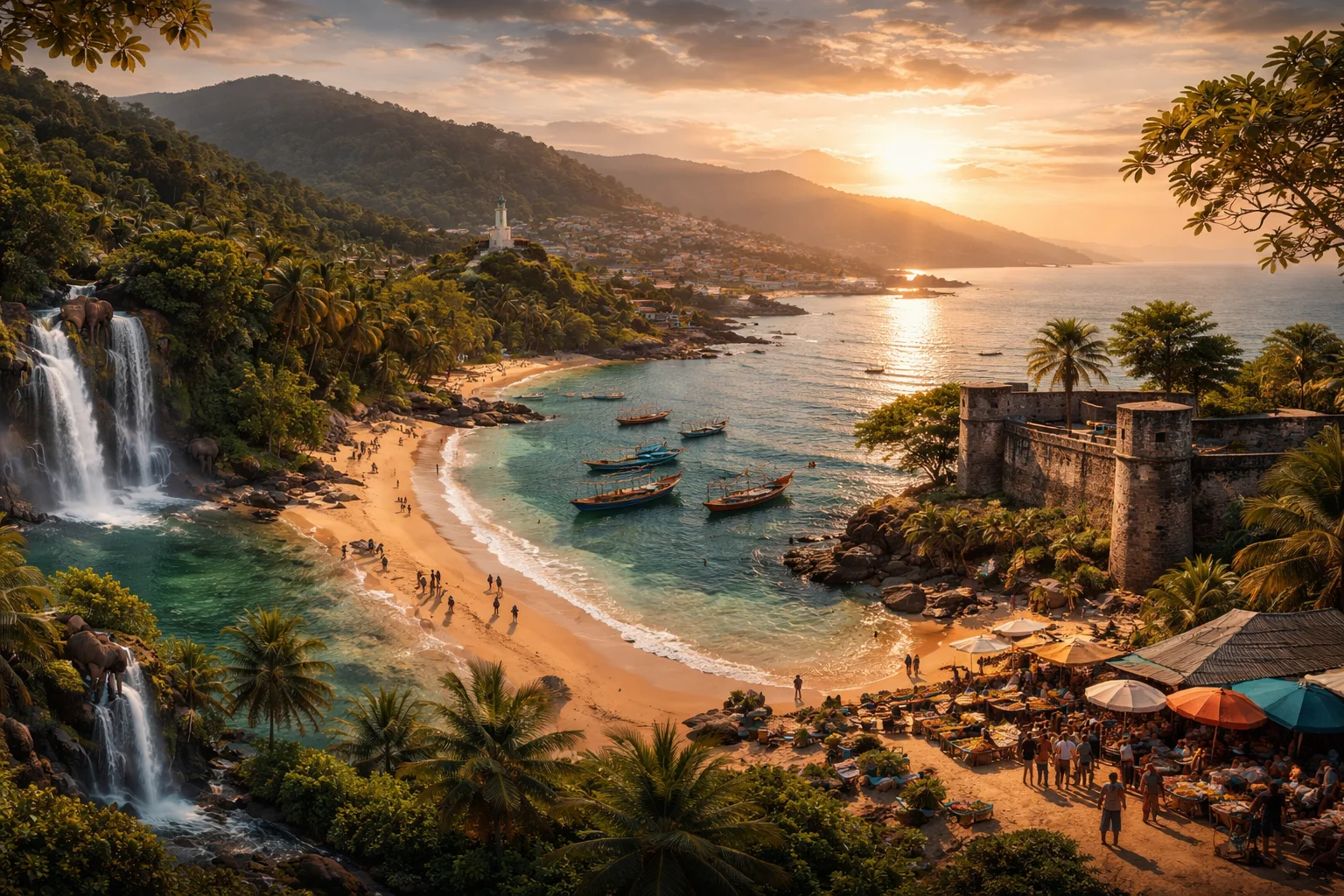
Sierra Leone overview
Sierra Leone is a sovereign West African state on the Atlantic coast defined by a compact coastline, significant mineral deposits and a multilingual society centered around an English-based creole. The country’s landscape ranges from lowland mangroves to interior highlands, and its economy has long been shaped by artisanal and industrial mining. Sierra Leone’s social cohesion is notable for the widespread use of Krio as an interethnic lingua franca and for a post‑colonial urban culture concentrated in coastal cities.
Common Geography Questions About Sierra Leone
Where Sierra Leone is located
Sierra Leone sits on the west coast of Africa, roughly between 7°N and 10°N latitude and 10°W to 13°W longitude. It shares land borders with Guinea to the north and northeast and with Liberia to the southeast; the Atlantic Ocean forms the western and southern edges of its territory. The nation’s coastline contains a broad estuary system—the Sierra Leone River estuary—that feeds a deep natural harbor and shapes the Freetown Peninsula. That coastal estuary, rather than a single straight shoreline, is a defining locator for Sierra Leone on regional maps.
Geography and landscape of Sierra Leone
Terrain in Sierra Leone moves quickly from coastal mangrove flats and sandy beaches to a lowland plateau and then to the Loma Mountains in the northeast, whose summit Mount Bintumani reaches nearly 1,950 meters. The country hosts parts of the Upper Guinean rainforest ecoregion and river basins such as the Rokel (Seli) and Sewa that drain to the Atlantic. Distinctive local landscapes include the Freetown Peninsula’s rocky headlands and interior pockets of isolated rainforest like Tiwai Island on the Moa River—small, biodiverse enclaves that contrast sharply with the extensive agricultural uplands farther inland.
Sierra Leone culture and society
Sierra Leone’s official language is English, but Krio—an English‑based creole—functions as the daily lingua franca across ethnic groups, a feature that ties together the country’s many languages including Mende, Temne, Limba and Kono. Religious life is split between Islam and Christianity, often mixed with indigenous rites; secret societies such as Poro and Bondo continue as local institutions in certain regions, governing initiation and social norms. Urban culture in Sierra Leone blends West African musical forms with Creole social institutions; the prominence of Krio as a unifying non‑majority language is a cultural characteristic that sets the country apart in the region.
History of Sierra Leone
Sierra Leone’s human story runs from precolonial chiefdoms through its distinctive role in the transatlantic and anti‑slavery eras: Freetown was established in the late 18th century as a settlement for freed and liberated Africans. During the 19th century British colonial administration created a dual structure of coastal colony and inland protectorate that reshaped local power. In the post‑independence era the country experienced political upheavals, culminating in a civil war in the 1990s driven in part by control of mineral resources. International interventions and hybrid tribunals that prosecuted resource‑fuelled crimes emerged from that conflict as part of Sierra Leone’s global historical imprint.
Sierra Leone economy and government
Sierra Leone is a constitutional republic with an executive president, a directly elected legislature and a judiciary; traditional hereditary chiefdoms remain formally integrated into local administration in rural districts, creating a two‑tier governance landscape uncommon elsewhere. The economy is structurally dependent on mining—particularly artisanal and industrial extraction of diamonds and titanium‑bearing minerals such as rutile—alongside smallholder agriculture (rice is the staple) and coastal fisheries. The national currency is the Sierra Leonean leone. Informal mining and export of alluvial stones have historically influenced both rural livelihoods and national politics in ways that distinguish Sierra Leone’s political economy.
Regions and major cities of Sierra Leone
Administratively, Sierra Leone is divided into provinces plus the Western Area that contains the capital. Freetown, the capital, is the country’s political and commercial center and hosts historic institutions of higher learning and government. Bo serves as the principal city of the south and a regional trade and education node; Kenema functions as the main urban center of the eastern mining region; Makeni anchors the north as a commercial and political hub. Each city aligns with distinct economic corridors—coastal trade for Freetown, agricultural markets around Bo, and mineral transport linked to Kenema’s hinterland.
Distinctive characteristics of Sierra Leone
Sierra Leone is widely associated with a few concrete, globally recognizable features: its role as an early resettlement site for freed African peoples that produced a distinctive Creole (Krio) culture; the presence of Bunce Island and other historic forts tied to the British transatlantic slave trade; and commercially significant deposits of rutile and gem diamonds that have affected international commodity markets and reform processes. The country also sits at the intersection of conservation interest—small but biologically rich sites like Tiwai Island—and legal history, where post‑conflict tribunals addressing resource‑driven crimes influenced international criminal practice.