Serbia Guide
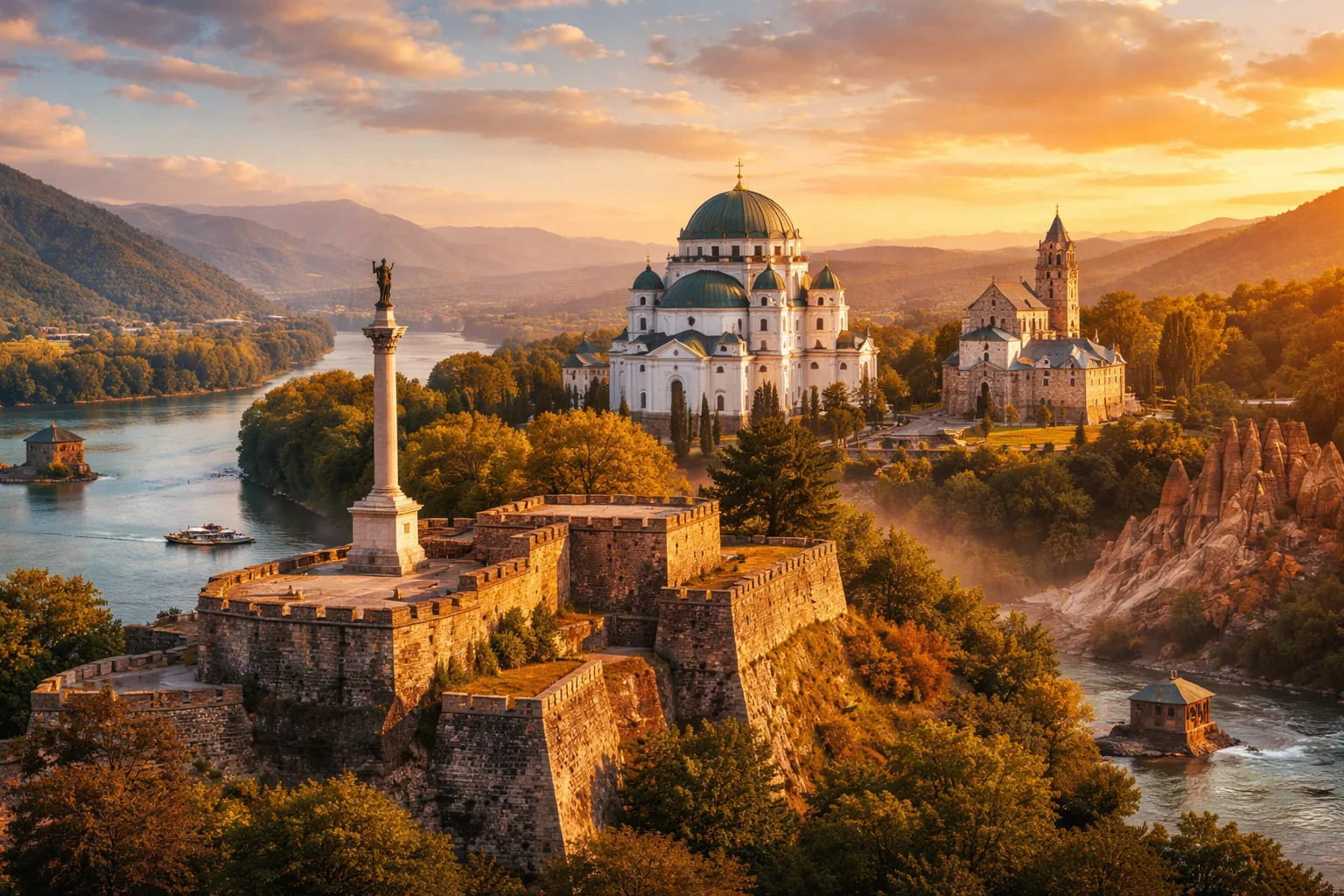
Serbia overview
Serbia is a landlocked country in southeastern Europe, situated where the central Balkans meet the Pannonian Plain. It serves historically and geographically as a crossroads between Central Europe and the eastern Mediterranean sphere, with a legacy that shaped medieval Balkan polities and modern state formation. The country combines broad agricultural plains in the north with rugged highlands to the south, and it preserves a distinctive social institution—the family feast day known as Slava—that structures communal and religious life. Serbia’s modern economy blends traditional agriculture (notably raspberry production) with industry and a growing information technology sector.
Common Geography Questions About Serbia
Where Serbia is located
Serbia lies in Europe on the Balkan Peninsula and the southern edge of the Pannonian Basin, roughly between 41° and 46° north latitude and 18° and 23° east longitude. It borders Hungary to the north, Romania and Bulgaria to the northeast and east, North Macedonia to the south, and Croatia, Bosnia and Herzegovina, and Montenegro to the west and northwest. A border with Kosovo also exists; Kosovo’s status is internationally disputed and affects Serbia’s southern frontier. Major waters shaping its location include the Danube and Sava rivers, with Belgrade uniquely positioned at their confluence.
Geography and landscape of Serbia
Serbia’s terrain ranges from the flat, fertile Pannonian Plain in Vojvodina to the dissected plateaus and river valleys of central Serbia and the high, forested mountains along its southern and western margins. Notable ranges include the Dinaric Alps foothills to the west and the Balkan (Stara Planina) mountain chain in the east; karst landscapes and limestone gorges appear in the southwest. The Iron Gates (Đerdap) gorge on the Danube is an outsized geographic landmark and a major hydroelectric and navigation chokepoint. Climatic zones vary from temperate continental in the north to mountain climates with heavy snowfall at altitude.
Serbia culture and society
Serbian society is characterized by a Slavic language base and Orthodox Christian tradition: Serbian is the official language and the constitution grants Cyrillic as the country’s official script while Latin script is also widely used. The Slava, a household celebration of a family’s patron saint, is a cultural practice largely unique to Serbian Orthodox communities. Vojvodina’s multiethnic mix—Hungarian, Slovak, Romanian and Rusyn minorities with protected language rights—gives Serbia a regional tapestry of customs and bilingual signage not typical in many neighbouring states. Urban concentrations around Belgrade and Novi Sad contrast with depopulating rural highlands.
History of Serbia
Serbia’s historical arc moves from early medieval principalities through the Nemanjić dynasty, which consolidated a medieval Serbian state and produced legal codices and monasteries influential across the Orthodox world. The 14th-century Battle of Kosovo became a foundational turning point for national memory as Ottoman rule extended over large parts of the territory. Centuries later northern regions entered Habsburg orbit while modern Serbian independence emerged through 19th-century uprisings and state-building. In the 20th century Serbia was a central player in the formation and later dissolution of Yugoslavia; those shifts redefined borders, institutions, and regional influence across the Balkans.
Serbia economy and government
Politically, Serbia is a parliamentary republic with a directly elected president as head of state and a prime minister who leads the government; legislative authority rests in a unicameral National Assembly. The constitution recognizes two autonomous provinces, of which Vojvodina’s multiethnic administration is functional and Kosovo’s status remains internationally contested. Economically, agriculture (notably raspberries and plums), manufacturing including automotive assembly in Kragujevac, and an expanding IT and services sector are pillars. The national currency is the Serbian dinar (RSD), and state involvement persists in energy, infrastructure, and some industrial enterprises.
Regions and major cities of Serbia
Administratively Serbia is divided into districts and municipalities, and it distinguishes two autonomous provinces, including Vojvodina in the north. The capital, Belgrade, is the country’s largest city and primary political and transport hub. Novi Sad to the northwest serves as a cultural center and hosts the internationally prominent EXIT music festival at Petrovaradin Fortress. Niš in the south is an ancient urban node with Roman and Byzantine layers; Kragujevac is an industrial center with a history as a former princely capital. Regional names such as Šumadija, Mačva and Timok reflect geographic and historical subregions.
Distinctive characteristics of Serbia
Serbia is associated internationally with several concrete features: its role as a major global supplier of raspberries and fruit concentrates; medieval Orthodox monasteries such as Studenica and Sopoćani that are UNESCO-listed for their frescoes; and a strong sporting and cultural profile through figures like tennis player Novak Djokovic. The country preserves Cyrillic as an official script—relatively rare in contemporary Europe—and hosts the EXIT music festival, which has become an international cultural brand anchored in Novi Sad’s Petrovaradin Fortress. Serbia also maintains a notable manufacturing legacy in automotive and arms industries.
Places in Serbia
Belgrade
Belgrade is the capital and largest city of Serbia, serving as the country's primary political and economic center. It hosts national government institutions, major cultural organizations, and principal academic bodies. The city is organized as a formally defined administrative unit composed of multiple municipalities. Its role as Serbia's principal metropolitan area gives it central significance for national governance, regional demographics, and cultural production.
Belgrade Fortress
Belgrade Fortress is a historic fortified complex occupying a prominent hill above the confluence of the Sava and Danube rivers in Serbia. It is a multi-layered archaeological and urban ensemble that defines the central public park and historic core of Belgrade. The site contains visible remains from Roman, medieval, Ottoman, and Habsburg construction phases, and its strategic riverside position constitutes a formally defined geographic control point shaping the city’s layout.
Belgrade Zoo
Belgrade Zoo is a municipal zoological garden in Serbia, located within the historic Kalemegdan parkland. The site occupies a compact urban parcel adjacent to the confluence of the Sava and Danube rivers and functions as the city’s principal curated animal collection under municipal management. The facility combines managed enclosures, exhibition buildings, and service yards arranged on terraced ground, giving a measurable footprint within the park’s protected cultural landscape. Keywords: location, history, significance, features.
Kalemegdan Fortress
Kalemegdan Fortress is a historic fortified complex and urban park in Belgrade, Serbia, occupying the city’s principal defensive plateau. It forms the core of the Belgrade Fortress and is significant as a multi-period archaeological and cultural ensemble. The site is a formally defined Cultural Property of Great Importance under Serbian heritage protection, and it contains visible structural remains from Roman, medieval Serbian, Ottoman, and Habsburg phases of fortification. Kalemegdan Fortress anchors Belgrade’s historical landscape.
National Museum of Serbia
National Museum of Serbia is the principal state museum of Serbia, located in the capital city of Belgrade. It occupies a prominent historic building on Republic Square and holds formal national museum status under Serbia’s Ministry of Culture, housing institutional collections that span archaeology, medieval and modern art, and applied arts. The museum functions as a national repository and research institution responsible for preservation and public documentation of Serbian movable cultural heritage.
Nikola Tesla Museum
Nikola Tesla Museum is a museum in Belgrade, Serbia, dedicated to preserving the life and technical legacy of inventor Nikola Tesla. It is located in the capital city and houses the primary repository of Tesla’s personal archive and scientific belongings, making the collection a measurable, institutional resource for study and conservation. The institution functions as a curated research collection and public museum concentrating on original documents, instruments, and personal effects linked to Tesla.
Skadarlija
Skadarlija is a historic bohemian district in Serbia, located in the central city of Belgrade. It functions as a distinct urban quarter within the Stari Grad municipality and is formally identified by the city as part of Belgrade’s historic urban core. The district is organised around a single named artery, Skadarska Street, and its designation and municipal boundaries are used in the city’s administrative mapping and planning documents. Skadarlija’s significance lies in its role as a preserved cultural-historical urban ensemble.
University of Belgrade
University of Belgrade is a public university in Serbia and the principal higher-education institution in the country. It occupies a network of faculties and institutes concentrated in Belgrade and operates more than thirty faculties and research institutes as a single legal and academic entity. The University of Belgrade serves as a national hub for tertiary education, research administration, and professional credentialing, with formal status under Serbia’s higher-education law and governance structures that include a senate and a rectorate. Its campus buildings and academic collections form a dispersed institutional footprint across the city.