Senegal Guide
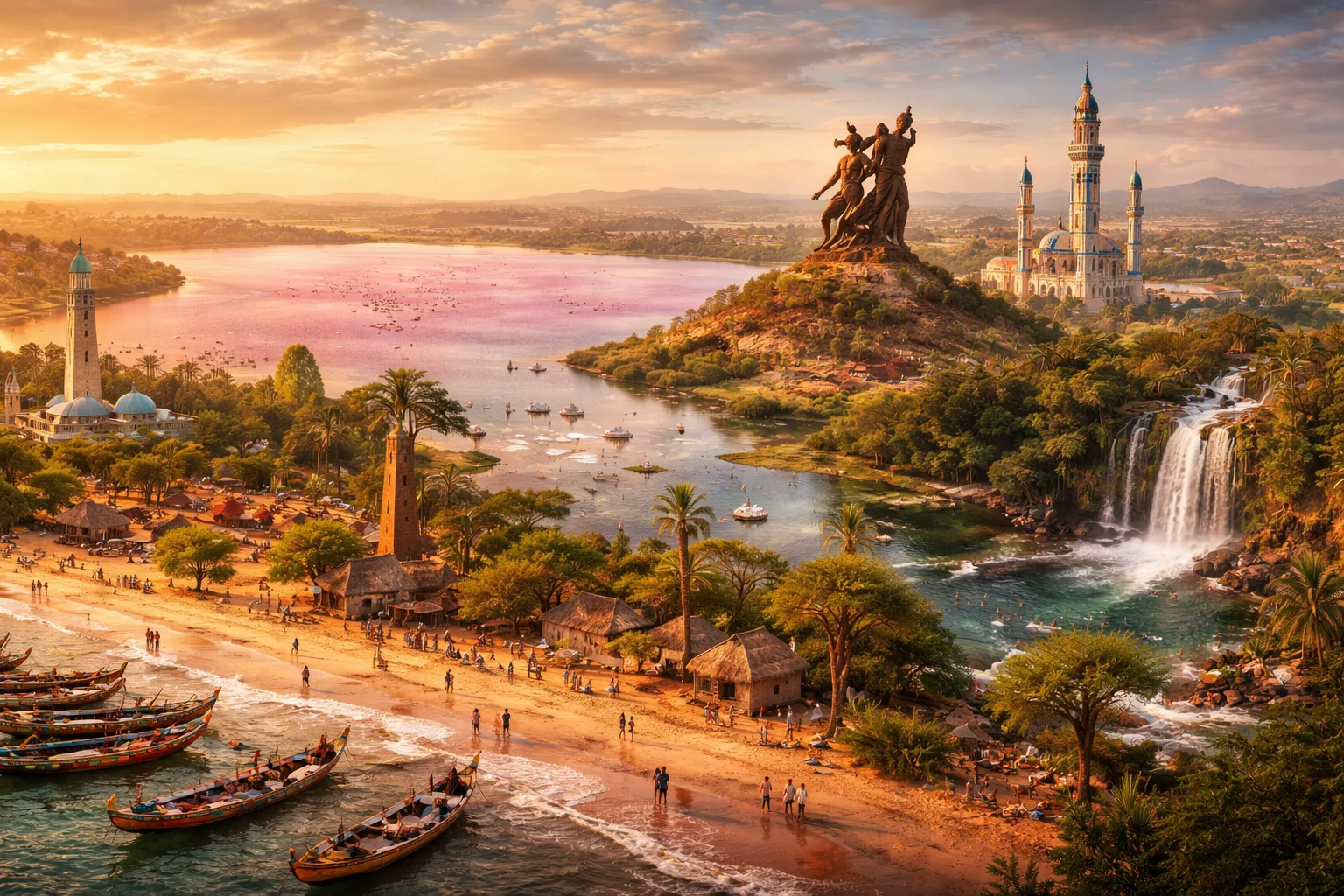
Senegal overview
Senegal is a West African country whose territory projects into the Atlantic on the Cape Verde Peninsula and uniquely surrounds — on three sides — the almost landlocked state of The Gambia. Positioned at the westernmost tip of the African mainland, the country combines a dense coastal urban core with interior Sahelian plains and a wetter southern region. Senegal’s historical role as the administrative center of French West Africa, its francophone institutions, and a visible tradition of Sufi brotherhoods give it disproportionately strong cultural influence across the region.
Common Geography Questions About Senegal
Where Senegal is located
Senegal sits on the continent of Africa in the western Sahel belt, roughly between about 12° and 16° north latitude and between 17° and 12° west longitude. Senegal borders Mauritania to the north, Mali to the east, Guinea and Guinea-Bissau to the southeast, and encloses The Gambia along the Gambia River’s valley. The Atlantic Ocean defines its entire western edge; the Senegal River forms much of the northern frontier. The Cape Verde Peninsula projects into the ocean at Dakar, and nearby offshore islands such as Gorée and the Saloum archipelago mark the country’s coastal geography.
Geography and landscape of Senegal
Senegal’s landscape runs from low, sandy Atlantic coasts to flat interior plains and seasonal wetlands. The Cap-Vert peninsula, home to Dakar, is the westernmost point of continental Africa. The Senegal River basin in the north gives way to semi-arid Sahelian steppe, while southern regions such as Casamance harbor mangrove networks and humid woodland. Notable local features include Lake Retba (the pink lake) near Dakar and the Sine-Saloum delta’s braided islands. The country has no high mountain chains; its relief is dominated by modest plateaus and isolated hills, and climate zones shift sharply north to south.
Senegal culture and society
French is the official language, but Wolof functions as the national lingua franca; Pulaar, Serer, Jola (Diola) and Mandinka are regionally important. Senegal’s society is marked by strong Sufi Islam—orders like the Mouride and Tijaniyya shape social networks, pilgrimage patterns, and economic ties, with the city of Touba serving as a distinct religious-political center. Urban culture in Dakar blends Wolof popular music (notably mbalax) with francophone literature; the concept of teranga (hospitality) is a locally rooted social norm. Ethnically diverse communities cluster regionally, and urbanization concentrates in a few coastal metropolitan areas.
History of Senegal
Senegal’s historical arc moves from medieval Sahelian polities—such as Tekrur and later the Jolof states—to becoming a focal point of Atlantic trade and, tragically, the transatlantic slave system centered on places like Gorée Island. During the 19th and 20th centuries Dakar emerged as the administrative heart of French West Africa, shaping infrastructure and institutions. Independence in 1960 brought Léopold Sédar Senghor, a poet-statesman and founder of the Négritude movement, who helped orient Senegal toward francophone cultural networks. The country’s past intertwines regional trade, colonial administration, and intellectual influence.
Senegal economy and government
Senegal operates a semi-presidential republican system with an elected president and an executive that shares power with a prime minister and a legislature; decentralized governance is implemented through regional councils. Economically, Senegal historically depended on groundnut (peanut) production and export; today the economy is more diverse, combining fisheries, phosphate and mineral extraction, urban services, and a growing oil and gas sector in recent decades. The country uses the West African CFA franc and participates in the West African Economic and Monetary Union, with Dakar’s port and transport services serving as a national economic backbone.
Regions and major cities of Senegal
Administratively divided into multiple regions, Senegal’s regional structure concentrates authority in capital-linked units; the coastal Dakar region is by far the most urbanized. Dakar is the national capital and principal port; Saint-Louis, on the Senegal River, is a colonial-era city and UNESCO site; Thiès functions as a rail and industrial hub; Ziguinchor anchors the culturally distinct Casamance area south of The Gambia. The Casamance region’s Mangrove and rice-based landscapes, and the northern Saint-Louis floodplain, create internally contrasting geographic and cultural regions within the country.
Distinctive characteristics of Senegal
Senegal is globally associated with specific cultural exports and landmarks: Gorée Island and its House of Slaves symbolize the Atlantic slave trade’s memory, while the Mouride city of Touba and its Grand Mosque are unique religious-political institutions with broad economic ties. Musically, mbalax and artists such as Youssou N’Dour brought a Senegalese sound to international stages. The nation’s traditional wrestling (laamb) enjoys national prominence as a sport with ritualized practices. Architecturally visible projects like the African Renaissance Monument and Dakar’s role as a West African transport node further distinguish Senegal on the world stage.
Places in Senegal
Cheikh Anta Diop University
Cheikh Anta Diop University is a public university in Senegal. Its main campus lies in the city of Dakar and the institution functions as the largest university in Senegal by student enrollment and as the principal public research university. The university organizes faculties and professional schools in science, humanities, medicine, engineering and social sciences, and it maintains nationally significant research collections and museum holdings. As a state-funded institution, Cheikh Anta Diop University is formally integrated into Senegal’s higher education system and serves as a central node for tertiary education, graduate training, and national research coordination. It offers undergraduate, master’s, and doctoral programmes and hosts national research units that publish scholarly work.
Dakar
Dakar is the capital city of Senegal, situated on the Cape Verde Peninsula and serving as the national political and economic center. The urban commune covers approximately 83 square kilometres and the metropolitan area contains several million inhabitants in official statistics. It anchors Senegal's major port functions, diplomatic missions, and cultural institutions that influence West African networks. The city's prominence underpins national governance and regional connections across economic, diplomatic, and cultural domains.
Gorée Island
Gorée Island is a small Atlantic island and historical settlement off the coast of Senegal, noted for its preserved colonial architecture and memorials. It lies close to the city of Dakar and serves as a concentrated site of cultural memory related to West African and Atlantic history. The island sits approximately two kilometers offshore and covers a compact urban footprint that concentrates historic buildings, narrow streets, and coastal fortifications within a few hectares.
Hann Park Zoo
Hann Park Zoo is a municipal zoological garden and managed landscape located in Dakar, Senegal. It occupies the Parc Forestier et Zoologique de Hann, a formally designated urban park that combines a botanical collection with a curated zoo and serves as Dakar’s principal public zoological institution. The site contains purpose-built animal enclosures, aviaries, and an arboretum that together form the city’s long-standing municipal zoological and botanical collection. This institutional role underpins its significance for urban biodiversity stewardship.
Museum of Black Civilisations
Museum of Black Civilisations is a national museum in Senegal dedicated to the histories, arts, and material cultures of African peoples and their diasporas. It is located in Dakar on the Cap-Vert peninsula and carries a formal status as Senegal’s institutional center for research and public display of Black civilizations. The museum contains multiple permanent and temporary exhibition galleries and maintains conservation and documentation facilities as part of its institutional mandate.