São Tomé and Príncipe Guide
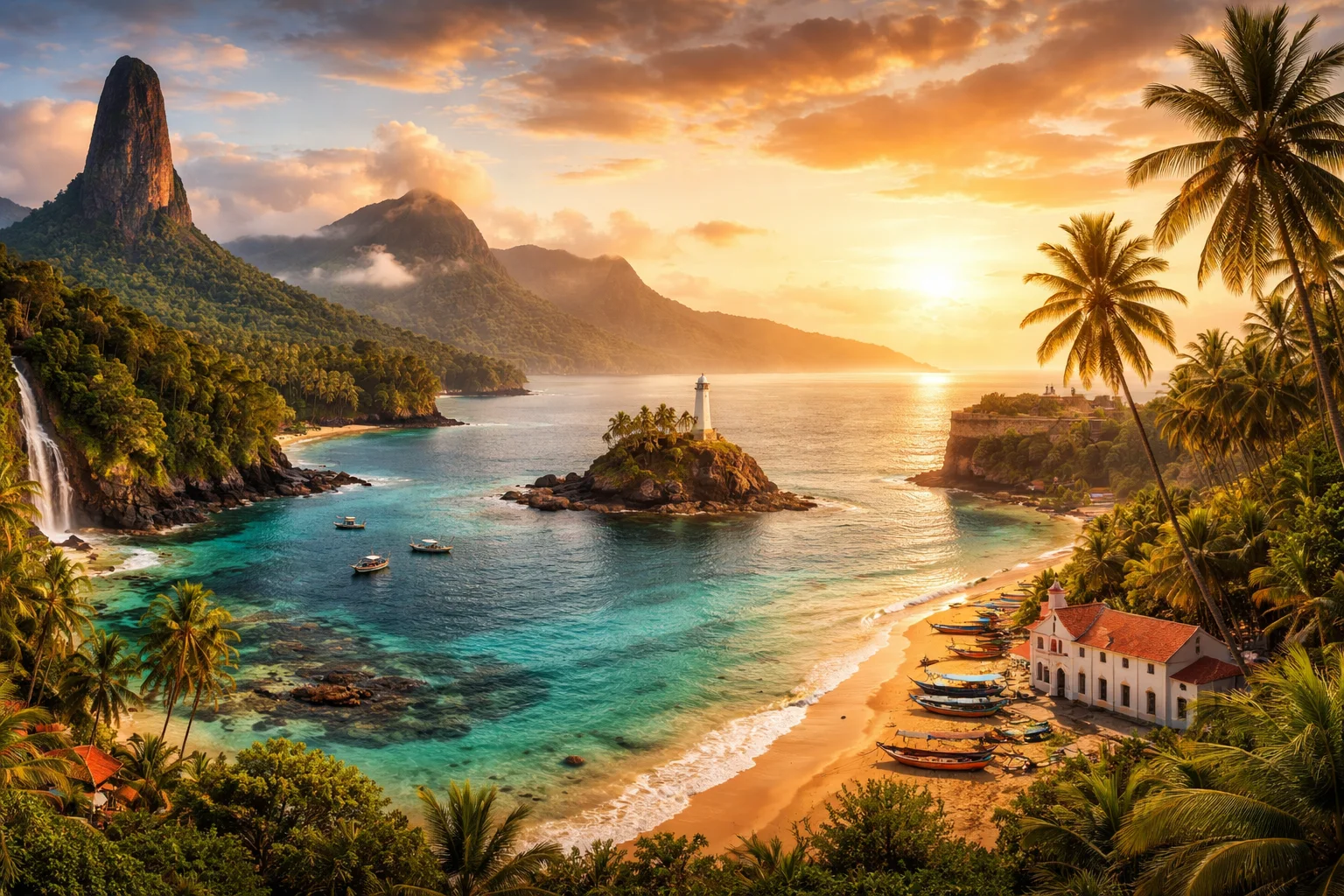
São Tomé and Príncipe overview
São Tomé and Príncipe is a small island nation in the Gulf of Guinea composed mainly of two volcanic islands, São Tomé and Príncipe. Located near the equator, it is one of Africa’s smallest countries by land area and population but notable for its endemic biodiversity, colonial-era plantation landscape, and Portuguese-speaking identity. The country’s significance lies in its concentrated ecological variety, historical role as a cocoa powerhouse, and an economy shaped by offshore fisheries and a legacy of roça plantations. This portrait frames its geographic and cultural distinctiveness.
Common Geography Questions About São Tomé and Príncipe
Where São Tomé and Príncipe is located
São Tomé and Príncipe sits in the Gulf of Guinea off the west coast of Central Africa between about 0°20′N to 1°40′N latitude and roughly 6°40′E to 7°25′E longitude. It has no land borders; the nearest continental neighbors across the Atlantic are Gabon and Equatorial Guinea, with the islands separated from Cameroon and Nigeria by the wider gulf. The Atlantic Ocean and the Gulf of Guinea define its location, and the islands lie along the Cameroon Line, a chain of volcanic seamounts and islands that includes Bioko and São Tomé. This island position gives São Tomé and Príncipe an outsized exclusive economic zone compared with its landmass.
Geography and landscape of São Tomé and Príncipe
The geography of São Tomé and Príncipe is volcanic and vertically dramatic: São Tomé reaches its highest point at Pico de São Tomé, a central volcanic peak rising above dense montane cloud forest, while Príncipe bears smaller but rugged relief. Soils derive from basaltic eruptions, and short, steep watersheds feed numerous short rivers that vanish quickly into the Atlantic. Unique features include the needle-like volcanic plug Pico Cão Grande and contiguous stands of lowland rainforest with very high endemism. Climate gradients are sharp—humid tropical rain forest in windward highlands, drier coastal plains—and the islands' compactness produces rapid transitions in landscape over a few kilometers.
São Tomé and Príncipe culture and society
The culture of São Tomé and Príncipe blends Portuguese language and administration with Creole traditions specific to the islands: Portuguese is official, while Forro and Angolar (and a small Principense Creole) persist as community languages. Religious practice is predominantly Christian with local syncretic customs; tchiloli—a historical sung drama combining Iberian theatrical forms and African performance—is uniquely associated with the islands. Social life is shaped by the roça plantation legacy: many villages grew from plantation settlements and kin networks formed around cocoa estates. Demography is distinctive for its small, dispersed population concentrated in a few coastal towns and a strong sense of island identity tied to Creole culture.
History of São Tomé and Príncipe
São Tomé and Príncipe’s recorded history begins when Portuguese navigators found the uninhabited islands in the late 15th century and established them as plantation outposts. Their early economy pivoted from sugar to slave-run cocoa and coffee plantations in the 19th century, making the islands a major cocoa producer by output per hectare. The islands were administered as an overseas Portuguese province until decolonization; independence arrived in 1975, after which a one-party socialist régime gave way to multiparty democracy in the 1990s. Throughout, the archipelago has served as a concentrated example of plantation capitalism, ecological isolation, and Lusophone colonial legacy.
São Tomé and Príncipe economy and government
São Tomé and Príncipe is a unitary state with a semi-presidential system: a directly elected president and a prime minister accountable to the National Assembly share executive responsibilities. The economy remains small and concentrated: historically dependent on cocoa production and the plantation (roça) infrastructure, it now combines cocoa agriculture with fishing, niche tourism, and services. The country uses the dobra as its currency and manages an economy where the maritime exclusive economic zone and potential hydrocarbon exploration have outsized strategic importance relative to land area. Land ownership patterns and the persistence of former roça estates shape rural economic relations uniquely.
Regions and major cities of São Tomé and Príncipe
Administratively, São Tomé and Príncipe consists of six districts on São Tomé island—Água Grande, Cantagalo, Caué, Lembá, Lobata and Mé-Zóchi—and the Autonomous Region of Príncipe, with local government on Santo António. The capital and largest city is São Tomé, a coastal port with colonial fortifications and the island’s principal public institutions. Other notable urban centers include Santo António on Príncipe, a small historic town anchored by a fishing and conservation-oriented economy, and Neves on São Tomé’s northwestern coast, which functions as a regional port and industrial point. The interior is dominated by former roça estates rather than dense urban networks.
Distinctive characteristics of São Tomé and Príncipe
São Tomé and Príncipe is widely associated with its high level of endemism, the UNESCO-recognized biosphere on Príncipe, and the iconic volcanic landmark Pico Cão Grande—features that attract conservation science and niche eco-tourism interest. Its historical role as a major cocoa producer and the visible landscape of roça plantations connect the country to global chocolate trade history. As a Lusophone African state it is a member of the Community of Portuguese Language Countries, linking it culturally and diplomatically beyond its small territory. The combination of compact volcanic topography, concentrated biodiversity, and plantation heritage gives São Tomé and Príncipe a distinctive international profile.