San Marino Guide
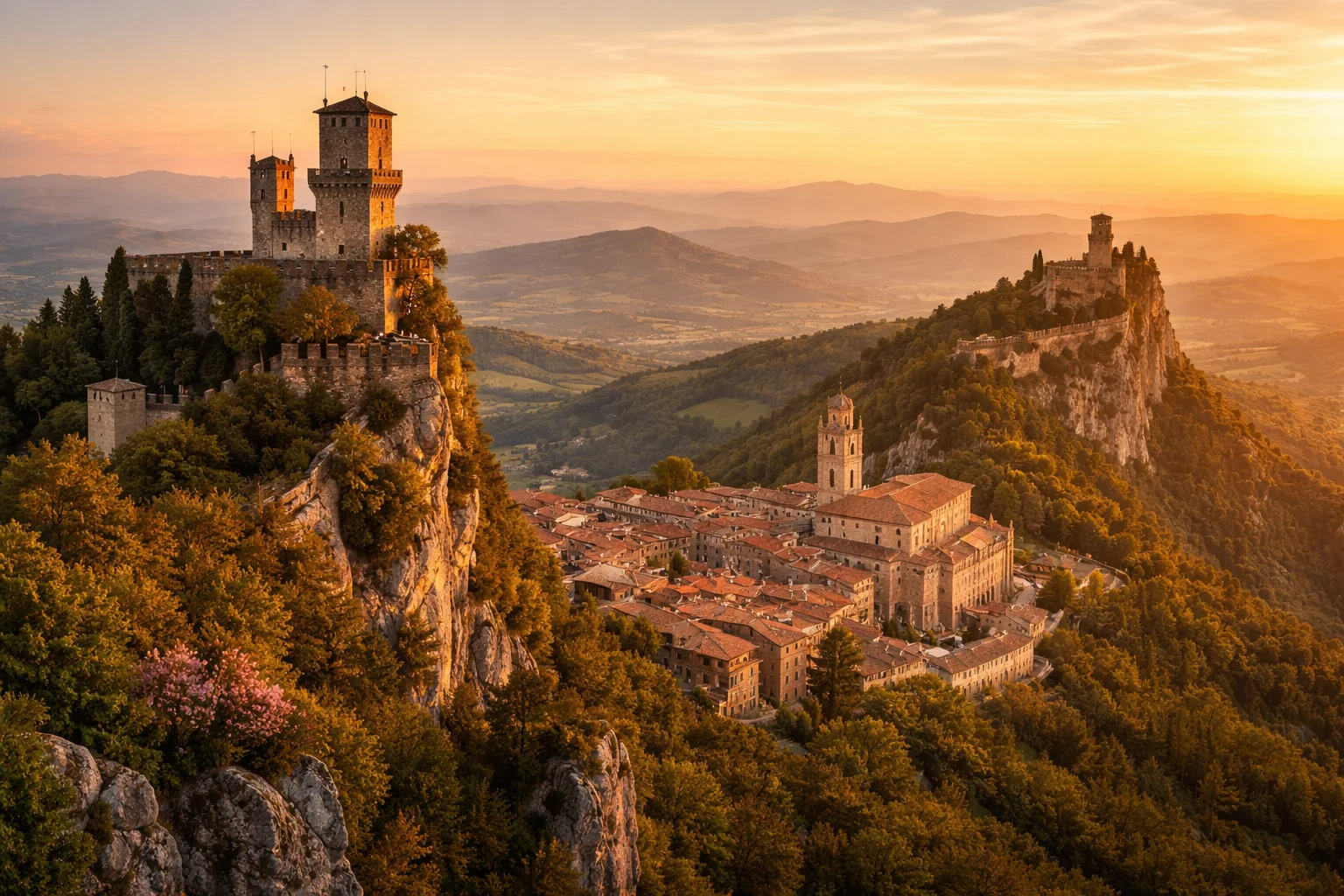
San Marino overview
San Marino is a sovereign microstate completely surrounded by Italy, notable for being one of the world’s smallest and longest-surviving republics. Set on the northeastern slopes of the Apennine chain, its compact territory combines a medieval hilltown, historic fortifications and modern public institutions. San Marino’s significance rests less on size and more on continuity: its legal traditions trace back to early medieval statutes and it maintains distinct fiscal and monetary arrangements that set it apart from surrounding regions. The country is often studied for its institutional resilience and enclave status.
Common Geography Questions About San Marino
Where San Marino is located
San Marino sits in southern Europe on the Italian Peninsula, inland from the Adriatic Sea at roughly 44.3°N, 12.4°E. It is an enclave entirely surrounded by the Italian regions of Emilia‑Romagna and Marche and therefore shares land borders only with Italy; it has no coastline. The nearest stretch of open water is the Adriatic, about ten kilometres east across the coastal plain. San Marino’s location — perched on the northeastern Apennines between a mountain ridge and the coastal lowlands — defines its cross‑border economic and transport links with Italian provinces.
Geography and landscape of San Marino
San Marino’s geography is dominated by a single ridge: Mount Titano rises to approximately 739 metres and provides the highest point of the republic; steep slopes drop toward cultivated foothills and then the Adriatic plain. The country lacks major navigable rivers; drainage is by short streams that flow into Italian catchments. Climatically it sits at a Mediterranean–submontane transition, with cooler, windier conditions on the ridge and milder weather in lower villages. The compact terrain produces abrupt elevation changes across short distances — a defining geographic constraint on land use and urban patterns in San Marino.
San Marino culture and society
Italian is the official language in San Marino, but a Romagnol‑derived Sammarinese dialect and locally specific idioms endure in rural communities. Roman Catholicism shapes many public rituals, yet civic life is organized around secular municipal assemblies and the modern republic; baptismal and patron‑saint celebrations coexist with contemporary national commemorations. The population is very small and concentrated in a few towns; family networks and multi‑generational households remain common, supporting local craft traditions. Sammarinese identity emphasizes civic continuity and the commemoration of Saint Marinus — a cultural anchor unique to this polity.
History of San Marino
San Marino’s origin story centers on a Christian stonemason, Saint Marinus, who, according to tradition, founded a monastic community on Mount Titano in 301 AD; that foundation underpins the republic’s claim to exceptional longevity. Over centuries San Marino preserved local autonomy amid shifting Italian principalities through negotiated privileges rather than conquest. The republic codified its internal rules in a set of statutes around 1600 that still inform its institutions. When the Italian peninsula unified in the 19th century and modern states emerged, San Marino retained independence through diplomacy and formal agreements with Italy.
San Marino economy and government
The political system of San Marino combines a unicameral legislature, the Grand and General Council, with a uniquely configured head of state: two Captains Regent who are elected every six months by the council, a practice rare in world politics. Administratively the country is divided into municipalities called castelli. Economically, San Marino operates a small open economy centered on tourism, a modest manufacturing base (including ceramics and textiles), and services such as banking, retail and the sale of collectible postage stamps and minted euro coins. The euro is used through formal arrangements with Italy and the EU despite San Marino not being an EU member.
Regions and major cities of San Marino
San Marino is subdivided into nine municipalities known locally as castelli, an administrative form that reflects medieval territorial organization rather than provinces. The capital, Città di San Marino, occupies the summit ridge of Mount Titano and houses government institutions in Renaissance and medieval buildings. Other principal population centres include Serravalle, which sits lower on the slopes and hosts larger commercial zones, and Borgo Maggiore, historically a market town and civic hub. These settlements concentrate services and cross‑border trade with neighbouring Italian communes.
Distinctive characteristics of San Marino
San Marino is widely recognized for a set of concrete, verifiable traits: its claim as one of the world’s oldest surviving republics; the three medieval towers crowning Mount Titano (Guaita, Cesta and Montale); and a UNESCO World Heritage listing for its historic centre and the mountain. Internationally it is associated with collectible philately and numismatics — San Marino issues its own euro coin designs and sought‑after postage stamps — and lends its name to sporting and cultural events abroad (for example, the historic San Marino Grand Prix title and participation in the Eurovision Song Contest). These precise associations distinguish San Marino’s global profile.