Saint Kitts and Nevis Guide
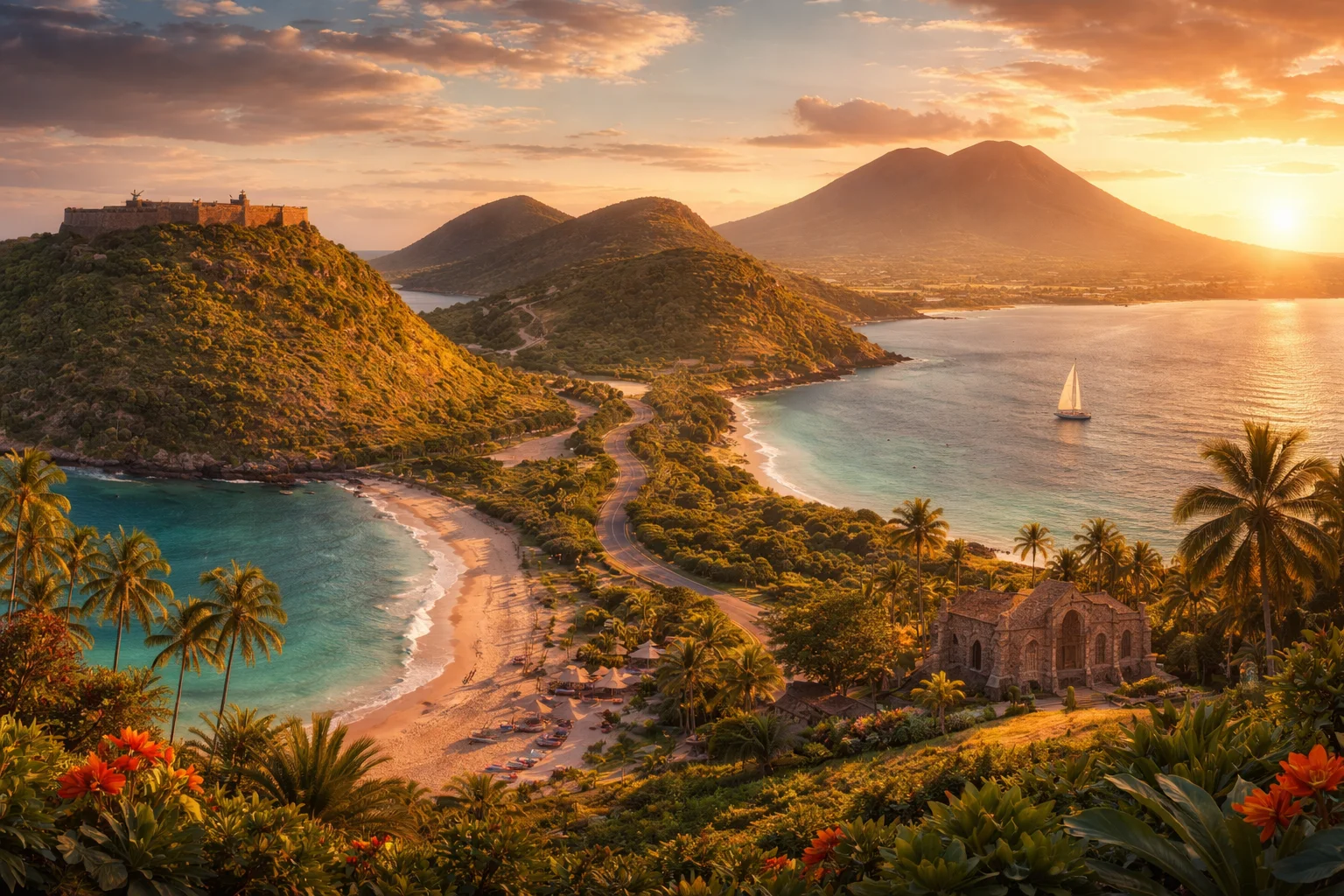
Saint Kitts and Nevis overview
Saint Kitts and Nevis is a two-island sovereign federation in the Caribbean, consisting of the larger island of Saint Kitts and the smaller island of Nevis. The country occupies a compact volcanic archipelago in the Leeward Islands and is the smallest sovereign state in the Western Hemisphere by land area. Its political structure combines a federal government with a semi-autonomous Nevis Island Administration. Economically and culturally the islands pivot on tourism, offshore services and a distinct Creole-derived popular culture centered on festivals, coastal settlements and historic plantation landscapes.
Common Geography Questions About Saint Kitts and Nevis
Where Saint Kitts and Nevis is located
Saint Kitts and Nevis lies in the Eastern Caribbean Sea, part of the Lesser Antilles chain of the West Indies, roughly at latitude 17.3°N and longitude 62.7°W. It sits between the Atlantic Ocean to the east and the Caribbean Sea to the west, with Antigua and Barbuda generally to the northeast and the British Overseas Territory of Montserrat to the south-southwest. The federation occupies a narrow maritime arena where inter-island shipping lanes and reef systems concentrate; its territorial waters and exclusive economic zone define much of its geographic footprint rather than broad land borders with neighbors.
Geography and landscape of Saint Kitts and Nevis
Volcanic peaks dominate the interior of Saint Kitts and Nevis, with Mount Liamuiga on Saint Kitts and Nevis Peak on Nevis forming central highlands that feed steep ridges and narrow coastal plains. The islands combine tropical rain on the windward slopes and markedly drier leeward shores, producing cloud forest remnants near the summits and black volcanic-sand beaches on exposed coasts. Coral reef terraces and fringing reefs line much of the coastline, while deep submarine slopes drop off quickly into the Atlantic—one reason the islands have pronounced marine biodiversity despite limited terrestrial area.
Saint Kitts and Nevis culture and society
English is the official language in Saint Kitts and Nevis, but everyday speech often features Kittitian Creole varieties and Nevisian idioms tracing to West African substrates and Anglo-Caribbean grammar. Cultural life centers on festivals—Carnival on Saint Kitts and Culturama on Nevis—with steelpan, calypso, soca and mas bands that reflect plantation-era social forms. The population is majority African descent, with small mixed and expatriate communities. A regional culinary marker is the national stew called “goat water,” a Creole meat-and-bread stew rarely found outside the federation and central to communal meal traditions.
History of Saint Kitts and Nevis
Saint Kitts and Nevis’s history is marked by early European colonization, plantation agriculture and Caribbean strategic rivalry. European contact began after 1493, and during the 17th and 18th centuries Saint Kitts became a contested English and French sugar colony built on enslaved African labor; the fortress at Brimstone Hill testifies to that strategic legacy. Sugar-driven plantation decline in the 20th century shifted the islands toward diversified economies and self-government, culminating in federation independence in 1983. Nevis’s enduring push for greater autonomy has shaped the federation’s constitutional arrangements and political debates since independence.
Saint Kitts and Nevis economy and government
The federation is a constitutional monarchy and parliamentary democracy: the British monarch is head of state represented locally by a Governor-General, while an elected National Assembly governs federal matters. Nevis maintains its own Island Assembly and Premier with constitutionally guaranteed powers and a right to consider secession. The economy relies on tourism, offshore financial services, light agriculture and remittances; sugar estates were historically dominant but now occupy a residual role. The country uses the Eastern Caribbean dollar and operates a notable citizenship-by-investment program that has become an explicit revenue component distinct from tourist receipts.
Regions and major cities of Saint Kitts and Nevis
Administratively Saint Kitts and Nevis divides into parishes—nine on Saint Kitts and five on Nevis—reflecting colonial-era land division rather than large urban governance units. Basseterre, the federal capital on Saint Kitts, functions as the primary commercial and port hub; Charlestown on Nevis serves as the island’s administrative and cultural center. Sandy Point Town and Cayon on Saint Kitts are smaller nodes with historical plantation ties. Geographically the federation contrasts a busier, tourism-oriented Saint Kitts with a quieter, more rural Nevis that retains stronger island-level governance and a distinct small-island identity.
Distinctive characteristics of Saint Kitts and Nevis
Several concrete associations distinguish Saint Kitts and Nevis internationally: the UNESCO-listed Brimstone Hill Fortress on Saint Kitts; Nevis as the birthplace of Alexander Hamilton; and the federation’s citizenship-by-investment program, one of the Caribbean schemes frequently cited in global mobility discussions. The islands also punch above their size in athletics and cricket traditions relative to population, and their combination of steep volcanic peaks, intact caldera-like summits and adjacent deep ocean makes them geologically conspicuous among small island states. These specific features shape how Saint Kitts and Nevis is recognized worldwide.