Rwanda Guide
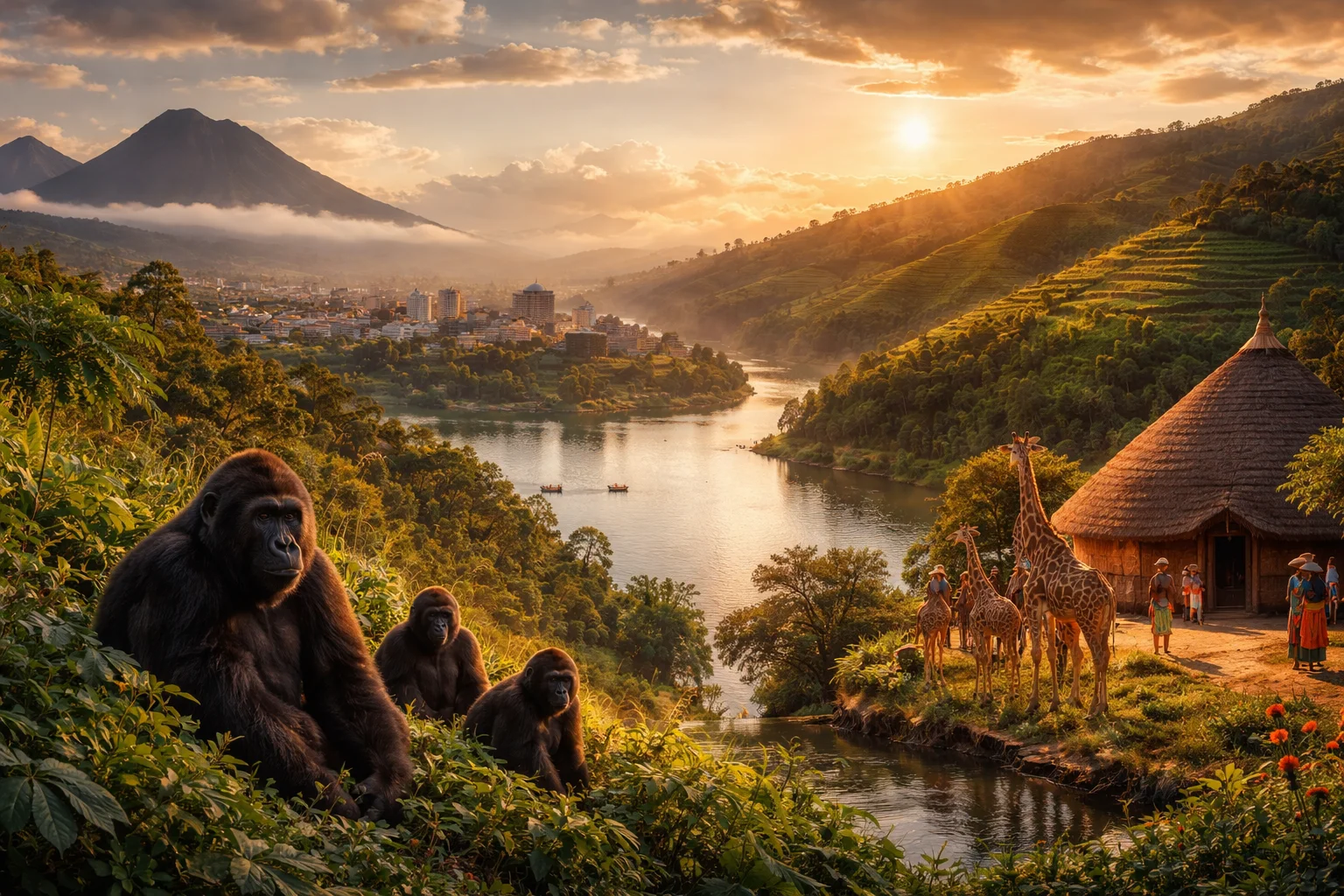
Rwanda overview
Rwanda is a compact, landlocked republic in east-central Africa known for steep hills, a centralized post-colonial state, and a rebuilt national identity following profound upheaval in the late 20th century. Located in the Great Lakes region, Rwanda combines montane forests, volcanic highlands and densely farmed terraces within a small territorial footprint. The country’s significance derives from its role in mountain gorilla conservation, the near-universal use of the Kinyarwanda language, and a developmental model that prioritizes governance reform, urban planning and regional integration over raw natural-resource extraction.
Common Geography Questions About Rwanda
Where Rwanda is located
Rwanda sits on the African continent in the Great Lakes subregion of East-Central Africa, roughly between 1°S and 2°S latitude and 29°E to 31°E longitude. It is bordered to the north by Uganda, to the east and south by Tanzania and Burundi respectively, and to the west by the eastern Democratic Republic of the Congo. Lake Kivu forms a long section of the western boundary and ties Rwanda into the Albertine Rift ecological zone. Because it is both small and high in elevation, Rwanda’s national center lies unusually close to its capital compared with larger states in the region.
Geography and landscape of Rwanda
Rwanda’s geography is dominated by a sweep of volcanic highlands—locally known as the “land of a thousand hills”—with the Virunga volcanic range along the northwest containing dormant and extinct volcanoes. The Nyungwe montane rainforest in the southwest is among Africa’s oldest rainforests, while the east transitions to savanna and the Akagera wetlands. Unique to Rwanda’s physical geography is Lake Kivu’s unusually high concentrations of dissolved gases (methane and CO2) in deep strata, leading to specialized geological monitoring and commercial gas-extraction projects not common to most countries. Elevation-driven microclimates produce distinct agricultural zones within short distances.
Rwanda culture and society
Rwanda’s culture centers on Kinyarwanda, the Bantu language spoken by virtually the entire population across ethnic identities; English, French and Swahili also have roles in education and trade. Social life blends long-standing practices—such as intore warrior dance, imigongo geometric cow-dung art, and seasonally timed agricultural festivals—with modern civic rituals like nationally organized community work days. Religious life is plural but predominantly Christian with important indigenous beliefs intertwined. A distinctive social feature is the national emphasis on a shared Rwandan identity expressed through language policy and public ceremonies that downplay pre-colonial ethnic labels.
History of Rwanda
Rwanda’s history moves from a centralized pre-colonial kingdom with a hereditary mwami (king) and intricate cattle-based elite structures, through late 19th-century German and then Belgian colonial administration that codified identity categories, to independence in 1962. The late 20th century saw catastrophic ethnic violence that culminated in the 1994 genocide against the Tutsi; that event became a defining rupture. In its aftermath the state pursued judicial innovations, refugee repatriation, and policies aimed at national unity, decentralization and rapid social rebuilding—transformations that have shaped regional diplomacy and comparative studies of post-conflict reconstruction.
Rwanda economy and government
Rwanda is organized as a presidential republic with a centralized executive and a system of provinces and districts intended to devolve service delivery while maintaining national policy coordination. The national currency is the Rwandan franc. The economy blends smallholder agriculture—specialty coffee and tea as notable export crops—with services concentrated in the capital and growing light industry and mining of tin, tungsten and tantalum. Distinctive economic traits include intensive hillside agriculture with engineered terracing, a targeted effort to build a Kigali-based tech and business services hub, and a development model that prioritizes public infrastructure and human-capital investments over bulk fossil-fuel extraction.
Regions and major cities of Rwanda
Rwanda’s administrative map divides the country into several provinces plus the City of Kigali. Kigali, the capital, functions as the political, financial and transport hub and is unusually centrally located relative to national borders. Other major cities include Musanze (near the Volcanoes Park gateway), Huye (formerly Butare, a cultural and academic center), and Rubavu/Gisenyi on Lake Kivu’s northern shore. Regionally, the northwest highlands, the southwest montane forest belt, the eastern savanna-parklands, and the lake-dominated western edge form distinct geographic and economic subregions with different settlement patterns and land-use practices.
Distinctive characteristics of Rwanda
Rwanda is widely associated with mountain gorilla conservation and high-value ecotourism concentrated in the Virunga/Volcanoes area, a conservation effort tied to rigorous park management and community revenue-sharing schemes. Globally notable policy markers include an early and strict nationwide ban on plastic bags and one of the world’s higher rates of female parliamentary representation, both cited in international governance studies. Terraced hillside farming for erosion control and a near-universal national language (Kinyarwanda) as the social glue further distinguish Rwanda’s national profile in comparative geography, culture, and governance discussions.
Places in Rwanda
Akagera National Park
Akagera National Park is a protected savanna and wetland reserve in eastern Rwanda covering approximately 1,122 square kilometers. The park is Rwanda’s largest protected area of lowland habitat and is significant for preserving savanna biodiversity within a predominantly montane country. It contains a mosaic of lakes, marshes, and grasslands and supports large mammal populations, making it an important site for regional conservation and scientific study.
Gisenyi
Gisenyi is a lakeside city in western Rwanda on the northern shore of Lake Kivu and the principal town of Rubavu District. It forms a significant urban node adjacent to Goma in the Democratic Republic of Congo, and it functions as a regional center for commerce, administration, and lakeshore activity. Gisenyi’s strategic position on Lake Kivu and its role as Rubavu’s main urban area underline its local economic and geographic significance.
Kigali
Kigali is the capital city of Rwanda and the country's primary center for national government and administration. It is located in central Rwanda and functions as the seat of national political institutions and major administrative bodies. Kigali's municipal status is formally defined under national law and its urban area concentrates the country's principal governmental buildings and national services. The city is significant as Rwanda's main hub for governance and national coordination.
Kigali Genocide Memorial
Kigali Genocide Memorial is a purpose-built memorial and burial site in Kigali, Rwanda, dedicated to victims of the 1994 genocide against the Tutsi. It functions as a commemorative landscape, an exhibition centre, and a repository for remains and documentation. The site contains mass graves estimated to hold more than 250,000 victims, making it a formally defined national place of remembrance and scholarly documentation with long-term educational responsibilities. Its institutional role combines memory, research, and conservation.
Lake Burera
Lake Burera is a freshwater lake in northern Rwanda situated within Burera District of the Northern Province. It forms a closely paired system with neighboring Lake Ruhondo and lies within the Albertine Rift, a formally recognized biogeographic region. The lake is significant for its highland rift setting and its role in regional hydrology, being part of the upper Nile catchment that contributes to downstream water networks.
Lake Kivu
Lake Kivu is a large rift valley lake on the border of Rwanda and the Democratic Republic of the Congo, notable for its size and gas-rich deep waters. It covers approximately 2,700 square kilometers and lies at about 1,460 meters above sea level. Lake Kivu is significant for regional hydrology, fisheries, and scientific study of dissolved gases, and it forms part of the Albertine Rift subregion of the East African Rift system.
Mount Bisoke
Mount Bisoke is a stratovolcano in the Virunga Mountains on the Rwanda–Democratic Republic of Congo border, notable for its summit crater lake and role in regional biodiversity conservation. Situated within Volcanoes National Park in northwestern Rwanda, Mount Bisoke attains an elevation of about 3,711 metres above sea level. The mountain’s geology and montane ecosystems have been documented in geological surveys and biological studies, and its forested slopes contribute measurable habitat for populations of eastern gorillas and other Albertine Rift endemics.
Nyungwe Forest
Nyungwe Forest is a montane rainforest in southwestern Rwanda that forms the core of Nyungwe National Park. It covers roughly 1,019 square kilometers and represents one of the largest remaining tracts of montane forest in East-Central Africa. The forest is significant for its high primate diversity, extensive endemic flora, and substantial contribution to regional hydrological stability and biodiversity conservation. Researchers conduct long-term ecological and evolutionary studies that use its intact forest systems as a reference for montane ecology.
University of Rwanda
University of Rwanda is a public national university in Rwanda. The institution was created as a consolidated national university headquartered in Kigali and formally established in 2013 through a government-led merger. University of Rwanda serves as the primary state institution for higher education, organizing undergraduate, graduate, and professional programs and housing multiple campuses and specialized colleges. The university is administered under a central governance structure and is officially recognized by Rwanda’s higher-education authorities as the principal public university system.
Volcanoes National Park
Volcanoes National Park is a protected mountain park in northwestern Rwanda that conserves volcanic terrain and critical wildlife habitat. It covers approximately 160 square kilometres of montane forest, bamboo and afro-alpine vegetation. The park is significant for containing a major portion of the world’s mountain gorilla population and for supporting long-term biological research. Its status as a national park reflects formal legal protection and priority conservation management within Rwanda’s protected-area network.
Volcanoes National Park Rwanda
Volcanoes National Park Rwanda is a national park in Rwanda that protects high-altitude rainforest and volcanic terrain. The park covers the northernmost sector of the Virunga volcanic chain and includes five principal volcanoes as a measurable geographic fact. Volcanoes National Park Rwanda is significant for its role in mountain gorilla conservation and long-term primate research that has influenced regional conservation policy and scientific study.