Romania Guide
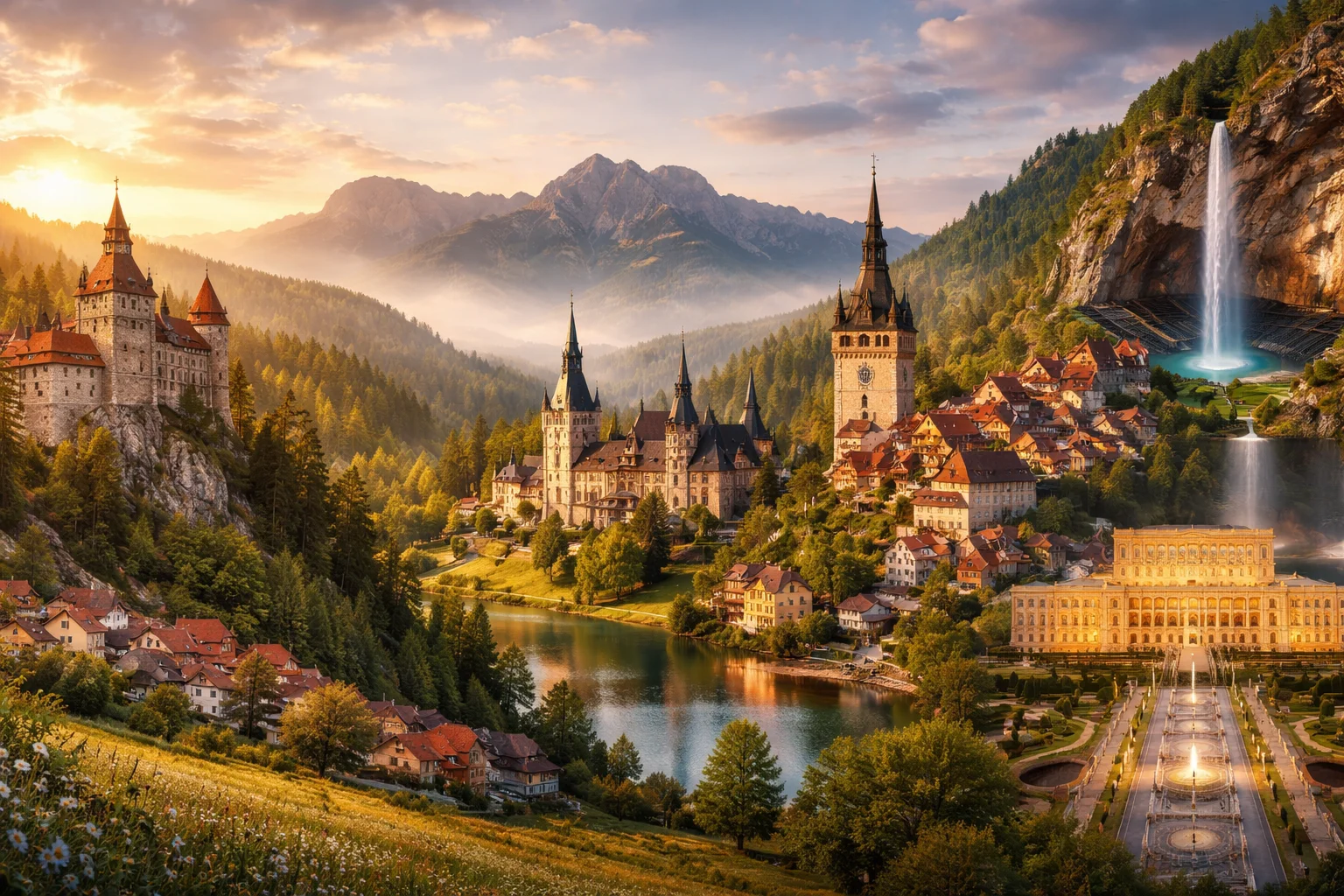
Romania overview
Romania is a country in Southeastern Europe with a Latin-rooted language and a geography that spans Carpathian mountains, a central plateau, and a Black Sea littoral. Positioned at a crossroads between Central and Eastern Europe, Romania’s significance lies in its mix of Romance-language culture amid Slavic neighbors, a large share of Europe’s remaining temperate forests, and a built legacy from diverse empires. Its national identity is shaped by medieval principalities that merged into a modern state, while contemporary strengths include an industrial manufacturing base and a rapidly growing technology sector concentrated in several regional cities.
Common Geography Questions About Romania
Where Romania is located
Romania sits on the continent of Europe, predominantly in the southeastern quadrant, spanning roughly between 43° and 48° north latitude and 20° to 29° east longitude. It borders Ukraine to the north and northeast, the Republic of Moldova to the east, Bulgaria to the south across stretches of the Danube, Serbia to the southwest, and Hungary to the west. A short Black Sea coastline in the southeast gives Romania direct access to maritime routes. That location places Romania as a bridge between the Carpathian interior and the Black Sea basin, with cross-border plains and mountain passes shaping historic routes.
Geography and landscape of Romania
Romania’s terrain is dominated by an arc of Carpathian Mountains encircling the Transylvanian Plateau; the Carpathians include distinct ranges such as the Southern Carpathians and the volcanic Eastern Carpathians. Rivers like the Danube cut gorges at the Iron Gates and feed the wide plains of Wallachia; the country’s largest inland water system includes numerous karst lakes and caves. Climatically, Romania ranges from alpine conditions in the high mountains to maritime-influenced weather on the Black Sea coast and continental interiors. One distinctive element is the Danube’s extensive inland valleys and the Transylvanian basins that created isolated biodiversity pockets uncommon in neighboring lowland countries.
Romania culture and society
Romania’s official language is Romanian, a Balkan Romance language that conserves a Latin core while incorporating Slavic, Greek, and Turkish layers; this linguistic profile is uncommon among its Slavic-speaking neighbors. Hungarian is widely used in parts of Transylvania, and Romani and minority languages persist in regional communities. Orthodox Christianity shapes many public rituals and annual cycles; secular folk customs such as the spring Mărțișor talisman and the doina musical lament remain regionally vital. Socially, Romania combines rural village traditions—visible in preserved painted monasteries and the Merry Cemetery of Săpânța—with urbanizing trends and a sizable diaspora that influences demographic patterns and remittance flows.
History of Romania
Romania’s territory was the core of ancient Dacia, incorporated into the Roman Empire after Emperor Trajan’s campaigns, leaving archaeological traces and a Latin linguistic legacy. Over medieval centuries, the principalities of Wallachia, Moldavia and the multi-ethnic Transylvania evolved under shifting suzerainties—Ottoman, Hungarian, and Habsburg—producing a patchwork of legal and cultural systems. Modern consolidation came through the union of principalities into a single state and a late-monarchical phase that industrialized parts of the country. The 20th century brought authoritarian and communist centralization, followed by a nationwide political rupture that reset institutions and international alignments in the post-communist era.
Romania economy and government
Romania is organized as a parliamentary republic with a directly elected president and a government headed by a prime minister, functioning within a constitutional framework and a multi-party legislature. Economically, the country combines legacy heavy industry and agriculture with competitive automotive manufacturing—most notably the Dacia automobile production integrated into a Western European group—and a large information technology and software services sector concentrated in urban centers. The national currency is the leu, and the economy features regional specialization: industrial clusters in Transylvania, port and logistics operations on the Black Sea, and extensive arable farming on the plains.
Regions and major cities of Romania
Administratively divided into 41 counties (județe) plus the municipality of Bucharest, Romania also preserves stronger identities in historic regions: Transylvania, Moldavia, Wallachia (subdivided into Muntenia and Oltenia), and Dobruja along the Black Sea. Bucharest is the capital and the political-administrative core, noted for its monumental civic architecture. Cluj-Napoca is a major cultural and technology hub in Transylvania; Timișoara is an economic center with a long history of Central European multiculturalism; Iași is the cultural and academic focal point of Moldavia. County-level governance interacts with national ministries to coordinate regional development projects.
Distinctive characteristics of Romania
Romania is internationally associated with several concrete, verifiable features: the Palace of the Parliament in Bucharest, one of the largest administrative buildings in the world by volume and surface; the Dacia automobile brand originating here and integrated into a major European carmaker’s supply chain; and the Coandă effect, named for Romanian aeronautical pioneer Henri Coandă. Cultural exports include the music of George Enescu and gymnast Nadia Comăneci’s Olympic legacy. Romania is also known for its rich medieval and Dacian archaeological sites, concentrated biodiversity in mountainous forests, and distinctive painted monasteries and folk arts tied to regional identities.
Places in Romania
Babes-Bolyai University
Babes-Bolyai University is a public research university in Romania based in the city of Cluj-Napoca. The institution is a national higher-education center that traces institutional continuity to academic foundations in Cluj dating to the late 16th century, and it operates more than twenty academic faculties across humanities, sciences, medicine, and professional fields. Babes-Bolyai University was created through the formal union of distinct academic traditions and maintains a central administration, a large academic library, and a network of research institutes that support doctoral training and published scholarship. The name commemorates the scientist Victor Babeș and the mathematician János Bolyai.
Bran Castle
Bran Castle is a medieval fortress and museum near the town of Bran in central Romania, noted for its associations with Transylvanian history and the Dracula legend. The structure was first documented in royal charters in 1377 and preserves a layered historical record from medieval defensive phases to later residential adaptations. Its significance arises from preserved defensive architecture, a substantial collection of period furnishings, and its role as a symbol in Romanian and literary history.
Bucharest
Bucharest is the capital city of Romania and its principal political, economic, and cultural center. The city occupies approximately 228 square kilometers and serves as the seat of Romania's national institutions. Bucharest is significant for its concentration of universities, national museums, and key administrative buildings. The urban area functions as Romania's primary hub for government, higher education, and national cultural organizations, reflecting its national-level importance and measurable urban footprint.
Bucharest Zoo
Bucharest Zoo is the principal zoological garden located in Bucharest, Romania, formally known in Romanian as Grădina Zoologică București. The site functions as a municipal zoological institution with a long-established public animal collection and a defined role in urban natural heritage; it occupies a managed landscape within the city and maintains curated enclosures for a documented assortment of captive species. This article profiles its location, structure, and institutional role.
Lipscani
Lipscani is a historic district in Bucharest, Romania. It is the city’s original commercial quarter, centred on Lipscani Street and formally included in Bucharest’s Old Town conservation area. The district comprises a contiguous network of narrow streets and merchant buildings organized around the medieval princely court known as Curtea Veche. Municipal heritage inventories list multiple protected structures within the area, and the street network constitutes a defined conservation zone in central Bucharest.
National Museum of Art of Romania
National Museum of Art of Romania is the state museum that holds Romania’s principal national art collections and is located in Bucharest, Romania. It occupies the former Royal Palace on a prominent civic square in central Bucharest, a formally designated national museum responsible for assembling, conserving, and exhibiting Romanian and European fine art collections. The institution combines a national collection of medieval and modern Romanian art with a separate European Old Masters collection under a single institutional mandate.
Peles Castle
Peles Castle is a Neo-Renaissance palace located in Sinaia, Romania, originally built as a royal summer residence and now maintained as a museum. The building served as a royal household and contains about 160 rooms arranged across multiple wings and towers. Its significance derives from architectural ambition, a large historic art and arms collection, and a role in Romanian state symbolism. The structure exemplifies late 19th-century palace design combined with technological innovations of that era.
University of Bucharest
University of Bucharest is a public research university located in Romania. It occupies a central role in the national higher-education system and was founded in 1864 by princely decree. The University of Bucharest comprises a cluster of faculties, research centers, and an administered Botanical Garden, and it retains formal public status under Romanian higher-education law. The institution maintains historic teaching and administrative buildings in central Bucharest and operates libraries and specialized institutes that support advanced study and national research programs. This combination of legal status, founding date, and named scientific collections provides measurable anchors for its institutional identity.
Village Museum
Village Museum is a national open-air ethnographic museum in Romania that preserves traditional rural architecture and material culture. It is located in Bucharest and is significant for assembling vernacular buildings relocated from multiple Romanian regions into a curated park setting. The institution functions as a conservation and research center for traditional construction techniques and folk crafts, and its campus is formally recognised as a repository of built heritage within Romania’s museum system.