Qatar Geography, Peninsula Location & Desert Landscape
Short answer
Quick answer about Qatar
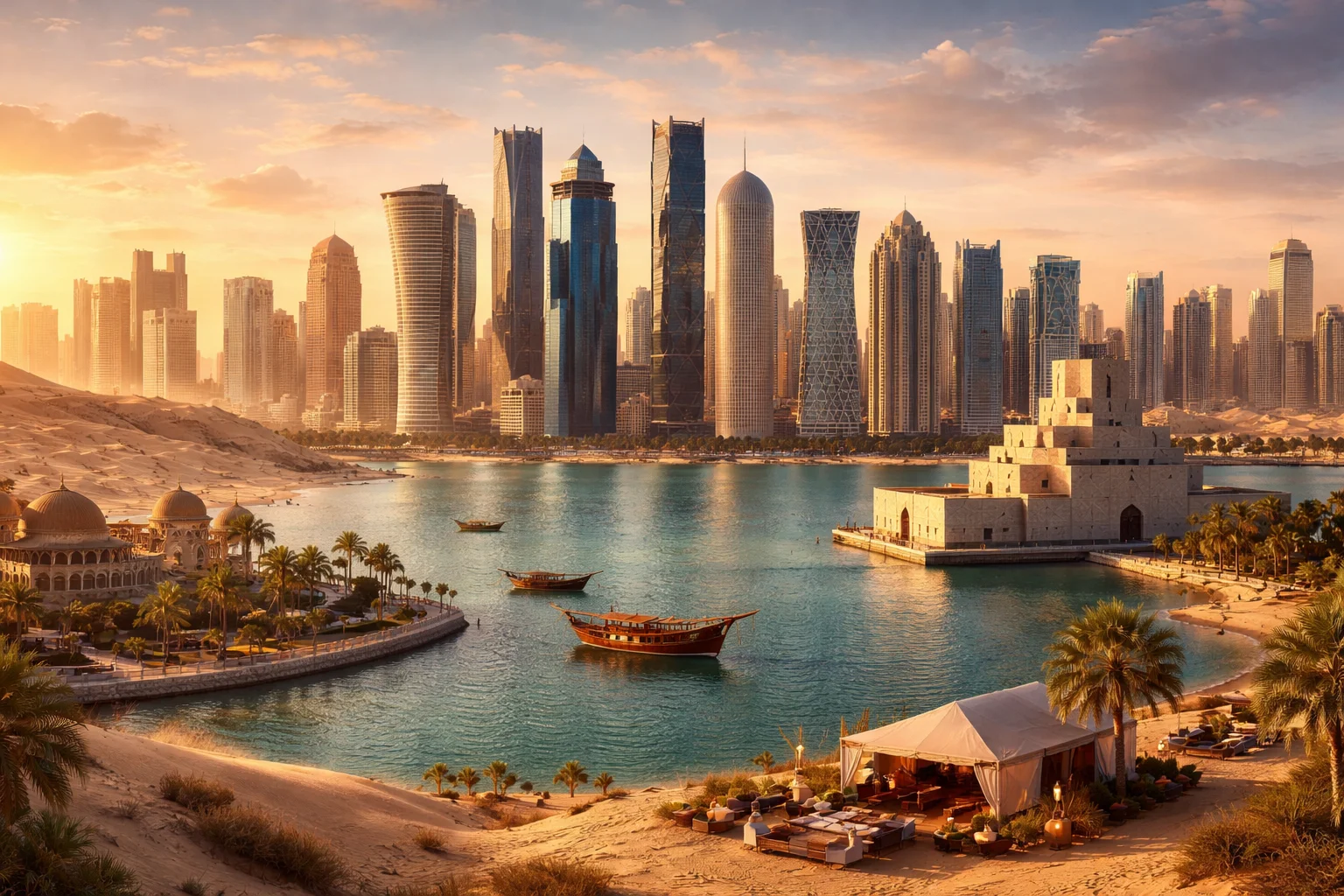
Qatar is a small peninsula country in Western Asia, projecting into the Persian Gulf from the Arabian Peninsula.
Its geography is mostly flat, arid, and desert-like, with long coastlines and Doha as the main urban center.
Location: Arabian Peninsula, Western Asia
Capital: Doha
Coast: Persian Gulf
Landscape: Low, flat, arid peninsula
Border: Saudi Arabia
Qatar overview
Qatar is a small peninsular state on the northeastern edge of the Arabian Peninsula, ruled as a hereditary monarchy. Its compact coastline has been reshaped by large-scale land reclamation projects that created distinctive artificial neighborhoods, altering the country’s maritime profile. Despite a modest land area, Qatar has an outsized global role driven by strategic energy infrastructure and concentrated urban development. This profile combines geographic specificity, concentrated wealth in energy-related assets, and rapid social transformation that set Qatar apart from most states in the Gulf.
Common Geography Questions About Qatar
Where Qatar is located
Qatar occupies a peninsula projecting into the Persian Gulf, roughly between 24° and 27° north latitude and 50° to 52° east longitude. It shares its only land border — a narrow stretch of desert — with Saudi Arabia at the Salwa area; all other connections are maritime. Across short sea lanes lie the islands and coastal waters of Bahrain and the United Arab Emirates, while Iran sits to the north across the Gulf. Qatar’s position on the Gulf concentrates its exposure to maritime trade and regional shipping routes in a way that defines its external orientation.
Geography and landscape of Qatar
Qatar’s terrain is predominantly flat or gently undulating limestone and gypsum plateau, punctuated by the highest point at Jebel Dukhan, a modest anticline rising to roughly a hundred metres. There are no permanent rivers or major freshwater lakes; instead the coastline features extensive sabkha salt flats and tidal inlet systems. The country’s aridity drives widespread desalination of seawater for municipal supply and has produced distinctive fossils and karst features in its bedrock. Southern and central districts contain shallow depressions and gypsum outcrops, while coastal morphology reflects both natural embayments and engineered reclamation.
Qatar culture and society
Arabic is the official language in Qatar, with a Gulf Arabic dialect prevalent among citizens and English serving as the lingua franca in business and daily life for many residents. Islam shapes public rituals and the calendar, but Qatari social life is also structured around the majlis — formalized guest councils where family, tribal and political matters are discussed — a practice that remains central to social organization. Citizens are a demographic minority alongside a large expatriate workforce, a characteristic that affects everything from housing patterns to education systems and legal status. Traditional seaborn trades such as pearling remain an invoked cultural reference point rather than a mass livelihood.
History of Qatar
Qatar’s modern emergence traces from pearling settlements and tribal confederations along the Gulf coast into the 19th century, when Ottoman and then British influence framed external relations. Treaties in the early 20th century brought de facto British protection; formal independence followed as Britain withdrew from the Gulf in 1971. The discovery and commercial development of hydrocarbon resources in the mid-20th century transformed a subsistence-oriented economy into a state-capitalized export economy. A significant domestic political shift in the 1990s consolidated the current ruling branch’s authority and accelerated state-driven modernization and institution-building.
Qatar economy and government
Qatar is governed as a hereditary monarchy led by an Emir, with advisory and consultative institutions including a Shura Council that has evolving legislative roles. The state exerts substantial direction over the economy through majority-owned energy firms and sovereign investment mechanisms; the national currency is the Qatari riyal. Hydrocarbons underpin public revenues and external trade, but policy emphasis has included building downstream LNG infrastructure, port and aviation links, and targeted diversification into finance and real estate. Labour markets are shaped by migrant-worker systems and large state-led projects that concentrate employment and capital in urban cores.
Regions and major cities of Qatar
Administratively, Qatar is divided into municipalities (baladiyat) that manage urban planning, municipal services and local governance. The capital, Doha, functions as the political and economic core and hosts the principal financial, cultural and port facilities. Other significant urban places include Al Rayyan—whose suburbs and university campuses form Doha’s western hinterland—and Al Wakrah on the southeastern coast, which combines older fishing settlements with recent waterfront development. Lusail, north of Doha, exemplifies large planned-city development with mixed-use districts and novel infrastructure that distinguishes Qatar’s urban strategy.
Distinctive characteristics of Qatar
Qatar is widely associated with several concrete global footprints: a state-funded international media network headquartered within its borders; landmark architecture and cultural institutions that attract regional attention; and an overseas investment presence managed through a sovereign fund that acquires long-term assets abroad. Militarily and diplomatically, the country hosts significant foreign logistics facilities and has acted as a venue for regional mediation. Its profile also includes organizing major international sporting and cultural events that required intensive urban and transport upgrades, making Qatar recognizable beyond its geographic size.
Places in Qatar
Doha
Doha is the capital city of Qatar, located on the eastern coast of the Qatar peninsula along the Persian Gulf. It is Qatar's largest urban centre by population and functions as the country's political and economic hub, hosting national government institutions and major corporate headquarters. The city forms the core of the metropolitan area and serves as the primary centre for commerce, higher education, and cultural investment within the state. Its administrative role defines the seat of municipal governance and central policymaking.
Doha Hamad International Airport
Doha Hamad International Airport is the principal international airport serving the State of Qatar. It functions as the country’s principal civil aviation gateway and carries the IATA code DOH as a formal designation. The airport is operated by Hamad International Airport company and serves as the principal hub for national air transport policy and major carrier operations. Its role includes passenger handling, cargo processing, and air navigation services for Qatar’s international connections.
Katara Cultural Village
Katara Cultural Village is a purpose-built cultural district in the State of Qatar. It is a formally designated cultural village administered by the Katara Cultural Village Foundation and occupies reclaimed coastal land on Doha’s eastern seafront, providing a concentrated campus of performing-arts venues, galleries, and cultural institutions. The district functions as an organized municipal cultural precinct with named facilities including an open-air amphitheatre, a purpose-built opera house, and multiple exhibition galleries that together define its institutional scope.
Lusail International Circuit
Lusail International Circuit is a purpose-built motor racing circuit in Qatar. It is located in the planned city of Lusail, north of Doha, and is formally designated to host international motorsport events including Formula One races. The circuit functions as a permanent paved venue with a main competition layout and supporting paddock and pit facilities arranged to meet international racing standards. Lusail International Circuit plays a defined role in Qatar’s portfolio of sporting infrastructure and event hosting capacity.
Lusail Stadium
Lusail Stadium is a purpose-built stadium in Qatar designed to host large-scale association football events and other civic occasions. The stadium has a seating capacity of about 88,000, making it a measurable, formally defined venue within Qatar’s national sports infrastructure. Lusail Stadium functions as an urban landmark and as a focal point in the planned city where it stands, serving both sporting and municipal event roles.
Museum of Islamic Art
Museum of Islamic Art is a museum in Qatar dedicated to the preservation and study of Islamic visual culture. It occupies a purpose-built waterfront site on Doha Bay at approximately 25.2960°N, 51.5318°E and is formally operated by Qatar Museums. The museum combines a curated collection of material culture with conservation and research facilities, and its purpose-designed building by architect I. M. Pei provides measurable gallery space and a distinct architectural program.
Museum of Islamic Art (Doha)
Museum of Islamic Art (Doha) is a national museum of Islamic art sited on a purpose-built peninsula along Doha Bay in Qatar. It preserves and interprets a large corpus of Islamic material culture and functions as a center for scholarship, conservation, and exhibition. The collection comprises roughly 14,000 objects spanning over a millennium of production across three continents. The building is a landmark designed by architect I. M. Pei and represents a formal intersection of modern architecture and Islamic design motifs.
National Museum of Qatar
National Museum of Qatar is the State of Qatar's official national museum located in Doha, Qatar. The institution occupies a purpose-built cultural complex that formally incorporates the restored palace of Sheikh Abdullah bin Jassim Al Thani and functions under the national authority Qatar Museums. As the country's designated national museum it serves as the primary repository for material culture, documentary archives, and curated collections that document the history and heritage of the Qatari peninsula.
Qatar University
Qatar University is the national public university of the State of Qatar. It was established by the Qatari government in 1973 and serves as the country’s primary institution for higher education and research. Qatar University operates a consolidated campus in the capital city and organizes undergraduate and postgraduate instruction across multiple colleges, including arts and sciences and engineering. The university holds formal status as the principal state-funded university charged with meeting Qatar’s higher-education policy objectives and workforce development needs.
The Pearl
The Pearl is an artificial island district in Qatar. Located off the coast of Doha, it is a planned reclamation development created to provide mixed residential, commercial, and marina infrastructure. The Pearl has formal status as a distinct urban district within Doha's municipal planning area and is organized into multiple reclaimed land parcels and peninsulas that house integrated marinas and waterfront promenades. This development altered Doha's seafront by adding purpose-built urban land to the coastal zone.
Frequently Asked Questions
What is Qatar's geography like?
Qatar is a mostly flat, arid peninsula with extensive Persian Gulf coastline.
Where is Qatar located?
Qatar is located on the Arabian Peninsula in Western Asia, projecting into the Persian Gulf.
What country borders Qatar?
Qatar has a land border with Saudi Arabia.