Portugal Guide
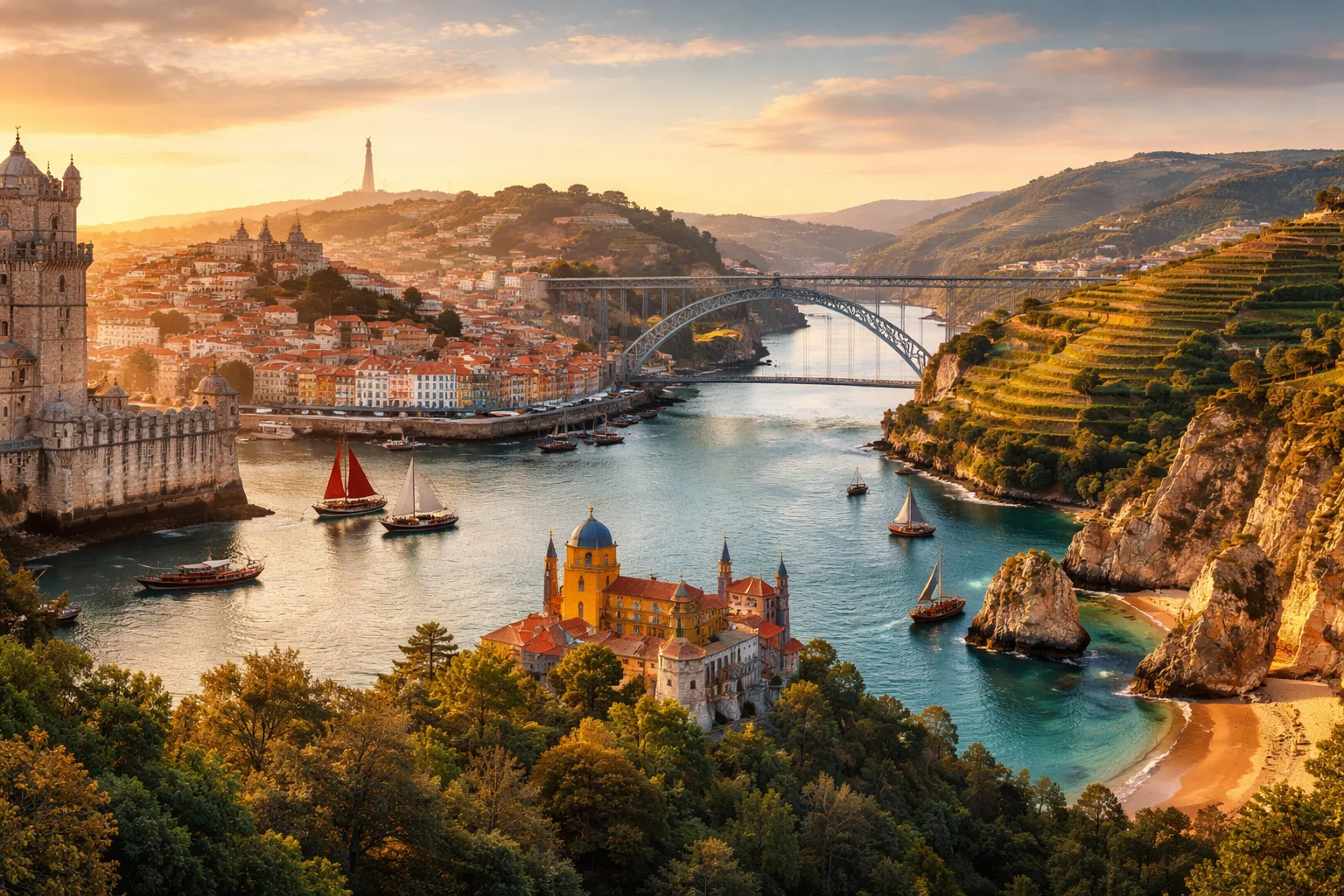
Portugal overview
Portugal is a sovereign country on the Iberian Peninsula in southwestern Europe. Its capital is Lisbon. Portugal has a compact mainland and two autonomous Atlantic archipelagos, the Azores and Madeira. It has one of Europe’s oldest continuous national identities, with modern borders largely fixed since the 13th century. Its maritime history connected Europe, Africa, Asia and the Americas, while the Portuguese language functions as a transcontinental bridge across the Lusophone world.
Common Geography Questions About Portugal
Where Portugal is located
Portugal is located at the western edge of continental Europe, on the Iberian Peninsula in southwestern Europe, facing the Atlantic Ocean. It shares a land border with Spain to the north and east. Lisbon, Portugal’s capital, lies near 38.7°N, 9.1°W. Portugal also administers the Azores and Madeira archipelagos in the North Atlantic; the Azores lie roughly 1,400–1,600 km west of the mainland and sit astride the Mid-Atlantic Ridge.
Geography and landscape of Portugal
Portugal’s mainland terrain ranges from the low coastal plains of the Algarve to northern granite ranges; Serra da Estrela is the highest point at 1,993 metres and supports the country’s only notable alpine plateau and small ski area. Major rivers—the Tagus (Tejo), Douro and Guadiana—shape agricultural valleys, while the Douro Valley is a steep, terraced wine landscape. The westernmost point of continental Europe, Cabo da Roca, marks Portugal’s Atlantic exposure. Climatic zones are chiefly Atlantic and Mediterranean, with pronounced north–south contrasts and a volcanic substrate for the Azores and Madeira.
Portugal culture and society
Portuguese is the national language, while Mirandese is officially recognized in a small northeastern pocket—an uncommon bilingual arrangement unique to this country. Roman Catholicism historically frames many public festivals (Santos populares in June), yet daily practices reflect secular trends and vibrant regional folk traditions. Fado, a melancholic urban song tradition from Lisbon and Coimbra, is emblematic and protected as intangible cultural heritage. Demographically, the population shows an aging profile and a long history of emigration; decades of diaspora communities have produced strong transnational cultural ties in Brazil, France and North America.
History of Portugal
Portugal’s history moves from pre-Roman Iberian tribes through Roman and Visigothic rule into Islamic al-Andalus control and a Christian Reconquista that produced a distinct county-turned-kingdom in the 12th century. Maritime exploration in the 15th and 16th centuries established a global empire—from Brazil to trading posts in Asia—and pioneered navigational techniques and cartography. After a dynastic union with Spain in the 16th–17th century and later political oscillations, a 20th-century authoritarian regime fell in the largely bloodless Carnation Revolution of 1974, a pivotal event that precipitated rapid decolonization of Portuguese Africa and reshaped national identity.
Portugal economy and government
Portugal is a unitary state with a semi-presidential parliamentary system: a directly elected president shares executive space with a prime minister accountable to parliament. Two autonomous regions—Madeira and the Azores—have their own regional governments and legislative assemblies, a constitutional arrangement that is central to national governance. The economy mixes services (notably tourism), manufacturing (auto components, electronics), and specialized exports such as cork and cork products—Portugal supplies a substantial share of global cork. The currency is the euro; economic policy is shaped by European Union membership and integration into continental markets.
Regions and major cities of Portugal
Administratively, mainland Portugal is divided into 18 districts, supplemented by the two autonomous regions offshore. Portugal’s capital is Lisbon, the country’s political and economic hub located on the Tagus estuary. Porto, in the north, anchors the Douro wine region and a historic commercial corridor; Faro serves as the Algarve’s service and tourism centre. Other regional nodes include Coimbra with its historic university tradition and Ponta Delgada as the Azores’ main urban centre—each city reflects distinct regional economies, climates and cultural histories within Portugal.
Distinctive characteristics of Portugal
Portugal is widely associated with Age-of-Discovery-era maritime innovations (the caravel and early cartography) that reshaped global trade routes. The Portuguese language links multiple continents: Brazil, Lusophone Africa, East Timor and other members of the Community of Portuguese Language Countries (CPLP) reflect that reach. Portugal is internationally recognized for Port wine production in the Douro demarcated region and for Fado music as UNESCO-recognized heritage. Other concrete signatures include Lisbon’s azulejo tilework and the country’s status as a leading global producer of cork, both cultural and economic specializations tied uniquely to Portugal.
Places in Portugal
Alfama
Alfama is a historic district in Portugal located within the municipality of Lisbon. It occupies the eastern slope of São Jorge hill and extends down to the Tagus River, and it contains landmark monuments such as São Jorge Castle and Lisbon Cathedral. The district forms a dense, surviving medieval street network that serves as a formally recognized part of Lisbon’s urban core. Alfama’s significance rests on its continuous urban fabric, built heritage, and long civic role in the city’s maritime and social history.
Bairro Alto
Bairro Alto is a district of Lisbon, Portugal, formally situated within the municipal parish of Misericórdia. It is significant as a historic urban quarter that functions as a preserved residential and cultural nucleus inside Lisbon’s central core. The district is formally defined within Lisbon’s municipal boundaries and occupies a compact plateau and hillside block, with its core commonly cited at approximately 38.714°N, 9.144°W within the city’s urban grid.
Belem
Belem is a district (freguesia) of the municipality of Lisbon in Portugal. It occupies a riverfront sector on the northern bank of the Tagus estuary and holds formal status as an administrative parish within Lisbon’s municipal organisation. The area contains a concentrated set of nationally designated monuments and state museum collections that define its institutional role within Portugal’s cultural heritage framework. Its administrative designation and waterfront position are formal, measurable facts in municipal records.
Benagil Beach
Benagil Beach is a coastal sandy shore in Portugal located within the municipality of Lagoa on the Algarve coast. The place is notable for an adjacent sea cave system, commonly called the Benagil Cave, that communicates with a small interior sandy pocket. Benagil Beach occupies a narrow coastal embayment bounded by karstified limestone cliffs and forms part of the Algarve’s documented coastal geomorphology and regional shoreline inventory.
Calouste Gulbenkian Museum
Calouste Gulbenkian Museum is a museum in Portugal that preserves the private art collection assembled by Calouste Gulbenkian. The institution is located in Lisbon and is formally operated by the Calouste Gulbenkian Foundation as a permanent museum and research collection. Its mission centers on long-term conservation and public study of the collector’s holdings, and the museum occupies dedicated exhibition pavilions within a foundation cultural campus.
Chiado
Chiado is a central urban district in Lisbon, Portugal, noted for its civic and cultural concentration. It forms part of the municipality of Lisbon and spans sections of the civil parishes Santa Maria Maior and Misericórdia, a formally defined administrative fact used in municipal planning. The district functions as a compact urban nucleus where municipal cultural facilities, shops, and literary institutions cluster within a few contiguous streets.
Douro Valley
Douro Valley is a river valley and an internationally recognized wine-producing landscape in northern Portugal. It occupies a central portion of the Douro River corridor and is significant for its terraced vineyards and long-established viticulture. The Douro Valley UNESCO cultural landscape covers approximately 24,600 hectares, providing a measurable boundary for heritage protection. This place is important for its combined agricultural systems, historical estates, and distinctive human-transformed terrain.
Lisbon
Lisbon is the capital of Portugal, located on the country’s western coast on the northern bank of the Tagus River estuary, where it meets the Atlantic Ocean. Portugal’s principal political, economic, and cultural center, Lisbon has approximately 545,000 residents in the municipality and about 2.8 million people across its metropolitan area. Its national institutions and maritime history underpin its significance within Portugal and global maritime heritage.
Lisbon Zoo
Lisbon Zoo is a zoological garden in Portugal. It is sited within the city of Lisbon and is formally known in Portuguese as Jardim Zoológico de Lisboa, with the Jardim Zoológico metro station located at the park entrance. The institution functions as a curated urban collection of animals and cultivated plants and maintains permanent built enclosures, veterinary facilities, and purpose-designed circulation infrastructure on its grounds.
MAAT
MAAT is a museum in Portugal focused on art, architecture and technology and operated by Fundação EDP. It occupies a purpose-built riverside institution in Lisbon, formally presenting temporary and project-based exhibitions alongside research and commissioning activities. The museum functions as a cultural platform linking contemporary visual practice with architectural inquiry, and its organizational status under Fundação EDP is a defined institutional fact that shapes its programming and partnerships.
Madeira
Madeira is an archipelago and autonomous region of Portugal in the North Atlantic Ocean, with the main island covering about 741 square kilometres. It is significant for its volcanic landscapes, endemic laurel forests, and a maritime history that influenced Atlantic navigation and trade. The geographic location supports high biodiversity and unique ecosystems, while regional governance provides formal administrative status within the Portuguese Republic.
National Coach Museum
National Coach Museum is a national museum in Lisbon, Portugal, that preserves and exhibits a historic collection of ceremonial and state carriages originating in the Portuguese royal holdings. The institution functions as a state-run cultural repository with purpose-built exhibition space in the Belém district and an institutional mandate for conservation, research, and public curation of material linked to Portugal’s monarchical ceremonial history. The museum’s formal status as a national museum anchors its conservation priorities.
Explore Natural Landmarks in Portugal
Browse islands and mountains connected with Portugal to keep exploring related geography clusters.