Poland Guide
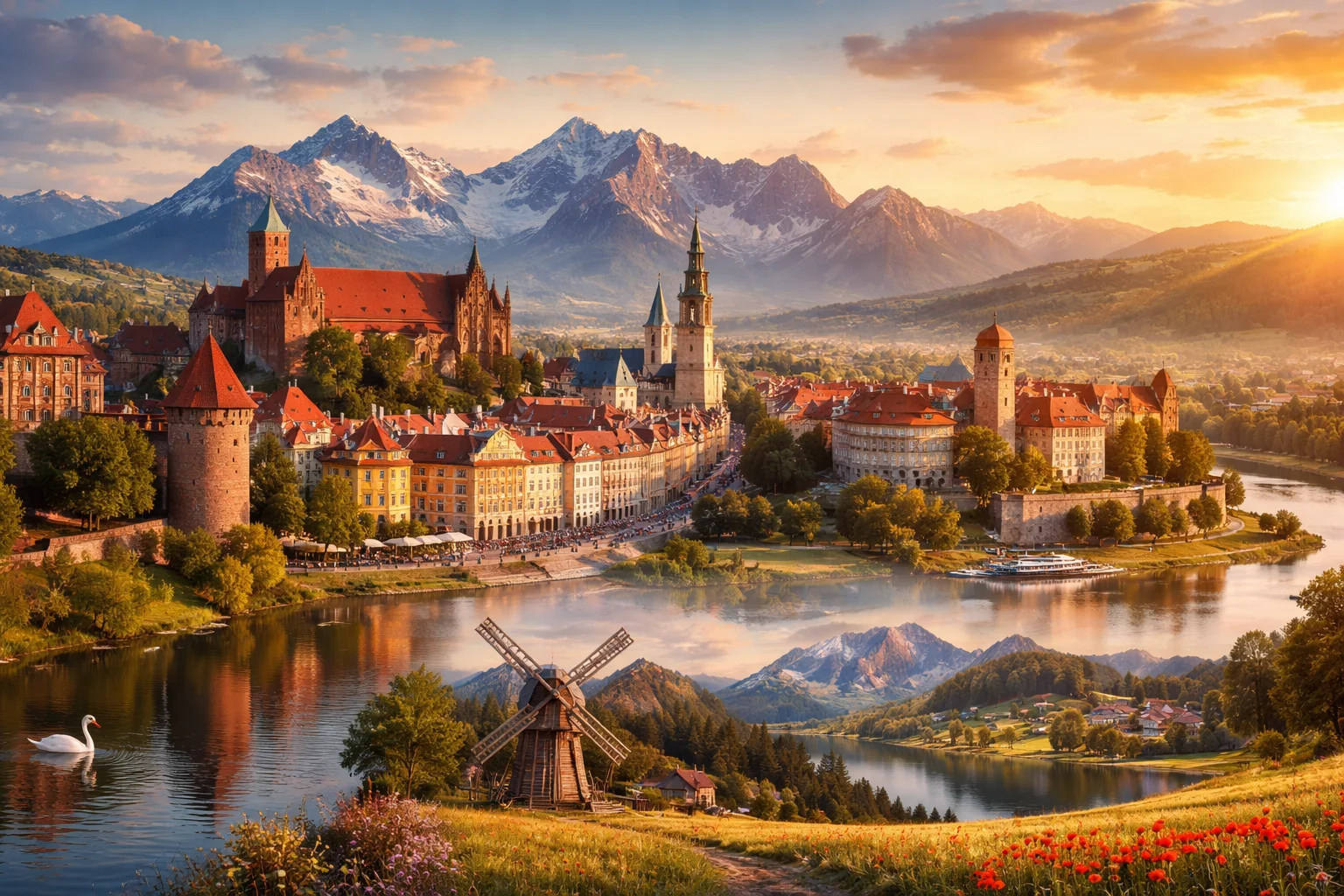
Poland overview
Poland is a Central European country located between the Baltic Sea and the continental interior, historically acting as a corridor between Western and Eastern Europe. It is notable for its role in the Polish–Lithuanian Commonwealth, which shaped regional political institutions, and for a landscape that ranges from glacial lakes to the Tatra alpine zone. Poland’s significance derives from a layered cultural heritage, regional languages like Kashubian, and institutions—such as the Sejm—that reflect a long parliamentary tradition and influence the country's modern identity.
Common Geography Questions About Poland
Where Poland is located
Poland sits in Central Europe at roughly 49°–55° N latitude and 14°–24° E longitude, framing a transit area between Scandinavia and the Black Sea basin. It borders Germany to the west, the Czech Republic and Slovakia to the south, Ukraine and Belarus to the east, and Lithuania plus the Russian exclave of Kaliningrad Oblast to the northeast. Poland’s northern coast faces the Baltic Sea; the shallow Gulf of Gdańsk and the Hel Peninsula are defining maritime features that concentrate ports and distinct coastal microclimates. These shores connect Poland to the Baltic maritime economy and seasonal seaside traditions.
Geography and landscape of Poland
Poland’s geography is stratified: a glaciated northern plain with moraine hills, a central band of river valleys and uplands, and southern mountain ranges. The Vistula (Wisła) flows north to the Baltic and structures transport and settlement patterns, while the Oder (Odra) defines part of the western frontier. Unusually for Europe, Poland contains the Białowieża Forest, a surviving primeval lowland woodland home to free-ranging European bison, and the Masurian Lake District with thousands of interconnected glacial lakes. In the south the Tatra Mountains form Poland’s only high-alpine environment, with peaks like Rysy shared on the Slovak border, and amber-bearing dunes fringe the Baltic coast.
Poland culture and society
Poland’s dominant language is Polish; Kashubian holds protected regional status and appears on public signage in parts of Pomerania, a legal recognition that is relatively rare for a small regional language. Roman Catholicism shapes many public rituals with the national shrine at Jasna Góra in Częstochowa and the Black Madonna icon as focal points for pilgrimage. Distinctive social customs include the Christmas Eve opłatek wafer blessing and name-day (imieniny) celebrations. Ethnic minorities—German, Belarusian, Ukrainian, Lithuanian and Roma—contribute localized traditions, while urban cultural life preserves music, theater and a university tradition centered on institutions such as the Jagiellonian University in Kraków.
History of Poland
Poland’s recorded past opens with the Piast rulers and the baptism of Mieszko I in 966, which integrated the Polans into medieval Christendom. The Polish–Lithuanian Commonwealth developed a unique elective monarchy and parliamentary Sejm that made the state a major European actor in the 16th–17th centuries. The late-18th-century partitions by Russia, Prussia and Austria erased Poland from the map until 1918. The 20th century brought invasion and occupation in World War II, the Warsaw Uprising’s urban resistance, and subsequent decades under a Soviet-aligned communist government. The Solidarity movement, rooted in Polish shipyards, precipitated negotiated political change and the re-establishment of democratic institutions.
Poland economy and government
Poland is a parliamentary republic with a directly elected president as head of state, a prime minister who leads government, and a bicameral legislature comprising the Sejm (lower house) and the Senate. The Sejm’s institutional name is a distinctive continuity from the early modern Commonwealth. Economically, Poland blends heavy industry—historic coal mining concentrated in the Upper Silesian Basin and shipbuilding traditions along the Baltic—with modern manufacturing such as automotive assembly and machinery. The national currency is the złoty. Agriculture supplies notable exports like apples and processed foods, while information technology and business services have expanded in Warsaw and regional hubs, complementing a vigorous small- and medium-enterprise sector.
Regions and major cities of Poland
Poland is administratively divided into 16 voivodeships (województwa), a structure combining centrally appointed voivodes with elected regional assemblies (sejmiki) established in post-communist reforms. Historic regions remain salient: Greater Poland (Wielkopolska) around Poznań marks the Piast origin of the state; Lesser Poland (Małopolska) with Kraków retains cultural prominence; Silesia’s industrial profile reflects layered Polish–German–Czech influences; and Kashubia preserves a distinct linguistic identity. The capital, Warsaw, is the political and economic center; Kraków functions as a cultural and academic locus; Gdańsk anchors the Baltic port complex. Other major cities include Wrocław and Łódź, known respectively for their academic clusters and industrial heritage.
Distinctive characteristics of Poland
Poland’s recognitions are concrete and specific: Nicolaus Copernicus of Toruń revolutionized astronomy, Frédéric Chopin’s piano legacy draws on Polish folk forms, and Marie Skłodowska-Curie, born in Warsaw, isolated polonium—her name linking science to the country. In cryptology, Polish mathematicians reconstructed the German Enigma machine before World War II, a critical technical achievement in intelligence history. The Solidarity movement and the election of Pope John Paul II are political-cultural associations with global resonance. Material and cultural exports—Baltic amber craftsmanship, pierogi and kielbasa, and a strong mathematical tradition from the Lwów school—further define Poland’s international profile.
Places in Poland
Auschwitz-Birkenau
Near Oświęcim in southern Poland, Auschwitz-Birkenau was a World War II concentration and extermination complex. Its camp network combined detention, forced labor, and industrialized killing, with multiple subcamps originally extending across approximately 40 square kilometers. The scale of the mass murder, together with the documentary and material evidence preserved at the site, keeps Auschwitz-Birkenau central to memory and scholarship.
Auschwitz-Birkenau Memorial and Museum
Auschwitz-Birkenau Memorial and Museum is a museum institution in Poland that preserves the physical remains and documentary record of the Auschwitz complex. It comprises the former concentration and extermination camps commonly identified as Auschwitz I and Auschwitz II‑Birkenau, retained as core collections of built fabric, artifacts, and archives. The institution functions as a state museum and memorial with a mandate for conservation, research, and documentation of crimes that took place on the site. The campus contains extant camp infrastructure and curated archival holdings.
Gdańsk
Gdańsk is a city on the Baltic coast of northern Poland and the capital of the Pomeranian Voivodeship. It is an important Polish seaport and regional administrative centre with a population of about 470,000 inhabitants. The city combines a historic medieval core with extensive postwar reconstruction and industrial waterfront facilities. Gdańsk is significant for its long mercantile tradition, maritime economy, and role in modern European political history.
Gdansk Zoo
Gdansk Zoo is a zoological garden in Poland, formally known in Polish as Ogród Zoologiczny w Gdańsku. The institution is located within the municipal boundaries of the city of Gdańsk and functions as that city’s public zoological collection and managed landscape. The zoo is a formally designated urban zoological institution under municipal oversight, maintaining purpose-built enclosures and curated habitats as part of the city’s cultural and scientific infrastructure.
Jagiellonian University
Jagiellonian University is a public research university in Poland with an institutional foundation traced to a royal charter in 1364. The university's central historic campus lies in Kraków's medieval core at approximately 50.06°N, 19.94°E and functions as a national centre for higher education, archival collections, and scholarly research. Governed by a rector and senate, Jagiellonian University operates university museums and the Jagiellonian Library, holdings that provide measurable material evidence of its long institutional continuity. The preserved Collegium Maius and documented founding year constitute concrete, verifiable markers of the institution's historical identity.
Kazimierz
Kazimierz is a historic district of Kraków in Poland. It occupies a peninsula bounded on three sides by channels of the Vistula River and holds formal status as one of Kraków’s municipal districts. The district is significant for its layered civic history as an independent medieval town later integrated into Kraków, and for preserving a compact ensemble of Jewish religious sites and a distinctive 19th-century market square known locally as Plac Nowy.
National Museum in Warsaw
National Museum in Warsaw is a national museum in Poland that serves as a principal state institution for art collections and research. The museum holds formal status as a national museum and maintains a permanent collection spanning antiquities, European and Polish painting, sculpture, and applied arts. Its primary building functions as a centralized repository and exhibition campus with institutional conservation and research capacities defined by its mandate to preserve national cultural heritage.
Orientarium Zoo Lodz
Orientarium Zoo Lodz is a purpose-built tropical and aquatic pavilion affiliated with the municipal Łódź Zoo in Poland. It serves as the zoo’s centralized indoor facility for Asian and aquatic ecosystems and is a formal unit within the zoo’s institutional collection and stewardship framework. The complex contains integrated aquarium and terrestrial exhibition spaces under a single controlled envelope, and it is administered by the city’s zoo authority as part of the institution’s long-term species management responsibilities.
POLIN Museum
POLIN Museum is a museum in Poland dedicated to the history of Polish Jews. It occupies a purpose-built cultural institution on the site of the former Warsaw Ghetto and presents a permanent core exhibition that traces Jewish presence in the territory of present-day Poland through archaeological material, archival holdings, and multimedia installations. The museum functions as a research and public-history institution with conservation facilities and a multi-level exhibition route designed for long-term collection care and interpretation.
Poznan Zoo
Poznan Zoo is a municipal zoological garden in Poznań, Poland. It is located within the city of Poznań, the capital of the Greater Poland Voivodeship, and holds formal status as the city-operated zoological institution responsible for curated living collections and public scientific outreach. The site functions as a managed landscape combining animal enclosures, specialist pavilions, and municipal parkland under an institutional mandate for animal husbandry, collection documentation, and conservation-oriented display.
Praga
Praga is a district of Warsaw, Poland, situated on the right bank of the Vistula River and forming the capital's eastern borough. It is officially part of Warsaw's municipal structure and contains continuous urban neighborhoods and industrial zones recognized in the city's planning documents. The district is notable for a measurable physical fact: its urban core occupies the Vistula's eastern river terrace directly across from the city's central borough, a position that shaped its development and transport roles.
Schindler's Factory Museum
Schindler's Factory Museum is a museum in Poland located in the former enamel factory of Oskar Schindler in Kraków. The institution occupies the original factory complex on Lipowa Street in the Podgórze district, and it functions as a municipal museum branch presenting the history of Kraków under German occupation. The museum includes permanent exhibitions installed within the factory's administration building and workshop halls, and it is part of the Historical Museum of the City of Kraków's institutional network.