Philippines Guide
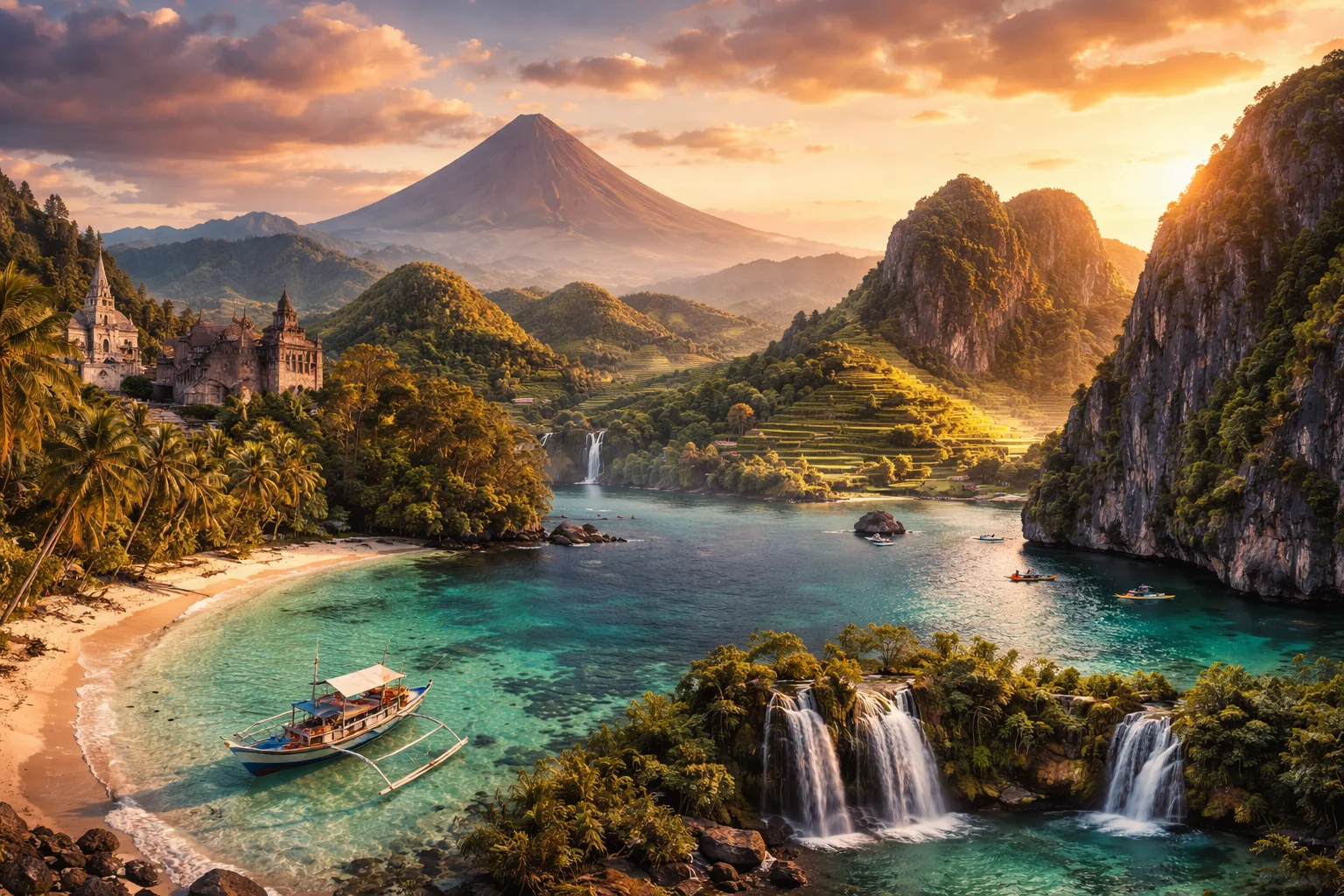
Philippines overview
Philippines is an archipelagic sovereign state in Southeast Asia composed of roughly 7,600 islands stretching across the western Pacific Ocean. It serves as a maritime and cultural bridge between East Asia and Oceania, shaped by Austronesian settlement, centuries of Spanish and American rule, and intense modern connections to global labor markets. The country’s character combines tropical biodiversity—from coral atolls to mountain terraces—with distinctive social institutions such as the barangay village system and an outsized overseas workforce that links local households to global economies.
Common Geography Questions About Philippines
Prepaid mobile data
Mobile data costs in Philippines
Globe's Go+99 open-access data lists 8 GB for ₱99.00 over 7 days. The derived unit cost is ₱12.38 per GB.
Where Philippines is located
The Philippines lies in maritime Southeast Asia between about 4° and 21° north latitude and 116° to 127° east longitude. It has no contiguous land border; instead it shares maritime boundaries with Taiwan to the north, Vietnam to the west, Palau and the Federated States of Micronesia to the east, and Indonesia and Malaysia to the south. Major surrounding seas—the South China Sea, Philippine Sea, Sulu Sea and Celebes Sea—frame its coastlines. That insular setting places the Philippines astride major Pacific shipping lanes and within the typhoon corridor of the western Pacific.
Geography and landscape of Philippines
Topographically the Philippines ranges from low-lying coral atolls to high volcanic peaks: Mount Apo on Mindanao is the highest point, while the Sierra Madre and the Cordillera Central form the major ranges on Luzon. The archipelago sits on the Pacific Ring of Fire, producing active volcanoes such as Mayon and the volcanic island inside Taal Lake—a volcano-on-an-island-in-a-lake phenomenon unusual worldwide. Rivers like the Cagayan traverse fertile basins, and coastal mangrove belts and fringing reefs place much of the country inside the Coral Triangle, a global marine biodiversity hotspot with major regional variation between the mountainous north, the central Visayan islands, and the more plateaued southern islands.
Philippines culture and society
Philippine society fuses Austronesian foundations with Hispanic, American and indigenous influences. Filipino (based on Tagalog) and English are official languages; dozens of regional tongues such as Cebuano, Ilocano and Hiligaynon remain primary in daily life. Roman Catholicism predominates broadly, while Islam has deep roots in the Bangsamoro communities of Mindanao—an internal religious geography that shapes political autonomy arrangements. Distinctive social customs include patron-saint fiestas that organize municipal calendars, jeepneys repurposed from U.S. military vehicles as cultural icons, and a legal legacy (the Clavería surname decree of 1849) that produced the unusually widespread use of Spanish surnames.
History of Philippines
Philippine history is a layered narrative of maritime polities, colonial integration into global trade, and twentieth-century nation-building. Precolonial barangays and sultanates engaged in regional commerce long before Spanish arrival in 1521; Spanish colonization (from 1565) inserted the islands into the Manila–Acapulco galleon trade, making Manila a transpacific entrepôt. Control passed to the United States after 1898, then the archipelago endured Japanese occupation during World War II before full independence in 1946. Postwar decades saw rapid social change, authoritarian rule in the 1970s and a mass nonviolent mobilization in 1986 that became a widely cited example of civilian-driven political transition.
Philippines economy and government
The Philippines is a unitary presidential republic with a bicameral Congress; local governance rests on provinces, cities and barangays—the latter a precolonial unit formalized in modern law. The economy is service-dominated, with business process outsourcing and tourism major earners alongside electronic exports and agricultural commodities like coconuts and bananas. A distinctive structural feature is the large number of overseas Filipino workers whose remittances support consumption and investment at home. The national currency is the Philippine peso (PHP), and geography imposes higher logistics costs and regional disparities across the archipelago, while the Bangsamoro Autonomous Region represents a formal political accommodation to a distinct Muslim-majority area.
Regions and major cities of Philippines
Administratively the country groups its territory into three principal island clusters—Luzon, Visayas and Mindanao—and multiple government regions including the National Capital Region and the Bangsamoro Autonomous Region. The capital, Manila, anchors Metro Manila, a dense urban conurbation that functions as the political and commercial core. Other major cities include Quezon City (a large residential and administrative center within Metro Manila), Cebu City (the historic Spanish-era port and contemporary economic hub of the Visayas), and Davao City (a vast local administrative area on Mindanao near Mount Apo). Regional identities—Ilocano, Visayan, Mindanaoan and others—remain salient in language and local governance.
Distinctive characteristics of Philippines
The Philippines is widely associated with specific global roles and cultural markers: it contains UNESCO-recognized sites such as the Banaue Rice Terraces and the Puerto Princesa Subterranean River, far-reaching marine assets in the Tubbataha Reefs and Coral Triangle, and endemic wildlife like the Philippine eagle. Globally, Filipinos are notably prominent as maritime seafarers and as healthcare and IT professionals abroad—patterns that shape remittance-driven household economies. Cultural exports include a strong popular-music and entertainment sector and visible traditions such as jeepneys and communal fiestas; its flag is among a few national flags designed to be flown inverted as a public symbol of wartime status.
Places in Philippines
Ateneo de Manila University
Ateneo de Manila University is a private Catholic research university in the Philippines administered by the Society of Jesus. The institution’s principal campus is located in Loyola Heights, Quezon City, serving as its long-standing academic, cultural, and administrative center. Founded in 1859 as a Jesuit school in Manila, Ateneo de Manila University maintains formal status as a university with graduate and undergraduate units and preserves named facilities such as the Rizal Library and the Ateneo Art Gallery. The university operates under a board of trustees appointed by the Jesuit province.
Avilon Zoo
Avilon Zoo is a privately operated zoological park in the Philippines, located in the municipality of Rodriguez, Rizal. It functions as a curated animal collection and managed landscape with formal animal-husbandry facilities and exhibit structures. The site occupies developed grounds within a municipal jurisdiction east of Metro Manila and is organized into distinct exhibit zones, including large aviaries and freshwater display halls that house long-term collections maintained under institutional care. Avilon Zoo is a noted institutional repository for captive tropical fauna.
Banaue Rice Terraces
The Banaue Rice Terraces are stepped rice paddies carved into mountain slopes in Ifugao province, Philippines. Built and maintained by indigenous Ifugao communities, they sustain traditional wet-rice agriculture within a cultural landscape shaped by communal labor and engineering. The terraces form part of the Rice Terraces of the Philippine Cordilleras on the UNESCO World Heritage list.
Binondo
Binondo is a district of the City of Manila in the Philippines. It sits on the north bank of the Pasig River and historically served as the city’s principal Chinese commercial quarter under Spanish colonial policy. The area includes a major parish church associated with the local community and functions as an administrative district within Manila’s municipal governance. Binondo combines formal municipal status, a defined riverine boundary, and an established commercial identity within the capital’s urban fabric.
Boracay
Boracay is a small island in the central Philippines and a nationally prominent coastal place noted for its beaches and marine environments. It is part of the municipality of Malay in Aklan province and covers about 10.32 square kilometers. Boracay’s significance derives from its concentrated coastal ecosystems, substantial tourism-driven economy, and its role in national environmental policy debates. The island’s compact area combined with intensive human use makes it a measurable case study for coastal management and policy analysis.
Chocolate Hills
The Chocolate Hills form a distinctive karst landscape in Bohol, Philippines. Roughly fifty square kilometers contain an estimated 1,260 to 1,776 conical limestone hillocks, notable for their remarkably consistent shapes. Their scale, geology, and cultural prominence make the hills an important reference point in Philippine geomorphology.
El Nido
El Nido is a municipality in the province of Palawan in the Philippines, defined by an archipelago of about 45 islands and islets clustered around Bacuit Bay. It is notable for steep limestone karst formations and extensive coastal marine habitats that support diverse coral reefs. The municipal seat serves as the administrative center for communities that rely on fishing and small-scale agriculture across both mainland and island barangays.
El Nido Beach
El Nido Beach is a coastal beach in the municipality of El Nido, on the island province of Palawan in the Philippines. It occupies the shoreline immediately fronting the town center and is formally within the municipal jurisdiction of El Nido. The beach directly bounds Bacuit Bay and functions as the principal municipal shoreline where local boat landings and a small pier are located, establishing its measurable role in town coastal infrastructure.
Intramuros
Intramuros is a historic walled district in the City of Manila, Philippines. It is the fortified core of Manila established under Spanish colonial rule and serves as a formal municipal district with an institutional body responsible for its administration. The district is defined by surviving stone ramparts and gated bastions that enclose a compact urban precinct containing churches, plazas, and government buildings that represent its civic and colonial functions.
Kawasan Falls
Kawasan Falls is a multi-tiered waterfall in the Philippines located on the island province of Cebu. The site is notable as a three-tier cascade carved into limestone, with distinct plunge pools formed by sustained river incision and carbonate bedrock erosion, giving Kawasan Falls measurable vertical steps and basin morphology that have been the focus of regional geomorphological descriptions and hydrological observations.
Manila
Manila, the capital and primary political center of the Philippines, is located on Luzon within the National Capital Region, commonly known as Metro Manila. The city serves as the seat of national government and as a center for commerce, culture, and education. Across its 42.88-square-kilometer municipal area, dense urban development surrounds national institutions, cultural resources, and places connected to Manila’s history of regional trade.
Manila Zoo
Manila Zoo is the municipal zoological and botanical garden located in the Philippines. It is formally titled the Manila Zoological and Botanical Garden and functions as the City of Manila’s urban zoo and plant collection within the capital’s park system. The facility is a public institution administered for animal display, horticultural management, and educational programming under municipal authority. The site combines living animal collections with designed botanical beds and mature shade trees.
Explore Natural Landmarks in Philippines
Browse islands and mountains connected with Philippines to keep exploring related geography clusters.