Peru Guide
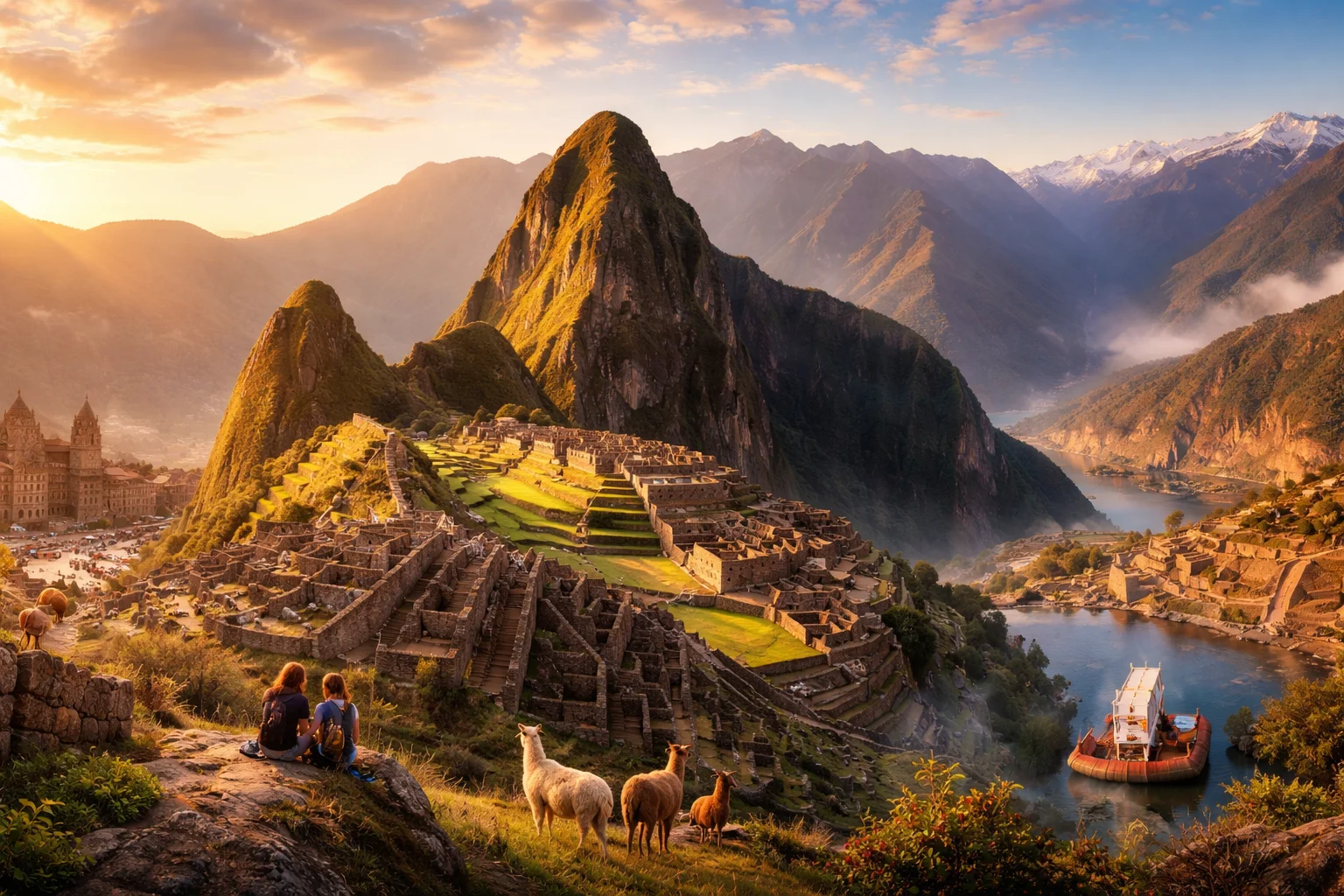
Peru overview
Peru is a unitary state on the western edge of South America that was the heartland of the Inca Empire and remains a locus of Andean-Amazonian-Pacific contrasts. It combines an arid Pacific coast, the high glaciated peaks of the Andes, and vast Amazonian lowlands, plus world-famous archaeological sites such as Machu Picchu. Peru’s significance derives from its role in pre-Columbian civilizations, its exceptional biological and cultural diversity, and its mineral-rich economy that links Andean mining to global commodity markets.
Common Geography Questions About Peru
Where Peru is located
Peru sits on the western flank of South America between roughly 0° and 18° south latitude and 68° to 81° west longitude. It borders Ecuador and Colombia to the north, Brazil to the east, Bolivia to the southeast and Chile to the south, with over 2,400 km of Pacific coastline to the west. The country’s location is defined by the convergence of the Pacific Ocean and the continental Andes, and the Amazon basin’s headwaters—two major rivers, the Marañón and the Ucayali, join inside Peru to form the Amazon River.
Geography and landscape of Peru
Peru’s geography ranges from the nearly rainless coastal strip influenced by the cold Humboldt Current to the Cordillera Blanca and Cordillera Central of the Andes, where Huascarán reaches 6,768 meters and supports tropical alpine glaciers. Inland lies the Peruvian Amazon, a biologically rich portion of the Amazon basin characterized by oxbow lakes and seasonally flooded varzea forests. Distinctive features include the Sechura Desert and the Nazca Lines etched into coastal pampas; the country’s geography produces steep altitudinal zoning that shapes agriculture and settlement patterns uniquely in Peru.
Peru culture and society
Peru’s culture is a multilingual mix: Spanish is dominant nationally, while Quechua and Aymara hold official status in areas where they predominate, alongside scores of Amazonian languages. Social life often combines Catholic calendar rites with Andean reciprocity practices such as ayni (mutual labor) and communal land traditions. Peru’s demographic profile includes a large mestizo population and one of Latin America’s highest proportions of self-identified indigenous people, which helps sustain living indigenous languages and ceremonial systems in the highlands and jungle communities.
History of Peru
Peru’s human history stretches from the early urban settlements of Norte Chico (Caral) through regional states such as Chavín and Wari to the consolidated Inca Empire centered in Cusco. The arrival of Spanish conquistadors led by Francisco Pizarro reshaped the territory into the Viceroyalty of Peru, a colonial administrative and economic hub for Pacific and Atlantic flows. Independence, forged by figures like José de San Martín and Simón Bolívar, ushered in a republican era; later centuries saw transformative shifts from hacienda economies to mineral exportism and the rediscovery of Inca sites such as Machu Picchu, which reframed global perceptions of Andean history.
Peru economy and government
Peru is a presidential republic with a single national legislature, the Congress of the Republic, and an executive president who serves as head of state and government. The economy is structurally linked to mineral exports—Peruvian mines supply significant quantities of copper, gold and silver—while fisheries (anchoveta fishmeal), agriculture (notably potatoes and quinoa), and tourism around archaeological sites are major foreign-exchange earners. The national currency is the sol. Peru’s economic profile combines high-value extractive sectors with informal urban labor and regionally distinct agricultural systems.
Regions and major cities of Peru
Administratively Peru is divided into 25 regions (including the Constitutional Province of Callao) and the special Lima and Callao provinces. The country is commonly discussed in three geographic-cultural zones: the coastal Costa, the Andean Sierra, and the Amazonian Selva. Lima is the capital and primary economic center; Cusco functions as the historic Inca capital and gateway for archaeology-focused travel; Arequipa anchors a southern volcanic highland economy. Trujillo and Iquitos illustrate coastal urban and deep-Amazonian urban forms respectively, demonstrating Peru’s city-level diversity.
Distinctive characteristics of Peru
Peru is globally associated with Inca heritage and Machu Picchu, the Nazca Lines’ geoglyphs, and the Peruvian Amazon’s biodiversity hotspots such as Manu National Park. It is a primary center of potato domestication, preserving thousands of native potato varieties and unique tuber genetics. Peru’s anchoveta fishery and mineral-export infrastructure link it to global commodity chains, while its culinary reputation—ceviche and pisco among them—has placed Peruvian cuisine on the international stage. Alpaca and vicuña fiber production and preceramic sites like Caral further mark Peru’s distinct contributions.
Places in Peru
Barranco
Barranco is a district of Lima Province in Peru. It occupies a coastal, cliff-front area within the southern portion of Lima’s urban zone and served historically as a seaside resort before evolving into a concentrated cultural quarter. The district is an administrative unit governed by the Municipalidad Distrital de Barranco. This civic status, combined with defined municipal boundaries and registered public spaces, frames Barranco’s formal role within the Lima metropolitan administration.
Colca Canyon
Colca Canyon is a deep Andean canyon in southern Peru that forms part of the Colca River valley system. It is significant for its extreme vertical relief, with river-to-rim differences reaching about 3,270 meters at the canyon’s deepest measured points and an overall valley extent of roughly seventy kilometres. The canyon’s physical prominence, combined with continuous highland agriculture and exposed volcanic stratigraphy, defines its geographic and scientific importance in the Peruvian Andes.
Cotahuasi Canyon
Cotahuasi Canyon is a deep Andean canyon in southern Peru. The canyon lies within the La Unión Province of the Arequipa Region and attains a maximum measured vertical relief of roughly 3,535 meters between rim summits and the Cotahuasi River channel. Cotahuasi Canyon extends for tens of kilometres along a steep river incision and includes abrupt walls, high summits, and active fluvial terraces that together define its formal geomorphic significance.
Gocta Cataracts
Gocta Cataracts is a segmented waterfall in Peru’s Amazonas Region, on the eastern flank of the Andes. A mountain stream crosses a steep escarpment in distinct plunges separated by rock ledges before entering a forested gorge. These separate free-falling sections give the falls their sustained vertical profile.
Huachipa Zoo
Huachipa Zoo is a zoological park in Peru located within the Lima metropolitan area. It is situated on the eastern periphery of Lima and functions as a curated urban zoological collection for the region. The site contains purpose-built facilities, including an aviary and dedicated primate enclosures, that support captive collections of both Peruvian native species and commonly exhibited South American taxa. Institutional management maintains the park as a managed landscape for conservation and education.
Huascaran National Park
Huascaran National Park is a Peruvian national park that protects a central portion of the Cordillera Blanca in the Ancash region. The park contains tropical glaciers and a compact cluster of high peaks that rise above 6,000 meters, and it is recognized for both its glacial systems and high-Andean ecosystems. Its formal status as a national protected area and inscription on the UNESCO World Heritage List underline its conservation and scientific importance.
Larco Museum
Larco Museum is a private archaeological museum in Peru that houses a major assembled collection of pre-Columbian art. It is located in Lima and is formally organized into permanent galleries devoted to ceramics, textiles, metalwork and goldwork, with a named gallery for erotic ceramics. The institution operates as a collecting, research, and conservation entity and presents material culture from multiple Andean cultural traditions within purpose-built exhibition spaces and research facilities.
Lima
Lima, the capital of Peru, lies on the country's central western coast. It is the national political and economic center, houses government institutions, and reaches major maritime routes through adjacent Callao. The city covers about 2,672 square kilometers and anchors a metropolitan area of approximately nine million inhabitants. Its cultural landscape reflects pre-Columbian, colonial, and modern periods.
Lima Jorge Chavez International Airport
Lima Jorge Chavez International Airport is the principal international airport serving Lima, Peru. It functions as the country's main air gateway, combining international and domestic operations within a consolidated passenger terminal complex. The facility is formally named for Peruvian aviator Jorge Chávez and serves as the principal point of entry for scheduled international air services to the Lima metropolitan area. The site hosts a major passenger terminal, an air traffic control tower, and cargo-handling areas.
Machu Picchu
Machu Picchu is an Inca citadel located in the eastern Andes of southern Peru, notable for its archaeological conservation. The site occupies a mountaintop ridge at approximately 2,430 meters above sea level, with terraced agricultural platforms and masonry complexes. Machu Picchu's combination of location, history, significance, and distinctive features makes it a central subject of Andean archaeology. Scholarly study emphasizes its planned urban sectors, ritual structures, and complex water management engineering and practices.
Miraflores
Miraflores is a district of the Province of Lima in the Republic of Peru. It functions as an administrative district with its own municipal government, the Municipalidad de Miraflores, and occupies a formally defined jurisdiction on Lima's coastal edge. The district is notable for its coastal cliffs, a concentrated civic center with municipal institutions, and a mix of urban zones that include residential, commercial, and archaeological parcels within a compact urban footprint.
National Museum of Archaeology of Peru
National Museum of Archaeology of Peru is a state-designated national museum in Peru focused on the country's archaeological heritage. The institution serves as a formal repository for archaeological collections and research related to pre-Columbian cultures, and it holds publicly curated exhibition galleries and conservation facilities as part of its official mandate. The museum's status as a national museum is a measurable, formal designation within Peru's cultural governance framework.