Paraguay Guide
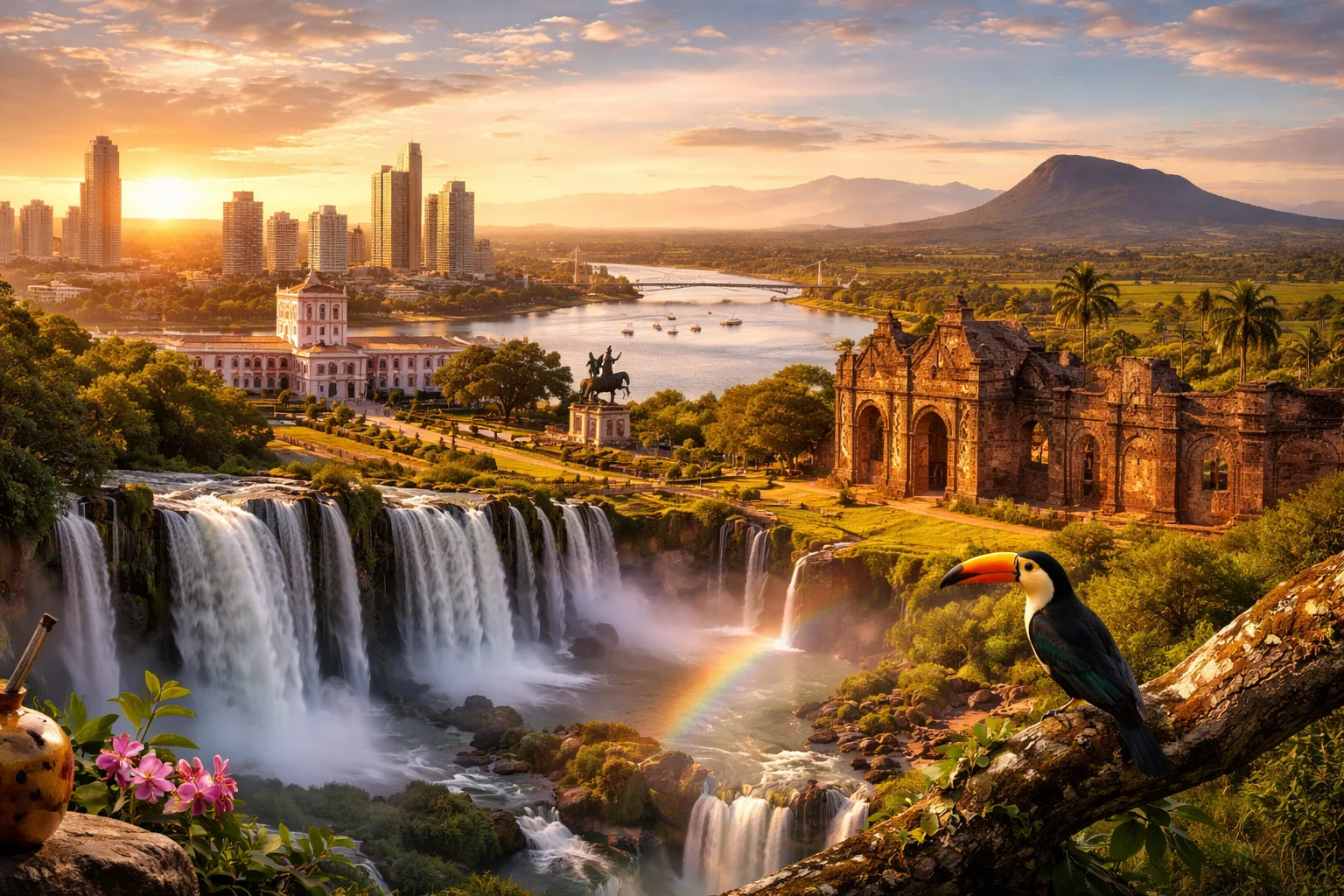
Paraguay overview
Paraguay is a landlocked republic at the physical and cultural interior of South America. The country occupies a narrow latitude band where subtropical lowlands meet semi-arid plains, producing sharp contrasts in ecology and settlement. Paraguay’s national life is shaped by intense bilingualism and a history that produced unusually autonomous rural communities and strong river-based transport despite the absence of a coastline. Small by continental standards, Paraguay punches above its size in regional energy production and in the persistence of indigenous-derived institutions in everyday life.
Common Geography Questions About Paraguay
Where Paraguay is located
Paraguay sits in central South America, roughly between about 19°S and 28°S latitude. It is bordered to the south and southwest by Argentina, to the east and southeast by Brazil, and to the northwest by Bolivia; those three neighbors together form Paraguay’s entire frontier. Although landlocked, Paraguay’s position astride the Paraguay and Paraná river basins gives it navigable links toward the Río de la Plata estuary and the Atlantic Ocean. The country therefore functions as an inland hub connecting the Río de la Plata watershed to interior South American plains in a way few other landlocked states do.
Geography and landscape of Paraguay
Paraguay divides sharply into two geographic halves: the eastern Paranaense region of rolling plateaus and humid forests, and the western Gran Chaco, a broad lowland of thorn scrub, dry savanna and seasonally flooded plains. Elevations are modest—Paraguay has no major mountain chains—and the highest summits are isolated hills rather than ranges. The western Chaco, unusually large relative to population, contains extensive quebracho timber stands and is one of the few South American interiors settled by distinct agricultural colonies adapted to aridity. Parts of Paraguay also reach into the Pantanal wetlands on the eastern fringe, creating an uncommon juxtaposition of semi-arid and wetland ecosystems inside a single national boundary.
Paraguay culture and society
Paraguayan culture is defined by persistent bilingual social life: Spanish and Guaraní coexist as everyday languages across social classes. Religious practice is predominantly Christian with strong local syncretic customs; communal drinking of tereré (cold yerba mate in an herb-infused infusion) functions as a social ritual that cuts across age and class in Paraguay specifically. The demographic profile features a majority mestizo population with significant indigenous linguistic retention; rural social organization often centers on family finca units and cooperative cattle ranching rather than large plantation estates typical elsewhere in South America.
History of Paraguay
Paraguay’s historical arc moves from pre-Columbian Guaraní settlement through a distinctive colonial outpost centered on Asunción, which acted as a launching point for inland missions and trade. After independence, Paraguay experienced a prolonged authoritarian isolation under early 19th-century leadership that deliberately limited immigration and commercial ties; that policy later contrasted sharply with rapid integration pressures following a devastating regional war in the 1860s that drastically reduced its population and reshaped its borders. The combination of early political seclusion and later traumatic loss left Paraguay with unusually concentrated state-building efforts and a strong emphasis on territorial consolidation.
Paraguay economy and government
Paraguay is governed as a presidential republican state with a bicameral legislature—an elected lower chamber and an upper chamber—and an independent judiciary. The Paraguayan economy combines intensive agriculture (notably cattle and oilseed crops) with an outsized role for electricity exports generated by large binational hydroelectric projects shared with neighbors. The national currency is the Paraguayan guaraní; fiscal structures reflect a mixture of formal export sectors and extensive informal commerce, especially in border urban corridors where cross-border trade shapes regional livelihoods.
Regions and major cities of Paraguay
Administratively, Paraguay is divided into seventeen departments plus a capital district. The capital, Asunción, is an early Spanish foundation that functions as the political and metropolitan center. Ciudad del Este, on the triple border with Brazil and Argentina, is a commercial hub whose cross-border markets and logistics networks are unusually dominant for a city of its size. Encarnación on the Paraná River serves as a cultural gateway to Argentina and hosts distinctive riverfront festivals; the country’s core settlement and infrastructure are concentrated in the eastern departments, while the western departments form a sparsely populated frontier.
Distinctive characteristics of Paraguay
Concrete features most commonly tied to Paraguay include the widespread use of the Guaraní language in official life and everyday speech, the cold social ritual of tereré, and a legacy of Jesuit-era mission sites that survive as unique colonial-era landmarks. Paraguay also has an outsized role in regional energy through jointly operated hydroelectric facilities that feed neighboring grids, and it is one of only two landlocked countries in South America—an attribute that has shaped its diplomacy and transport networks. Culinary items such as chipa (a cheese bread of indigenous origin) and the Paraguayan harp in folk music further provide internationally recognizable cultural markers.
Places in Paraguay
Asunción
Asunción is the capital city of Paraguay and the country's principal political and administrative center. It sits at approximately 43 meters above mean sea level, a measurable urban datum. The city's location on the Paraguay River explains much of its historical and economic significance. Asunción's urban features combine colonial-era public buildings with a modern government district and riverfront infrastructure.
Asuncion Zoo
Asuncion Zoo is a zoological and botanical institution in Paraguay, based in the national capital of Asunción. Its formal Spanish name is Jardín Zoológico y Botánico de Asunción, and it functions as the country’s principal curated collection combining live animal exhibits and managed plantings. The site is formally defined as an organized municipal collection with established enclosures, botanical sections, and institutional responsibilities for specimen care and public scientific display.
Capiatá Museum
Capiatá Museum is a municipal cultural institution in the city of Capiatá, Central Department, Paraguay. It documents the location's history, material culture, and municipal archives through curated displays and research resources. The institution is administered by the Municipality of Capiatá as part of its cultural services. The museum maintains a permanent collection and rotating exhibits that together form a reference corpus for local historical and anthropological study.
Cerro Cora National Park
Cerro Cora National Park is a Paraguayan national park that protects a historic battlefield and regionally significant biodiversity in Amambay Department, Paraguay. The park encompasses the landscape where the final engagement of the Paraguayan War occurred and where President Francisco Solano López died in 1870. This designation confers formal legal protection as a national park under Paraguay’s conservation framework. The site combines commemorative monuments with preserved native vegetation and serves as a reference point for national history and natural heritage.
Encarnación
Encarnación is a city in southern Paraguay that functions as the capital of the Itapúa Department and a principal riverside urban center. It lies on the left bank of the Paraná River and is significant for cross-border commerce, regional administration and cultural institutions. The city stands about 70 metres above mean sea level, and its municipal boundaries encompass a mix of urban neighborhoods and riverside infrastructure supporting port operations and organized civic activities.
Filadelfia (Chaco)
Filadelfia (Chaco) is a town in the Paraguayan Gran Chaco and the administrative capital of Boquerón Department. It serves as the principal regional center for government services, cooperative agriculture, and cultural life in western Paraguay. The settlement occupies a formal municipal jurisdiction and functions as the department's seat of administration. Filadelfia (Chaco) stands out for its organized colony origins and continued role as a hub for surrounding rural communities.
Itaipu Dam
Itaipu Dam is a large hydroelectric dam on the Paraná River that straddles the border between Paraguay and Brazil. It sits within Paraguay's Alto Paraná department and functions as a binational power station under a bilateral operating entity. The facility has an installed generation capacity of 14,000 megawatts delivered by twenty 700-megawatt generating units, making it a quantifiable engineering landmark of continental significance.
Jesuit Missions of La Santísima Trinidad
Jesuit Missions of La Santísima Trinidad is an 18th-century Jesuit reduction complex in the Itapúa Department of Paraguay. The site comprises monumental church ruins, a plaza, and ancillary mission structures significant for colonial-era cultural exchange. It is a formally defined archaeological ensemble inscribed as a UNESCO World Heritage Site in 1993, providing measurable evidence for studies of mission urban design and colonial artisanal production. The complex exemplifies organized communal settlements created by Jesuit missionaries and Guaraní communities.
National University of Asuncion
National University of Asuncion is Paraguay’s principal public university and a state higher-education institution based in the Asunción metropolitan area. The university maintains a consolidated campus known as the Ciudad Universitaria in the municipality of San Lorenzo, and it functions as a national center for degree programs, professional training, and publicly funded research. National University of Asuncion is formally organized as a multi-faculty institution with dispersed academic units across Greater Asunción and holds institutional responsibility for several research institutes and clinical facilities.
Saltos del Monday
Saltos del Monday is a waterfall complex on the Monday River in Alto Paraná Department, Paraguay. The site includes several cascades with a principal vertical drop of approximately 45 meters and a rocky plunge basin. Saltos del Monday is significant as a prominent natural landmark in Paraguay and as a representative example of fluvial erosion on volcanic bedrock. The location combines measurable geomorphic dimensions with recognized ecological and cultural value in the Paraguay-Paraná watershed.
San Cosme y Damián
San Cosme y Damián is a district and town in Paraguay’s Itapúa Department, defined as a municipal administrative unit. The place functions as a local seat of government within that department and has legally established municipal boundaries under Paraguayan law. San Cosme y Damián is significant for its preserved colonial-era remnants and for forming part of the historical network of settlements created during Spanish and Jesuit colonial activity in the region.
Ybycuí National Park
Ybycuí National Park is a protected national park in Paraguay that conserves native forest, freshwater systems, and historic industrial remains. The park lies within Paraguarí Department and has formal status as a nationally designated protected area under Paraguayan environmental law. Ybycuí National Park is significant for combining ecological remnants of the Upper Paraná Atlantic Forest with nineteenth-century ironworking structures, creating an integrated landscape of natural and cultural heritage under state protection.