Palau Guide
Palau overview
Palau is a sovereign island nation in the western Pacific Ocean made up of roughly 340 islands and islets. It is politically compact with a much larger patron state and relies heavily on maritime territory rather than land area for its strategic and economic footprint. Palau’s identity centers on a coral-ringed archipelago, a small population dispersed across islands, and internationally notable marine conservation policies. The country’s compact arrangements, island geography, and concentrated tourism economy shape its external relations and domestic priorities.
Common Geography Questions About Palau
Where Palau is located
Palau lies in the western Pacific, within the subregion of Micronesia, roughly between 133° and 134° east longitude and 2° and 8° north latitude. It does not share land borders with any nation; the nearest independent states are the Philippines to the west and the Federated States of Micronesia to the east. Palau’s maritime boundaries extend into the Philippine Sea and the broader Pacific Basin, and its Exclusive Economic Zone is many times the size of its landmass. The country’s location on oceanic plateaus and seamount chains defines its insular character.
Geography and landscape of Palau
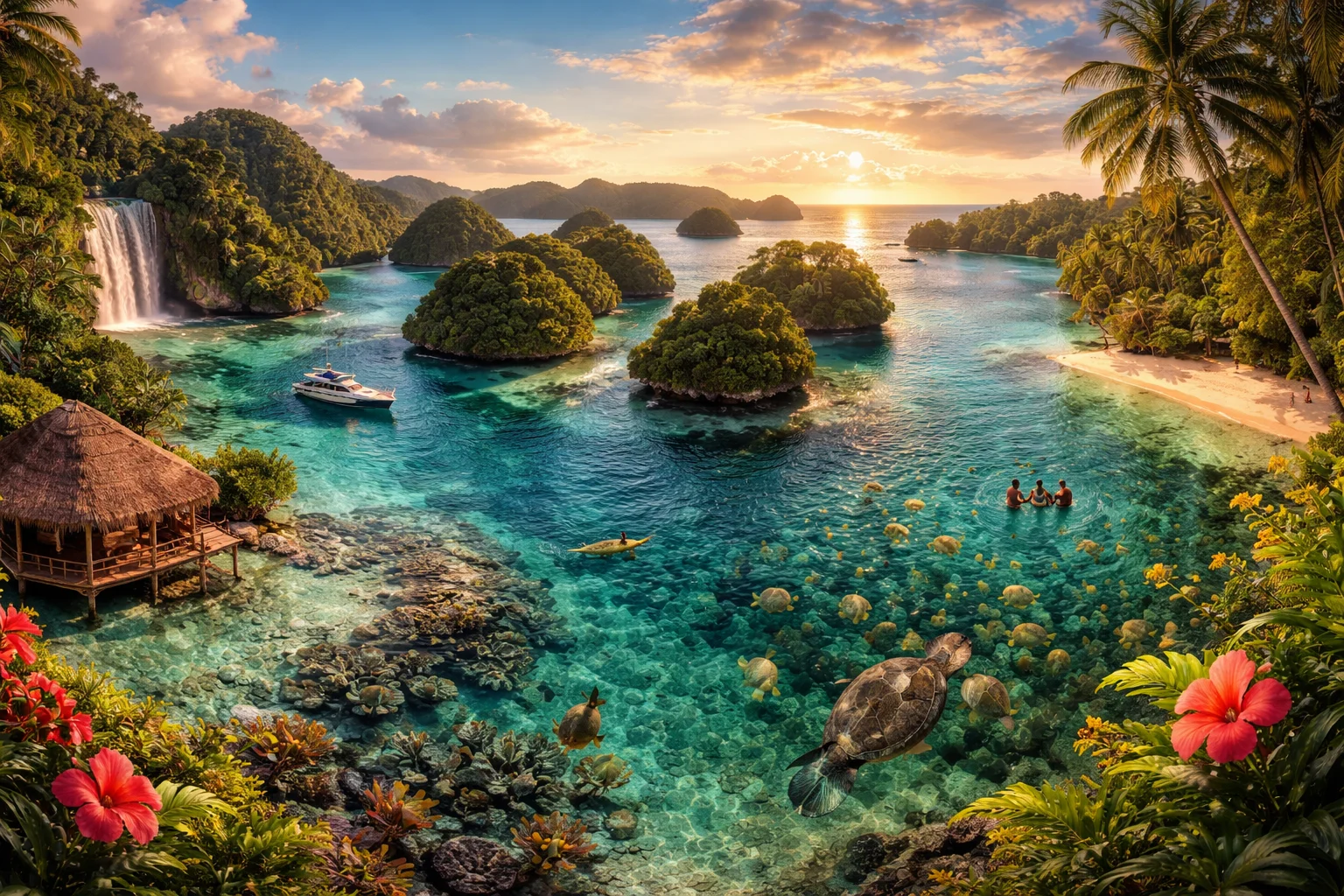
Palau’s terrain is dominated by two contrasting island types: high volcanic islands and low limestone “rock islands.” The largest landmass, Babeldaob, is a green volcanic island with the country’s highest elevation at Mount Ngerchelchauus (~242 m); in contrast the famous Rock Islands are mushroom-shaped limestone karsts with steep cliffs and collapsed caves. Palau lacks major rivers but has freshwater streams and extensive mangrove systems on sheltered coasts. Climate is equatorial tropical, with a distinct wetter season and localized microclimates driven by island size and reef configuration—conditions that create unusually high coral diversity for a country of its land area.
Palau culture and society
Palauan culture blends Austronesian traditions with layers of Spanish, German, Japanese and American influence, producing a matrilineal inheritance system for land and clan membership uncommon globally. Palauan and English are official languages; several smaller Micronesian languages persist in outer states. Social life is organized around clan councils and customary titles, with customary law still adjudicating land disputes alongside the formal judiciary. Christianity is widespread but often syncretized with indigenous ceremonial roles. Demographically, a small, aging population and strong diaspora ties shape labor patterns, remittances, and cultural continuity in family-centered villages.
History of Palau
Palau’s recorded history moves from initial Austronesian settlement to intermittent contact with European explorers, then to colonial administration under Spain and Germany, followed by a half-century of Japanese mandate before U.S. trusteeship after World War II. The trajectory culminated in sovereign governance established through a compact-style relationship with a larger power rather than full integration. Palauan leaders negotiated constitutional provisions—such as environmental and nuclear-related clauses—that influenced the pacing of sovereignty. This layered past explains Palau’s hybrid legal institutions and its outsized role in regional postwar geopolitics.
Palau economy and government
Palau operates a presidential republic with a bicameral legislature at the national level and powerful state governments at the local level; its political arrangements include a formal free-association framework with the United States that shapes defense and some assistance. The economy is concentrated in services—chiefly tourism focused on diving and sport fishing—plus government administration, fishing licenses, and small-scale agriculture. The United States dollar is Palau’s legal tender, and external aid and Compact transfers have historically been fiscal stabilizers. Unique fiscal features include trust funds and license revenues keyed to fishing and maritime permits within a large Exclusive Economic Zone.
Regions and major cities of Palau
Administratively Palau is divided into 16 states, each with local government centered on village communities rather than large urban agglomerations. The capital, Ngerulmud, sits on Babeldaob and is notable for being a deliberately established administrative center with very low local population density. Koror remains the principal commercial hub and the most populous urban area, while Airai hosts the country’s main international airport and industrial nodes. Regional distinctions run from the volcanic interior and government centers of Babeldaob to the more tourism-oriented Rock Islands and outer states with distinct dialects and customs.
Distinctive characteristics of Palau
Palau is globally associated with marine protection and niche environmental diplomacy: it pioneered national-scale shark protections and high-profile marine reserves that exceed its land footprint by area. Its Rock Islands Southern Lagoon is inscribed for outstanding universal value, and Jellyfish Lake hosts non-stinging jellyfish populations found in very few places worldwide. Palau also stands out for a legally framed visitor-environment pledge system tied to entry, a Compact-style sovereignty arrangement influencing security posture, and a land-tenure system that privileges matrilineal clans—each a concrete trait that consistently defines Palau in international policy, conservation, and cultural discussions.