Pakistan Guide
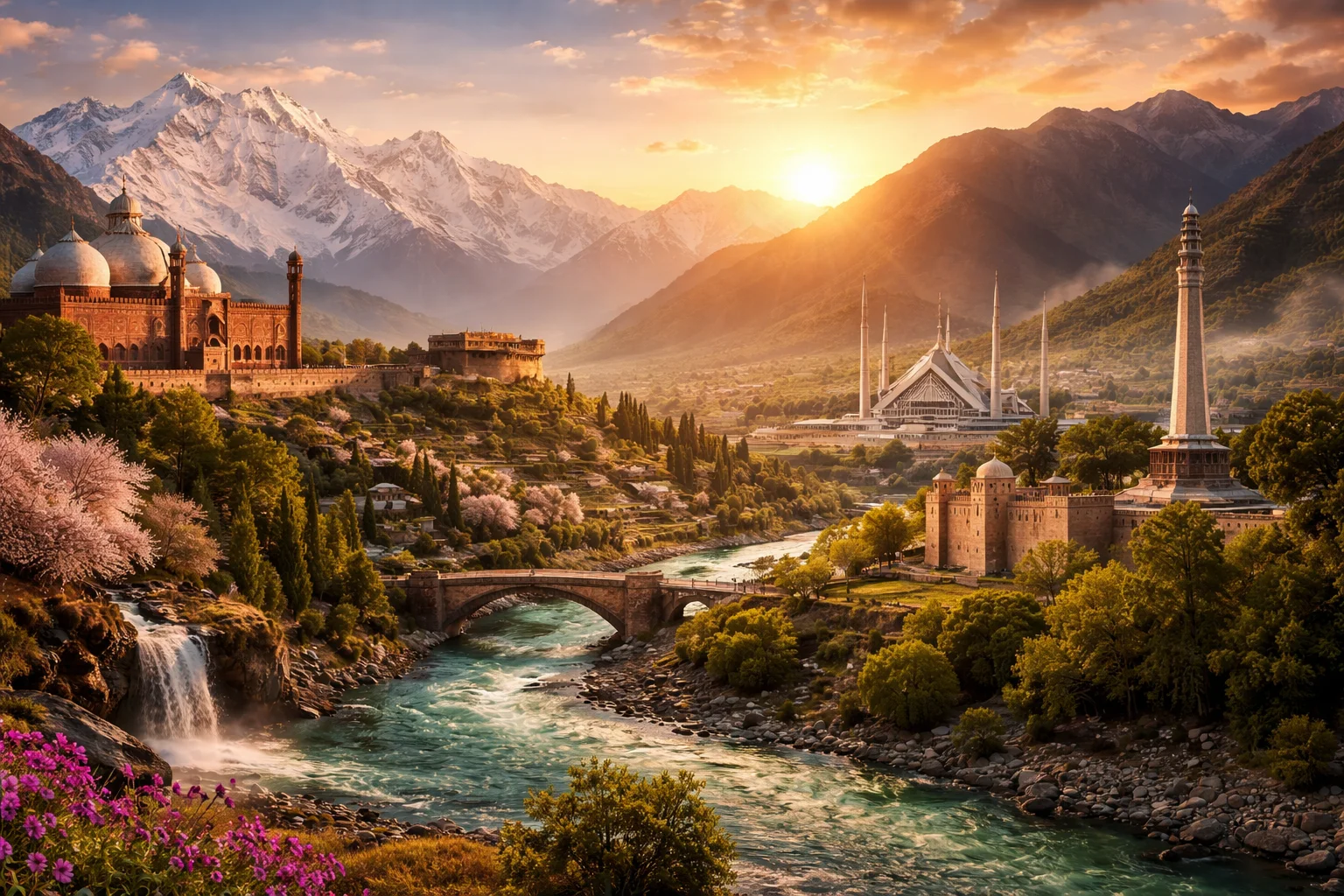
Pakistan overview
Pakistan is the Islamic Republic of Pakistan, a sovereign federal state in South Asia. The country’s name—coined from Urdu and Persian roots—literally means “Land of the Pure,” a distinctive etymological origin that shaped early political identity. Pakistan combines densely populated river plains, a long Arabian Sea coastline, and rugged highlands, producing a governance model that must reconcile provincial autonomy with centralized institutions. Its global significance comes from strategic geography between South and Central Asia and a diaspora that links domestic politics to major labour and capital flows abroad.
Common Geography Questions About Pakistan
Where Pakistan is located
Pakistan sits on the western edge of South Asia, roughly between 24°N–37°N latitude and 61°E–77°E longitude. It shares land borders with India to the east, Afghanistan to the west and northwest, Iran to the southwest and China along a short, high-altitude corridor in the northeast (the Karakoram link). To the south lies the Arabian Sea, with the country’s coastline shaping its maritime access. Pakistan’s geopolitical location includes a contested Line of Control in the Kashmir region that distinguishes its de facto boundary from internationally recognized lines.
Geography and landscape of Pakistan
Pakistan’s geography ranges from the sandy Thar Desert in the southeast to the trans-Himalayan Karakoram in the north, which contains K2, the world’s second-highest peak—a unique mountaineering landmark. The Indus River system carves the central plain and supports one of the planet’s largest contiguous irrigation networks, a structural feature central to national agriculture. Balochistan’s plateau and the Makran coast present arid, sparsely populated terrain, while the northern valleys offer alpine climates and glaciated river sources—regional contrasts that define land use, transport corridors, and settlement patterns within Pakistan.
Pakistan culture and society
Pakistan’s society is linguistically plural: Urdu functions as the national lingua franca while regional tongues—Punjabi, Pashto, Sindhi, Balochi and Saraiki—dominate everyday life in their provinces. Distinctive cultural practices include Sufi devotional traditions centered on local shrines, and the visually idiosyncratic truck art industry that turns commercial vehicles into mobile murals. Religious life is predominantly Muslim with Sunni and Shia communities and localized traditions such as Pashtunwali in Pashtun areas; these social norms shape dispute resolution, hospitality, and marriage customs in specific provinces of Pakistan.
History of Pakistan
The territory of Pakistan encompasses the urban remains of the Bronze Age Indus Valley civilization—notably Harappa and Mohenjo-daro—then later became a conduit for Islamic empires and Mughal architectural patronage. Colonial incorporation into British India altered administrative boundaries and economic patterns, culminating in the partition that produced a separate sovereign state in 1947. The state’s subsequent evolution included military rule, civilian governments and the partition of its eastern wing in 1971; each turning point reshaped governance, federal relations and Pakistan’s role in regional diplomacy.
Pakistan economy and government
Pakistan is constitutionally a federal parliamentary system with a President as head of state and a Prime Minister leading the government, operating alongside provincially elected assemblies—an arrangement complicated by a history of military influence in policymaking. The economy pivots on agriculture fed by the Indus irrigation network, a large textile manufacturing sector, and export-oriented industrial clusters such as surgical-instrument and sports-goods manufacturing centered in Sialkot. The national currency is the Pakistani rupee. Energy and water management—notably hydropower potential tied to northern rivers—are persistent structural economic issues.
Regions and major cities of Pakistan
Administratively Pakistan comprises provinces (Punjab, Sindh, Khyber Pakhtunkhwa, Balochistan), plus Islamabad Capital Territory, Gilgit-Baltistan and Azad Jammu & Kashmir. The Pakistan capital, Islamabad, is a purpose-built city situated against the Margalla Hills and hosts federal institutions. Karachi is the country’s principal commercial port on the Arabian Sea; Lahore functions as a cultural and historic hub near the eastern border; Peshawar serves as a frontier city and trade gateway to Afghanistan. Each city anchors distinct economic hinterlands and provincial identities.
Distinctive characteristics of Pakistan
Pakistan is strongly associated with specific global profiles: a major center for surgical-instrument and sports-equipment manufacturing in Sialkot; a longstanding presence in international mountaineering because of peaks like K2; and a national literary tradition that produced influential Urdu poets whose work circulates across South Asia. The country is also identified internationally as a nuclear-armed state and as the steward of extensive archaeological remains from the Indus urban civilization—concrete associations that shape scholarly, diplomatic and commercial engagement with Pakistan.
Places in Pakistan
Hunza Valley
Hunza Valley is a high-mountain river valley in Gilgit-Baltistan, Pakistan, centered on settlements such as Karimabad. The valley's main inhabited terraces lie near 2,400 meters above sea level and support compact agrarian communities. Hunza Valley extends roughly 100 kilometers along tributary courses before contributing to larger river systems in the upper Indus basin. Its measurable extent and elevation make it a clearly defined geographic unit within northern Pakistan.
Islamabad
Islamabad is the capital city of Pakistan and the administrative centre of the Islamabad Capital Territory. It serves as the seat of the federal government and hosts national institutions. The city covers approximately 906 square kilometres and was developed as a planned capital to concentrate governmental functions in a distinct federal territory. Islamabad’s significance derives from its formal role in governance, its function as a national administrative hub, and its concentration of legislative and judicial buildings.
Lahore Museum
Lahore Museum is a public museum in the city of Lahore, Pakistan. It is located in central Lahore and functions as a major repository for regional archaeology, Islamic art, and provincial ethnography. The museum’s holdings are organized into distinct galleries for archaeology, Islamic decorative arts, and vernacular crafts. As an institutional collection, Lahore Museum serves an archival role for objects recovered from the surrounding Punjab region and northern South Asia.
Lahore University of Management Sciences
Lahore University of Management Sciences is a private research university in Pakistan, located in the city of Lahore. The campus functions as a degree-granting institution with a multi-disciplinary structure and an urban campus covering approximately 100 acres. Founded through a private initiative to expand professional education, the university is governed by a board of trustees and organizes academic activity through several constituent schools that award undergraduate, graduate, and professional degrees. Lahore University of Management Sciences is a prominent institutional center for management, science, engineering, humanities, and law in Pakistan.
Lahore Zoo
Lahore Zoo is a zoological collection and managed urban animal park in Pakistan. It is located within central Lahore on the city's historic Mall Road, immediately adjacent to Bagh-e-Jinnah, and functions as the principal municipal curated collection for the city. The site combines animal enclosures, an aviary, and specialized structures such as an elephant compound, giving Lahore Zoo a defined institutional footprint within Lahore's civic landscape.
Quaid-i-Azam University
Quaid-i-Azam University is a public research university in Pakistan established to provide higher education and research in the capital. The university was founded in 1967 and occupies a formally measured campus area of approximately 1,700 acres. Quaid-i-Azam University serves as a national-level institution for advanced study in natural sciences, social sciences, and interdisciplinary research, and it is chartered and funded under Pakistani government statutes and subject to oversight by national higher-education authorities. The institution’s formal status as a public university and its large, contiguous campus in the Margalla foothills are central to its identity and measurable scale.
Walled City of Lahore
Walled City of Lahore is a historic urban district in Pakistan that comprises the old walled core of Lahore. It occupies the city’s premodern centre and contains major landmarks such as the Lahore Fort, Wazir Khan Mosque, and the Shahi Hammam. The district is the focus of a formal heritage conservation effort administered by the Walled City of Lahore Authority, which documents buildings, manages restoration projects, and coordinates conservation-sensitive urban works within the historic boundary.
Explore Natural Landmarks in Pakistan
Browse islands and mountains connected with Pakistan to keep exploring related geography clusters.