Oman Guide
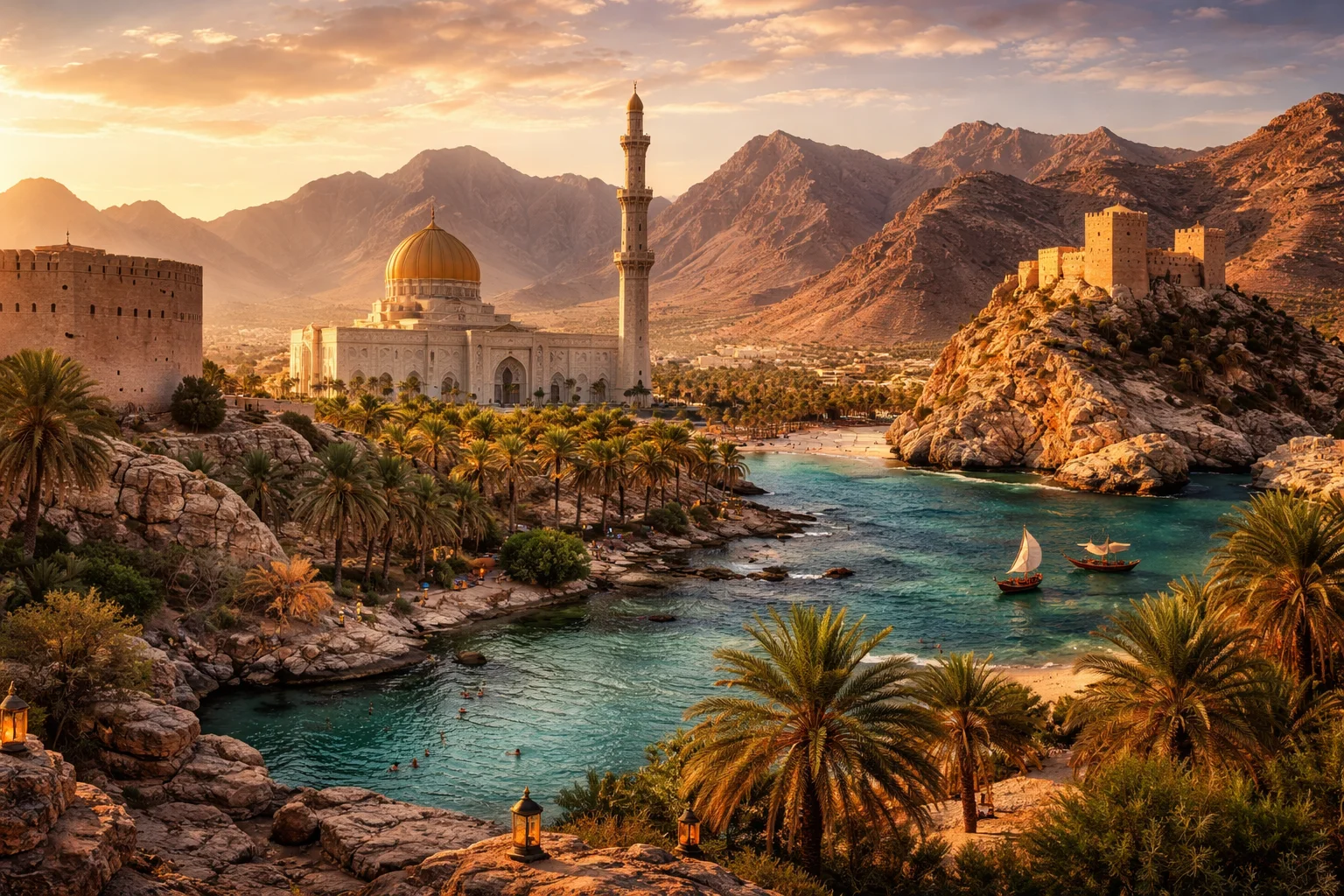
Oman overview
Oman is the Sultanate of Oman, a sovereign state on the southeastern edge of the Arabian Peninsula that combines desert interior, a rugged mountain spine and more than 3,000 kilometers of coastline. The country’s significance rests on its long maritime history and its formal status as a hereditary sultanate with a modern administrative apparatus. Economically it has relied on hydrocarbons while pursuing diversification into fisheries, mining and logistics. The nation’s character is shaped by a compact urban center, extensive expatriate labor, and distinctive institutions that reflect a blend of tribal, Islamic and seafaring traditions.
Common Geography Questions About Oman
Where Oman is located
Oman sits in southwestern Asia on the Arabian Peninsula, centered roughly between 16° and 26° north latitude and 52° to 60° east longitude. It borders Saudi Arabia to the west, the United Arab Emirates to the northwest and Yemen to the southwest; a small northern exclave faces the Strait of Hormuz. Coastal boundaries run along the Arabian Sea and the Gulf of Oman. The Musandam Peninsula, separated from the mainland and projecting into the Strait, creates an uncommon geopolitical geometry and places the country adjacent to a major global maritime chokepoint.
Geography and landscape of Oman
The country’s topography ranges from the Hajar Mountains—whose highest summit, Jabal Shams, rises above 3,000 meters—to soft sand seas such as the Sharqiya (Wahiba) Sands. Permanent rivers are absent; water moves through seasonal wadis and ancient aflaj irrigation channels. Climate zones vary from hot-arid interior plains to a unique monsoon-influenced belt in the southern Dhofar region that produces a brief cool, green season. Climatic and elevational contrasts concentrate agriculture, date cultivation and grazing into narrow bands, while extensive carbonate plateaus and limestone khors on the coast produce fjord-like inlets uncommon on other Arabian shores.
Oman culture and society
Arabic is the official language, but regional dialects, Baluchi communities, and historical ties to East African Swahili-speaking populations shape linguistic variety. The predominant branch of Islam is Ibadi, a minority trend globally that has a prominent institutional role in local religious life. Social customs center on the majlis as a formal council space, the wearing of the khanjar dagger in ceremonial dress, and formalized guest-host protocols. Demographically the workforce includes a sizable expatriate population concentrated in construction and energy sectors, which produces multilingual urban enclaves alongside conservative rural tribal communities.
History of Oman
Oman’s history traces from Bronze Age frankincense routes through a medieval maritime culture that built dhows and extended influence along the East African coast. European contact began with Portuguese fortification in the 16th century; by the 19th century an Omani sultanate exercised authority in Zanzibar and coastal swathes of East Africa. The 20th century reorganized the state amid interior consolidation, oil-era fiscal change and a mid-century program of state-led modernization that transformed infrastructure and institutions. These shifts turned a mercantile seafaring polity into a centralized modern state with lingering transoceanic cultural links.
Oman economy and government
Governance is a hereditary sultanate with executive power concentrated in the Sultan, complemented by a Council of Ministers and a dual consultative assembly system combining an elected Majlis al-Shura and an appointed State Council. The national currency is the rial, which is tightly managed and ranks among the world’s higher-valued currencies. The economy has been anchored by oil and gas production but also includes fisheries, copper and chromite mining, and a growing logistics sector tied to deepwater ports. Public employment and state investment historically underpin the fiscal model while policies emphasize gradual diversification from hydrocarbons.
Regions and major cities of Oman
Administratively the country is divided into governorates (muhafazat) and further into wilayats; the capital city is Muscat, the principal political and commercial hub. Other major cities include Sohar, an ancient port now associated with industry; Nizwa, a historic inland center known for its fort and as a former religious capital; and Salalah, positioned in the Dhofar region with a markedly different seasonal climate. Coastal towns such as Sur retain traditional shipbuilding crafts. Regional distinctions hinge on mountain, desert and monsoon-influenced zones that shape local economies and settlement patterns.
Distinctive characteristics of Oman
Concrete traits strongly associated with this country include its historic role in the frankincense trade that linked southern Arabia to classical and medieval markets, the global recognition of traditional aflaj irrigation systems, and a distinctive national emblem—the curved khanjar dagger—visible on official regalia. The nation’s northern Musandam promontory produces dramatic sea inlets, while the southern Dhofar monsoon supports an annual green season rare on the peninsula. Internationally it is often cited for its maritime heritage, long-standing seafaring links with East Africa, and a currency policy that supports regional financial stability.
Places in Oman
Muscat
Muscat is the capital city of the Sultanate of Oman and the country’s primary political and economic centre. It occupies a coastal position on the northeastern Arabian Peninsula and functions as the seat of government and location of major state institutions. Muscat is formally defined as both a municipal capital and the core of the Muscat Governorate. The city hosts national diplomatic missions and key port facilities that have shaped its regional significance over centuries.
National Museum of Oman
National Museum of Oman is the state museum of the Sultanate of Oman and a central repository for the country's material heritage. The museum is located in the capital city of Muscat and formally functions as the national institution responsible for preserving and presenting Omani archaeology, history, and culture. Its role includes maintaining permanent galleries, temporary exhibition spaces, conservation laboratories, and research collections under national cultural authorities.
Sultan Qaboos University
Sultan Qaboos University is the principal public university of Oman, established by royal decree and named for Sultan Qaboos bin Said. It functions as the country's national flagship for higher education, combining undergraduate and postgraduate instruction, research centers, and affiliated clinical care facilities. The university occupies a purpose-built campus with multiple academic colleges and an associated teaching hospital, offering professional degrees across medicine, engineering, sciences, humanities, and agricultural and marine sciences. As a state-funded institution, the university serves formal governmental roles in national workforce development, accreditation, and applied research for Oman's development priorities.
Wadi Shab
Wadi Shab is a coastal wadi and narrow limestone gorge in northeastern Oman, notable for its freshwater pools and sea outlet. It is located on the eastern seaboard between the towns of Tiwi and Sur and serves as a representative example of mountain-to-sea fluvial systems on the Arabian Peninsula. The site lies about 140 kilometers southeast of Muscat, and its main gorge extends for several kilometers from mountain inlet to coastal mouth. Wadi Shab’s natural features give it regional significance.