Norway Guide
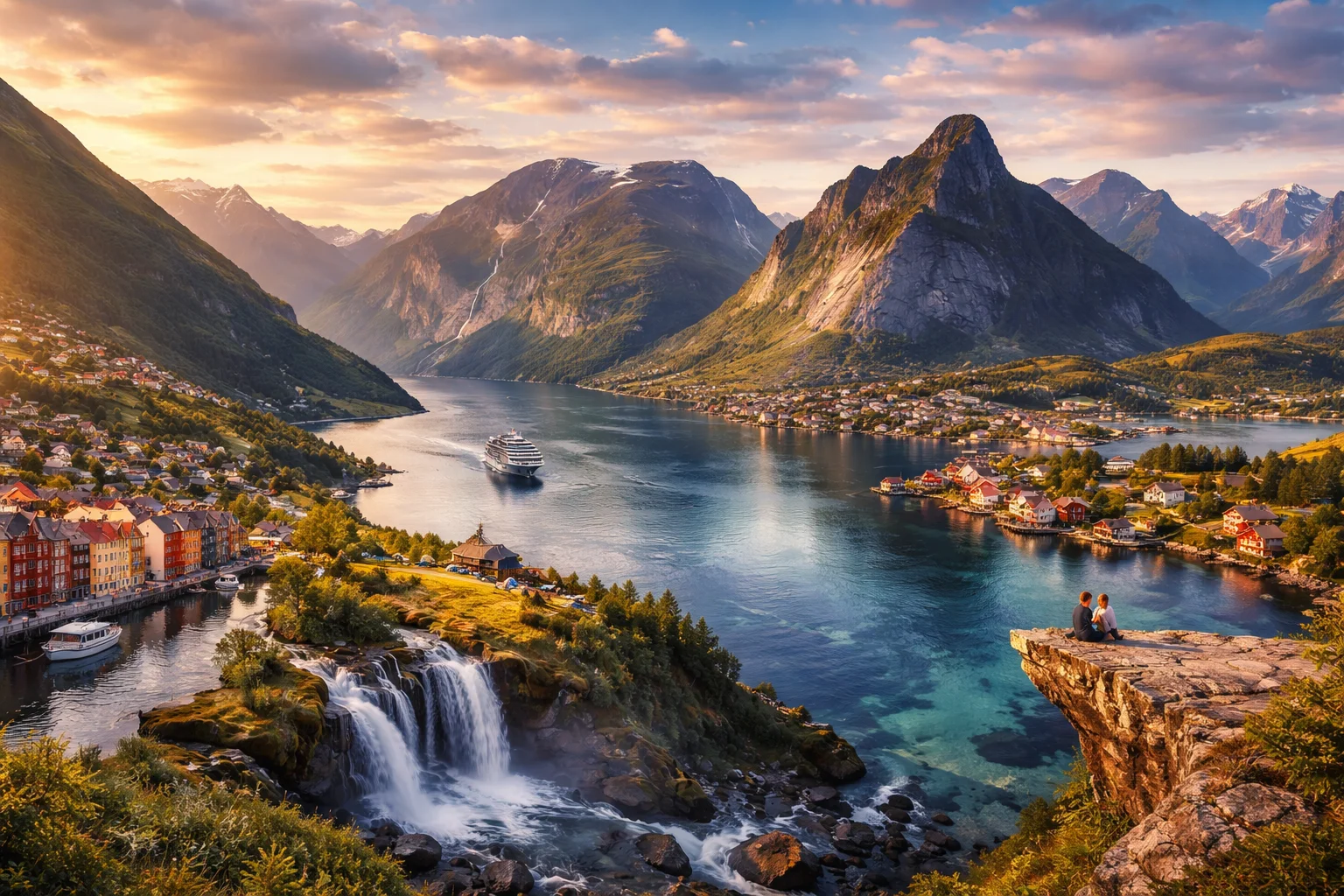
Norway overview
Norway is a sovereign state on the western edge of the Scandinavian Peninsula, defined by a long, glacier-carved coastline and a northern archipelago that reaches into the Arctic Ocean. The country combines a light-industrial, petroleum-based economy with extensive hydropower and a large sovereign wealth fund that shapes long-term fiscal policy. Politically, Norway is a constitutional monarchy with a unicameral legislature; culturally it preserves two official written standards of Norwegian alongside recognized Sami languages. Its landscape of fjords, mountains and Arctic islands gives Norway a geographic identity that directly influences settlement, economy and culture.
Common Geography Questions About Norway
Where Norway is located
Norway lies in Northern Europe on the western side of the Scandinavian Peninsula, roughly between 58°N and 71°N latitude. It borders Sweden along a long eastern land frontier, shares shorter land borders with Finland and Russia in the far northeast, and has a maritime boundary with the United Kingdom across the North Sea. The Norwegian coastline faces the Norwegian Sea and the northern Barents Sea; the Svalbard and Jan Mayen archipelagos extend Norway’s territory well into the Arctic Ocean. Norway’s position along the North Atlantic current system moderates coastal climates despite its high latitudes.
Geography and landscape of Norway
Norway’s terrain is dominated by the Scandinavian Mountains (Scandes), a high, rugged spine of peaks and plateaus that includes Galdhøpiggen, the country’s highest summit. Glacially carved fjords—deep, narrow inlets such as those around Geiranger and Sogne—cut the western coast, producing one of the world’s longest and most indented shorelines. The Glomma is Norway’s longest river, while Jostedalsbreen is the largest glacier on continental Europe. Climatic zones range from temperate oceanic along the southwest coast to subarctic and Arctic tundra in northern islands; the midnight sun and polar night occur above the Arctic Circle, affecting local livelihoods and tourism.
Norway culture and society
In Norway, two written standards—Bokmål and Nynorsk—are officially recognized alongside several Sami languages protected as minority languages, and the Sámediggi (Sami Parliament) represents indigenous interests. Cultural practices emphasize friluftsliv, a social value of outdoor life rooted in small-scale farming and coastal fishing communities. Folk traditions such as the Hardanger fiddle, stave churches and the 17 May national day parade remain visible in modern civic life. Norway has an urbanized population concentrated in the southeast yet maintains strong rural identities in fishing and reindeer-herding districts; social policy reflects a comprehensive welfare model with high public-service coverage.
History of Norway
Norway’s story begins with Viking Age maritime societies that conducted trade, raiding and settlement across the North Atlantic, then passed into centuries-long unions—first with Denmark and later with Sweden—that shaped institutions and language. The 1814 constitution drafted at Eidsvoll established a distinct legal framework still central to national identity, and full independence after the peaceful dissolution of the union with Sweden in 1905 was a major turning point. The mid-20th-century discovery of offshore petroleum transformed an agrarian and fisheries-based economy into an energy-exporting state and funded modern welfare arrangements; the Svalbard Treaty opened an unusual international regime for Arctic islands.
Norway economy and government
Norway is a constitutional monarchy with a parliamentary system; the Storting is the unicameral legislative body that enacts laws and budgets. The country is not an EU member but participates in the European single market through the EEA and is a founding member of EFTA. The economy combines major sectors: offshore oil and gas production in the North Sea, extensive hydroelectric generation, maritime shipping and seafood exports—particularly farmed Atlantic salmon. The Norwegian krone is the national currency, and fiscal policy is guided by revenues partly channeled into the Government Pension Fund Global, a sovereign wealth fund designed to manage long-term petroleum income for future generations.
Regions and major cities of Norway
Norway’s public administration is organized into counties (fylker) and municipalities (kommuner), with historical and cultural regions commonly referenced as Northern Norway, Trøndelag, Western Norway, Southern Norway and Eastern Norway. Oslo is the capital and the nation’s political and economic hub. Bergen, once the Hanseatic trading post on the west coast, serves as a maritime and cultural center; Trondheim holds medieval and ecclesiastical heritage as the site of Nidaros Cathedral. Tromsø functions as a principal Arctic city and research gateway. The Svalbard archipelago, administered separately, hosts permanent settlements under a unique international treaty regime.
Distinctive characteristics of Norway
Norway is globally associated with its fjords—Geirangerfjord and Nærøyfjord are UNESCO World Heritage Sites—and with Arctic governance through Svalbard’s treaty status and northern research stations such as Ny-Ålesund. The country’s sovereign wealth fund is notable for its scale and ethical investment mandate, and Norwegian-built offshore technology and maritime shipping companies are internationally prominent. Cultural associations include polar exploration figures like Roald Amundsen and the Nobel Peace Prize, which is awarded in Oslo; Norway is also widely recognized for leading electric-vehicle adoption and for being a major global supplier of farmed salmon.
Places in Norway
Bergen
Bergen is a city and municipality on the western coast of Norway that functions as a regional cultural and economic centre. The city occupies a formally defined municipal area of approximately 465 square kilometres and serves as a focal point for maritime commerce and higher education in western Norway. Bergen’s significance stems from its long-standing role in coastal trade, its concentration of research institutions, and its influence on Norwegian arts and fisheries.
Briksdal Glacier
Briksdal Glacier is an outlet glacier of the Jostedalsbreen ice cap in Norway. It terminates at a proglacial lake, Briksdalsbrevatnet, providing a clear ice–water contact used in field measurements. It represents a narrow valley tongue descending from a large ice cap and serves as a measurable example of outlet-glacier dynamics within the Jostedalsbreen system. Long-term frontal observations of the glacier contribute to national glaciological datasets.
Fram Museum
Fram Museum is a maritime museum in Norway that preserves the original polar exploration ship Fram and related collections. It is located on the Bygdøy peninsula in Oslo and centers its displays on the ship Fram as the institution’s primary exhibit housed within a purpose-built hall. The museum functions as a conservation and research institution focused on Norwegian polar history and maintains a permanent ship display as its measurable, defining object.
Geirangerfjord
Geirangerfjord is a glacial fjord in western Norway, located in Møre og Romsdal county and noted for dramatic relief. It stretches about 15 kilometres inland and reaches depths near 260 metres, providing a measurable example of glacial over-deepening. The fjord’s steep cliffs and multiple waterfalls confer international significance as a well-preserved fjord landscape and an important subject for studies of geomorphology and cultural mountain farming.
Grunerlokka
Grunerlokka is a district of Oslo, Norway, formally administered within the municipal borough structure of the city. It is located northeast of Oslo’s central area and is significant for its historical role as an industrial corridor along the Akerselva river and for its concentration of preserved factory architecture now repurposed for residential and cultural uses. The district has a formally designated borough status under Oslo municipality and includes named public spaces such as Sofienbergparken.
Hardangerfjord
Hardangerfjord is a fjord in Norway. It extends approximately 179 kilometers from the North Sea into western Norway and touches the municipalities of Ullensvang, Eidfjord, Ulvik, Kvam, and Kvinnherad. Hardangerfjord is significant for its long, glacially carved shoreline and for supporting one of Norway’s largest continuous fruit-growing districts along steep, terraced slopes. The fjord’s length, complex system of arms, and adjacent high plateaus make it a major coastal feature in Norway’s marine geography.
Jostedalsbreen Glacier
Jostedalsbreen Glacier is a large ice cap glacier in Norway covering an extensive area of the mainland interior. The glacier is the largest single ice mass on the European mainland and is formally associated with a national park that protects substantial parts of its ice cap and outlet glaciers. Jostedalsbreen Glacier is notable for its multiple prominent outlet arms and for providing a measurable natural laboratory for studies of ice dynamics and meltwater drainage.
Jotunheimen National Park
Jotunheimen National Park is a protected national park area in Norway that preserves a high-alpine mountain landscape. The park encompasses the core of the Jotunheimen mountain region and contains some of Norway’s highest mountain peaks and extensive glacier systems. Its significance rests on formally protecting northern Europe's high-mountain terrain, maintaining geological exposures of ancient bedrock, and conserving complex alpine ecosystems under Norwegian national park status.
Kristiansand Zoo
Kristiansand Zoo is a zoological park in Norway located within the municipality of Kristiansand. It is formally designated as a managed zoological institution and occupies a managed landscape combining animal enclosures and themed exhibition areas. The park’s layout interleaves outdoor habitats with constructed exhibits across varied terrain, and its institutional role includes maintaining a curated collection of both native Scandinavian species and non-native species for public education and conservation-oriented programs.
Lysefjord
Lysefjord is a fjord in Norway located in Rogaland county on the country’s southwestern coast. The fjord extends roughly 42 kilometres from its mouth at Høgsfjorden inland to the hamlet of Lysebotn, with maximum reported depths exceeding 400 metres; this measurable length and depth mark Lysefjord as a prominent glacial fjord in Norwegian hydrography. The entry identifies its physical form, shoreline features, and regional significance for geology and infrastructure.
Munch Museum
Munch Museum is a museum in Norway dedicated to the works and archive of painter Edvard Munch. It stands as Oslo’s municipal institution for the artist and is administered by the City of Oslo, serving as the primary public repository for Munch’s paintings, prints, and archival materials. The museum’s mandate combines collection stewardship, conservation, and scholarly research within a purpose-built gallery complex. Munch Museum is significant for concentrating a large public assembly of the artist’s work and related documentation.
Naeroyfjord
Naeroyfjord is a narrow glacial fjord in western Norway, situated within Vestland county and linked to Sognefjord. The fjord extends roughly seventeen kilometers inland and narrows to about two hundred fifty meters at its tightest point. Naeroyfjord is composed of glacially scoured bedrock and preserves visible glacial landforms along deep-water marine habitats studied by researchers. It also serves as a widely cited reference location for fjord geomorphology, sediment studies, and coastal ecology research.