North Macedonia Guide
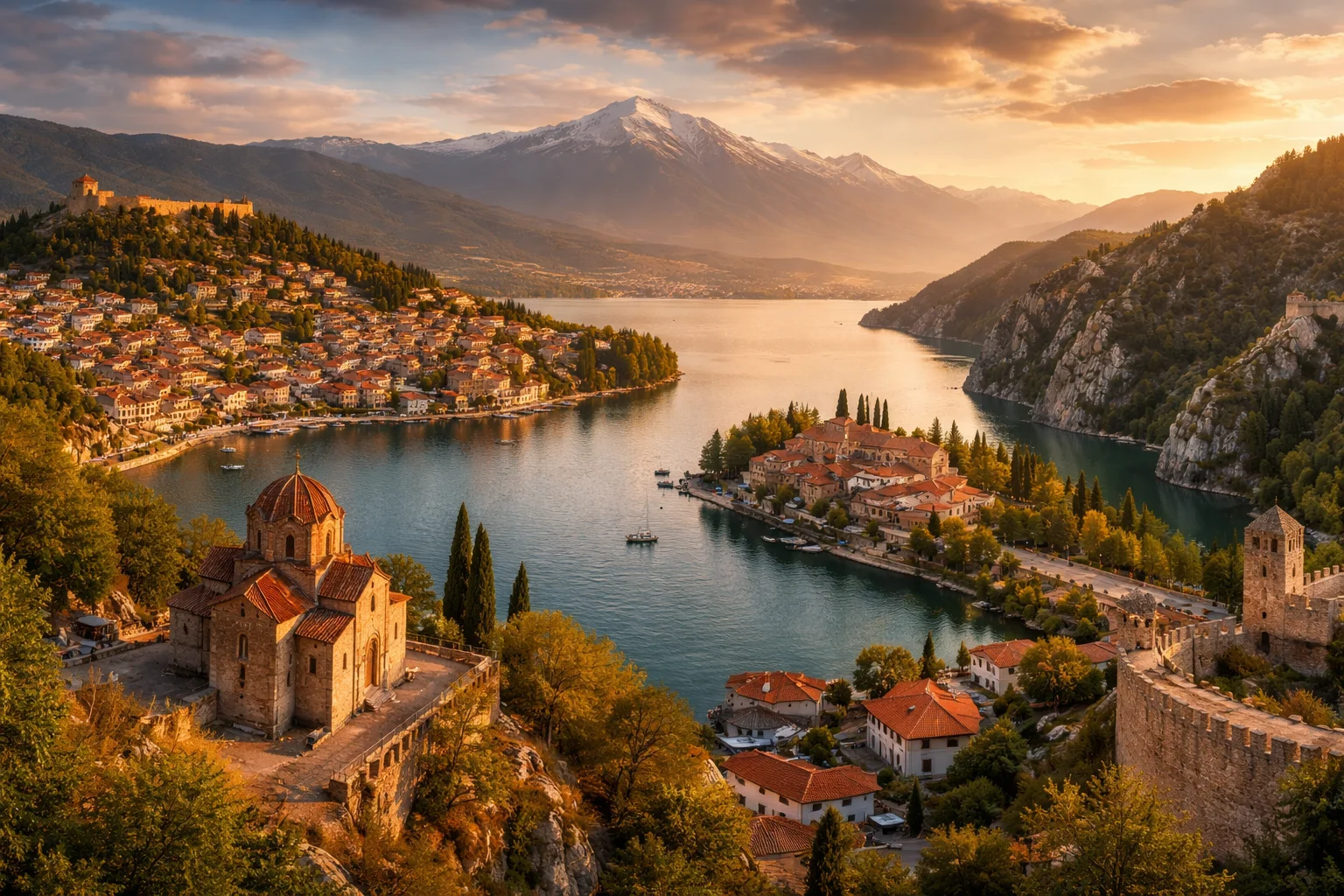
North Macedonia overview
North Macedonia is a parliamentary republic in the central Balkans, defined by its compact territory, mountainous spine and a patchwork of ethnic communities. Situated on transport routes between the Adriatic and Aegean seas, the country is best known for Lake Ohrid — one of Europe’s oldest lakes with numerous endemic species — and for resolving a long-running interstate name dispute through the Prespa Agreement that led to its current official name. Its identity blends Ottoman urban legacies, a South Slavic language codification, and a concentrated cultural heritage that punches above its size.
Common Geography Questions About North Macedonia
Where North Macedonia is located
North Macedonia lies in Southeast Europe on the Balkan Peninsula, roughly between 40° and 42° north latitude and 20° to 23° east longitude. It is bordered by Serbia (including Kosovo to the northwest), Bulgaria to the east, Greece to the south, and Albania to the west, creating a landlocked enclave connected by mountain passes and river valleys. The Vardar River runs through its central axis and the country contains portions of two transboundary ancient lakes, Ohrid and Prespa, which crucially anchor its geographic position within the regional watershed.
Geography and landscape of North Macedonia
The geography of North Macedonia is dominated by a mountainous terrain interrupted by the Vardar valley; Mount Korab (2,764 m), shared with Albania, is the country’s summit. The Šar Mountains and Osogovo range shape northern alpine zones while the southern lowlands around the Vardar corridor display Mediterranean influences. Unique to North Macedonia is Lake Ohrid’s karst basin with exceptionally clear, deep waters and species found nowhere else in Europe. Most of the country drains into the Vardar basin, producing sharp regional contrasts in microclimate and vegetation across short distances.
North Macedonia culture and society
Macedonian is the constitutionally recognized official language, with Albanian granted co-official status in numerous municipalities; Turkish, Romani and Serbian are also present. Religious practice is divided mainly between Orthodox Christianity (centred on the Macedonian Orthodox Church) and Islam, and social life often revolves around family networks, church and mosque calendars, and village-based customs. Distinct cultural markers include the Ohrid Summer Festival’s long-running program of classical and traditional music and the sustained use of multipart folk singing, along with high rates of bilingualism in areas where Macedonian and Albanian communities intermix.
History of North Macedonia
North Macedonia’s history threads ancient Paeonian and classical Macedonian legacies through Roman provincial administration, medieval prominence under the Ohrid Archbishopric, and five centuries of Ottoman rule — which left concentrated bazaars and mosques in cities such as Bitola and Skopje. In the 20th century the territory became a constituent republic of socialist Yugoslavia, which promoted a standardized Macedonian language and institutions; the republic declared independence in 1991. A defining modern turning point was the interstate compromise resulting in the country’s current name, concluded to settle a protracted dispute over historical and regional identity.
North Macedonia economy and government
North Macedonia is a parliamentary republic with a unicameral Assembly (Sobranie), a directly elected president as head of state, and a prime minister leading the government. Post-conflict constitutional reforms introduced under the Ohrid Framework Agreement enshrined minority representation and language rights, shaping the political system’s power-sharing mechanisms. The economy is diversified among services, light manufacturing, mining and agriculture; notable sectors include metal processing, textiles and the Tikveš wine region, famed for the indigenous Vranec grape. The national currency is the Macedonian denar, and small and medium enterprises play a dominant role in employment.
Regions and major cities of North Macedonia
Administratively, North Macedonia is organized into 80 municipalities plus the City of Skopje, and is commonly grouped into eight statistical regions for planning. The capital, Skopje, spans multiple municipalities and combines Ottoman-era Old Bazaar quarters with modernist post-earthquake reconstruction. Bitola, historically called Monastir, retains 19th-century consular architecture and a strong cultural scene; Ohrid is a lakeside town whose medieval churches and archaeological sites anchor a UNESCO designation. Regional identities often align with river basins and mountain ranges rather than strictly with municipal borders.
Distinctive characteristics of North Macedonia
North Macedonia’s global profile rests on concrete, identifiable features: Lake Ohrid’s exceptional biodiversity and UNESCO status; the Tikveš wine region and its Vranec grape variety; the medieval Ohrid literary and ecclesiastical center that influenced Slavic literacy; and the internationally mediated Prespa Agreement that altered the country’s official name. Architecturally, Skopje’s reconstruction after the 1963 earthquake involved international planners and a distinctive modernist imprint. These specific legacies — ecological, cultural and diplomatic — are among the attributes most closely associated with North Macedonia worldwide.
Places in North Macedonia
Lake Ohrid
Lake Ohrid is a tectonic lake on the border between North Macedonia and Albania, notable for its biological and cultural importance. It lies predominantly within North Macedonia and is one of Europe’s oldest lakes, with a maximum recorded depth of approximately 288 meters. The lake’s prolonged geological stability supports unique ecosystems and dense archaeological remains, giving it combined scientific, historical, and cultural significance across the Balkan region.
Skopje
Skopje is the capital and largest city of North Macedonia, serving as the country's main political and administrative centre. It lies at an elevation of about 240 metres above sea level and functions as the national seat of government and principal economic hub. Skopje's significance stems from its role as a demographic and cultural focal point and from a dense concentration of historic sites, administrative institutions, and transport infrastructure.
Skopje Zoo
Skopje Zoo is the principal zoological institution in North Macedonia, located in the capital city of Skopje. It functions as the country’s main urban zoological collection and occupies municipal land within Skopje’s built area, formally recognized by local authorities as a public zoological garden. The site combines managed animal enclosures with public parkland vegetation and serves an institutional role in maintaining living collections for the nation.