Nigeria Guide
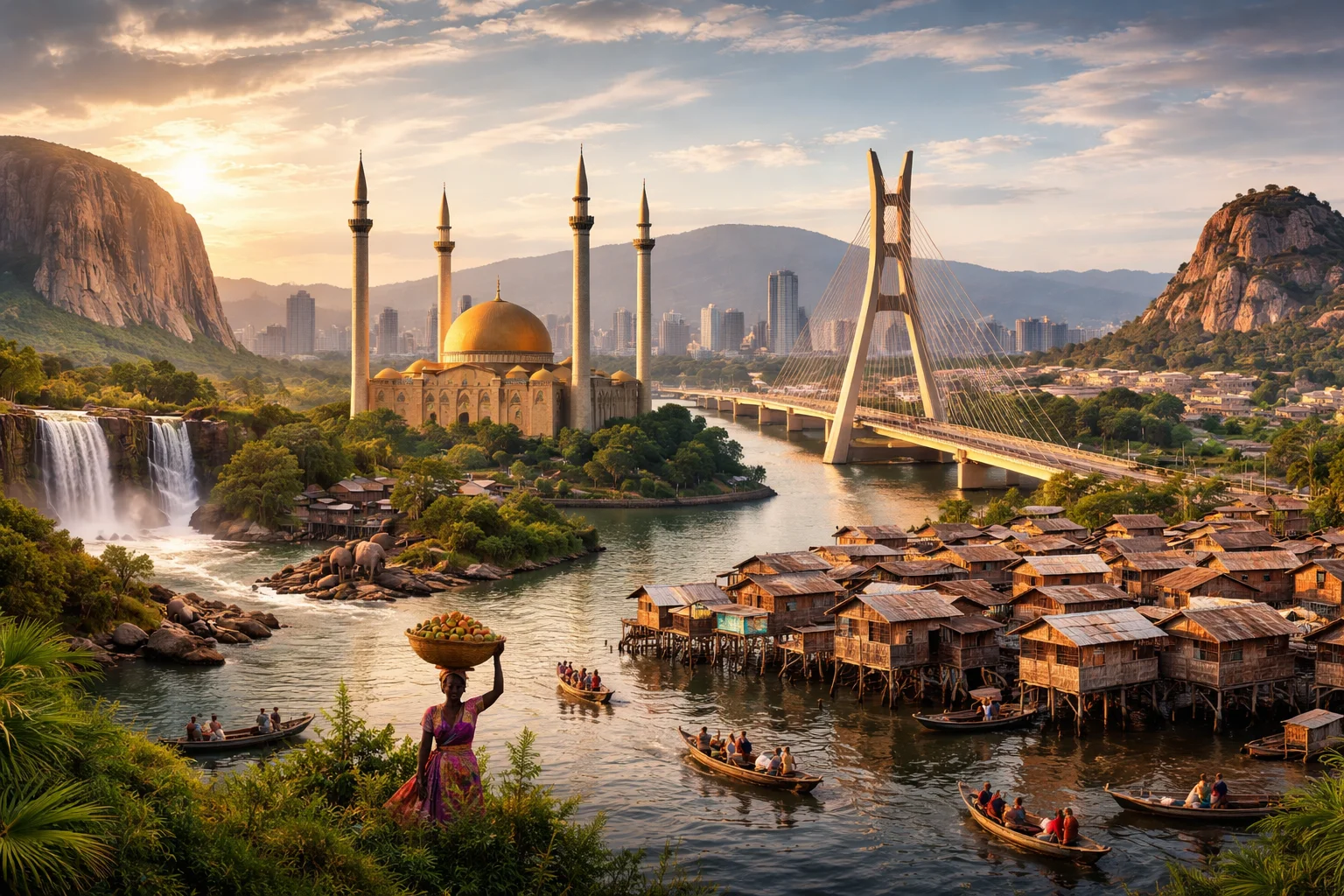
Nigeria overview
Nigeria is a federal republic in West Africa and the continent’s most populous country, noted for an unusually large youth population and intense linguistic diversity. Its national life concentrates rapid urbanization, a vast informal economy and a globally active cultural sector producing music, literature and film that circulate across Africa and the diaspora. The country’s scale generates sharp internal contrasts: densely populated metropolitan regions sit beside extensive rural frontiers that remain central to food production and social networks.
Common Geography Questions About Nigeria
Where Nigeria is located
Nigeria occupies a central position along the Gulf of Guinea on the western edge of sub-Saharan Africa, lying roughly between 4° and 14° north latitude and between 2° and 15° east longitude. It shares land borders with Benin to the west, Niger to the north, Cameroon to the east and a short frontier with Chad through Lake Chad to the northeast. The Niger River crosses the country and meets the Benue at Lokoja before draining southward; that river system and the Gulf of Guinea coastline have defined settlement, transport and the country’s historical name.
Geography and landscape of Nigeria
Nigeria’s geography ranges from flat coastal plains to high plateaus and isolated summits. In the far east the Mambilla Plateau rises abruptly, and Chappal Waddi on that plateau is the country’s highest point at over 2,400 metres; the central Jos Plateau is a cooler upland historically associated with tin extraction. Moving north, landscapes shift from Guinea and Sudan savannas into the semi-arid Sahel margin, while the southern lowlands support rainforest and coastal lagoons. Soils, rainfall seasonality and localized escarpments create distinct agricultural niches across Nigeria’s ecological belts.
Nigeria culture and society
Nigeria hosts extraordinary linguistic plurality: more than 500 languages and dialects coexist alongside English as the official language and a widely spoken Nigerian Pidgin. Major language families include Niger–Congo groups such as Yoruba and Igbo and Chadic languages like Hausa; these networks underpin distinct ritual calendars, marriage customs and festival cycles. Religious life is broadly divided between Islam and Christianity, yet many communities combine older rites with newer faiths. Social organization emphasizes extended-family ties, market-centered livelihoods and lively neighborhood associations that shape everyday civic life across Nigeria. This linguistic base shapes everyday culture across regions.
History of Nigeria
Nigeria’s deep history stretches back to Iron Age societies such as the Nok culture, whose terracotta figures attest to early craft specialization. Later centuries saw the emergence of forest and coastal polities—most prominently the Benin Kingdom with its sophisticated metalwork—and northern Hausa city-states and the Sokoto Caliphate that reorganized Sahelian political life. Colonial administrators merged separate protectorates in a 1914 amalgamation that created the territorial basis of the modern state; independence in 1960 was followed by a late-1960s civil war and decades of alternating military and civilian rule that shaped contemporary political institutions.
Nigeria economy and government
Nigeria operates a federal presidential republic with power divided between a central government and 36 states plus the Federal Capital Territory; the constitution includes a 'federal character' clause intended to distribute appointments across ethno-regional lines. The National Assembly is bicameral and executive authority is vested in an elected president. The economy relies heavily on hydrocarbon extraction, which underpins export earnings and public finances, alongside substantial agricultural activity and a large informal sector. The national currency is the naira, and the state’s role in energy—through a national petroleum corporation and international oil-export affiliations—has long shaped fiscal and investment patterns.
Regions and major cities of Nigeria
Nigeria is administratively organized into 36 states and the Federal Capital Territory; for planning and political purposes the states are often grouped into six geopolitical zones—North West, North East, North Central, South West, South East and South South—that influence resource allocation and electoral strategy. The capital, Abuja, sits within a purpose-built territory in the interior and was established as the federal seat to provide a neutral location among regions. Other major cities include Kano in the north, Ibadan as a southwestern educational and commercial center, and Port Harcourt anchoring the southern industrial and energy complex.
Distinctive characteristics of Nigeria
Nigeria’s most recognizable global signatures combine cultural production and entrepreneurial concentration. A prolific film sector—commonly called Nollywood—produces thousands of feature-length and serialized titles annually that circulate across Africa and its diasporas. Modern Afrobeat originated in Lagos under figures such as Fela Kuti and continues to influence global popular music. Nigerian literature, galvanized by authors like Wole Soyinka and Chinua Achebe, became central to anglophone African letters. Emerging technology and creative start-up clusters—notably in Lagos suburbs known for concentrated tech firms—have also raised Nigeria’s profile among rapidly developing digital markets.
Places in Nigeria
Abuja
Abuja is the capital city of Nigeria and the administrative centre of the Federal Capital Territory. It occupies the principal federal institutions, including the Presidential Villa, National Assembly, and Supreme Court. The Federal Capital Territory covers about 7,315 square kilometres, providing the formal jurisdiction for the capital. Abuja’s significance derives from its role as Nigeria’s political seat and from being a purpose-built capital designed to concentrate national government functions.
Nigerian National Museum
Nigerian National Museum is a federal museum in Lagos, Nigeria, holding major archaeological, ethnographic and art collections under the National Commission for Museums and Monuments. The museum is a purpose-built public institution located in central Lagos that functions as a formal federal repository and conservation centre for material culture from across Nigeria. Its defined role includes collection stewardship, research support, and long-term conservation of sculptural and archaeological objects.
University of Ibadan
University of Ibadan is a federal university in Nigeria established as University College Ibadan in 1948 and later granted full university status. The institution is located in the city of Ibadan and serves as a national center for higher education, research, and professional training. The university maintains an associated teaching hospital, the University College Hospital, and a major research library named the Kenneth Dike Library, which together define measurable institutional infrastructure and public service functions within Nigeria’s higher education system.
University of Ibadan Zoo
University of Ibadan Zoo is a university-managed zoological collection in Nigeria located on the University of Ibadan campus in Ibadan, Oyo State. It functions as an institutional teaching and research facility, housing living specimens of West African mammals, birds, and reptiles and supplying material support for zoology and veterinary programs. The facility is formally part of the university’s campus holdings and is measured by its role in academic curricula rather than by tourist metrics.
University of Lagos
University of Lagos is a federal public university located in Nigeria and serves as a major centre for higher education in Lagos State. The institution was established in 1962 and operates a principal campus in the Akoka neighbourhood of Yaba, with additional professional campuses for medicine and specialized studies. The University of Lagos administers a broad range of faculties and professional programmes and occupies a measurable campus footprint of approximately 802 acres on the Lagos mainland, providing a formal research and teaching base governed by a University Council and Vice-Chancellor.
Victoria Island
Victoria Island is an urban district in Lagos, Nigeria, occupying a coastal island within the Lagos metropolitan area. It is located on a reclaimed and naturally low-lying landform between Lagos Lagoon and the Atlantic seaboard, with approximate coordinates near 6.43°N, 3.42°E. The district is significant for its concentration of commercial office buildings, diplomatic representations, and mixed-use development that together form a distinct administrative and economic sector of Lagos.
Zuma Rock
Zuma Rock is a large monolithic inselberg in central Nigeria that serves as a prominent natural landmark and cultural symbol. It rises about 725 metres above sea level and stands roughly 300 metres above the surrounding plains, making it a measurable topographic feature. Located near the boundary of Niger State and the Federal Capital Territory, Zuma Rock is significant for its striking profile, frequent depiction in visual media, and role in regional identity and scientific study.