New Zealand Guide
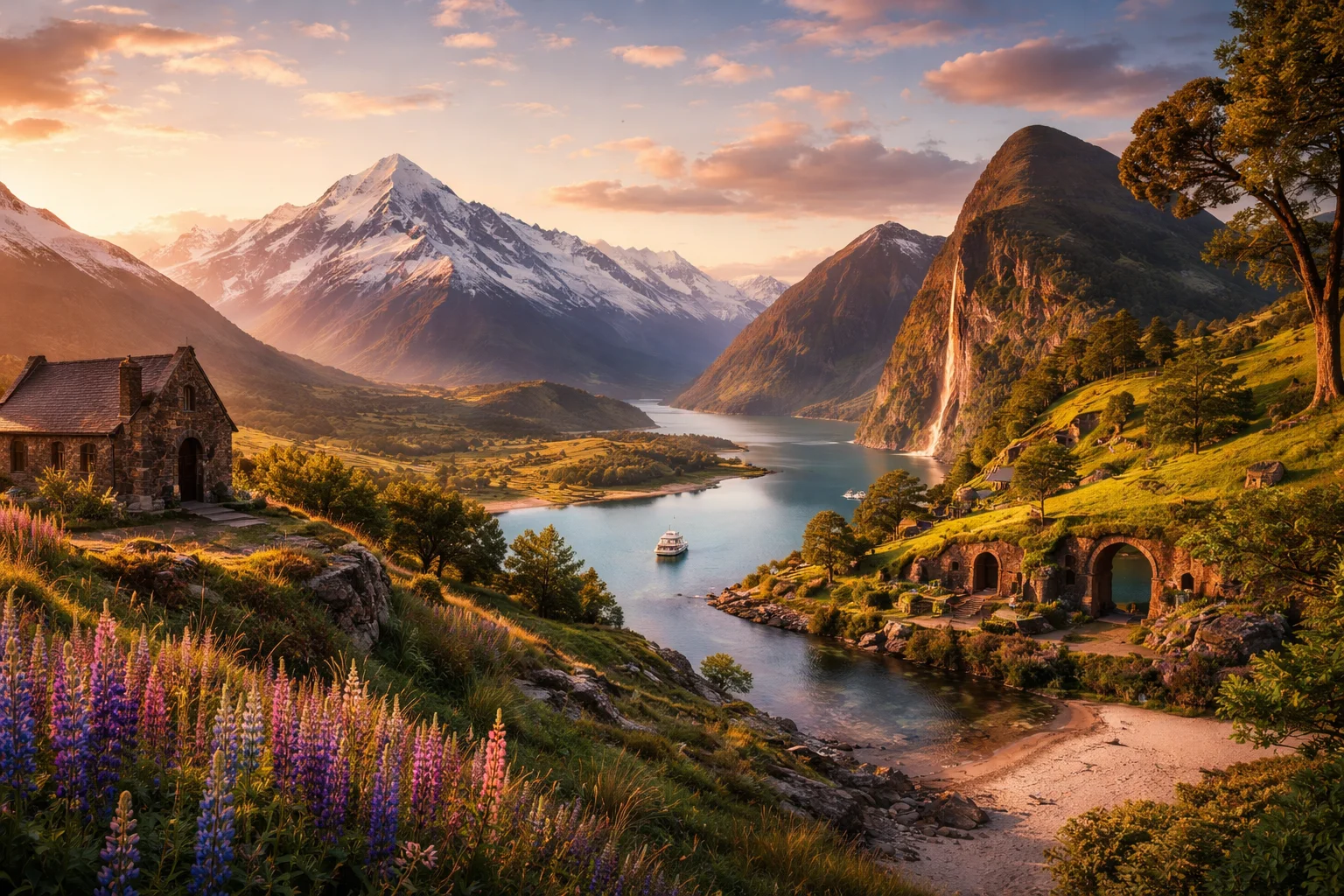
New Zealand overview
New Zealand is a sovereign island nation in the southwestern Pacific Ocean made up primarily of two large landmasses, the North and South islands, plus numerous smaller islands. Straddling the boundary between the Pacific and Australian tectonic plates, it combines temperate pastoral lowlands, active volcanoes and alpine ranges. New Zealand is notable for its high proportion of endemic species, a legally recognised indigenous Māori culture, and an economy shaped by agricultural exports and creative industries. The country has no land borders and a dispersed population concentrated in a few urban centers.
Common Geography Questions About New Zealand
Where New Zealand is located
New Zealand sits in the South Pacific, roughly centred near 41°S, 174°E, about 2,000 kilometres southeast of Australia. It has no land borders with other states; its closest neighbours are Pacific island nations and Australia across the Tasman Sea. The country is bounded by the Tasman Sea to the west and the Pacific Ocean to the east, with the Cook Strait separating the North and South islands. Unique among nations, New Zealand largely overlies the submerged continental fragment Zealandia and lies directly on an active plate boundary, giving its location both insular and geologically dynamic.
Geography and landscape of New Zealand
New Zealand’s geography is sharply varied: the Southern Alps run the length of the South Island and include Aoraki/Mount Cook, while the North Island contains the central volcanic plateau and the caldera of Lake Taupō. Rivers such as the Waikato and Clutha traverse pastoral plains; Fiordland’s steep fiords and West Coast glaciers like Franz Josef are dramatic exceptions to rolling farmland. The Taupō Volcanic Zone and Rotorua’s geothermal fields create surface geothermal activity uncommon in most temperate countries. Regional contrasts—volcanic North Island, alpine South Island, subantarctic outliers—define local land use and biodiversity patterns.
New Zealand culture and society
English, te reo Māori and New Zealand Sign Language are official languages in New Zealand, reflecting a legal recognition of indigenous language alongside colonial heritage. Māori cultural protocols such as pōwhiri (formal welcome) and the haka persist in public life and legal practice; the Treaty of Waitangi continues to inform public policy and resource settlements. The population is urbanised with significant concentration in a handful of metropolitan areas; there is a distinct bicultural public sphere and visible Pacific Islander communities concentrated in some cities. Social customs emphasise informal address and outdoor recreational life anchored in local landscapes.
History of New Zealand
New Zealand’s history begins with Polynesian navigators who settled the islands as part of East Polynesian expansion and developed distinct iwi and hapū (tribal) societies. European contact in the 17th and 18th centuries accelerated with mapping and trade, culminating in the 1840 Treaty of Waitangi that framed relations between Māori and the British Crown. Subsequent conflicts over land and sovereignty shaped regional politics; over the late 19th and 20th centuries New Zealand evolved from colony to dominion and then to a fully autonomous state within the Commonwealth. Its historical arc includes early women’s suffrage and distinctive legal arrangements arising from treaty settlements.
New Zealand economy and government
New Zealand operates a unitary parliamentary representative democracy under a constitutional monarchy, with a single-chamber Parliament elected by mixed-member proportional representation (MMP). It lacks a single codified constitution; governance rests on statutes, constitutional conventions and the Treaty of Waitangi as a founding instrument. The economy blends commodity exports—particularly dairy and meat via large cooperatives—with services such as tourism, film production and technology. The national currency is the New Zealand dollar (NZD). Regional governance relies on a mix of regional councils and unitary authorities that manage land and water resources in a geographically fragmented state.
Regions and major cities of New Zealand
Administratively New Zealand is divided into regions and territorial authorities rather than federal states; regional councils manage environmental planning while unitary authorities combine regional and local powers. Major cities include Wellington (the capital, seat of national government and located at the south-west tip of the North Island), Auckland (the largest urban centre built atop a volcanic field), and Christchurch (the South Island’s principal city, defined by the Canterbury Plains). Geographic regions—Northland, Waikato, Bay of Plenty, Canterbury, Otago and Fiordland—carry distinct economic and cultural identities tied to landform and climate.
Distinctive characteristics of New Zealand
New Zealand is widely associated with a handful of concrete items: the endemic flightless kiwi bird and its symbolic use for national identity; internationally prominent conservation work on predator-free offshore sanctuaries; and a strong cinematic and creative reputation exemplified by large-scale film production facilities and effects houses. The country’s nuclear-free policy and active role in Antarctic logistics (including the Ross Dependency) are specific diplomatic trademarks. In sport and popular culture, New Zealand’s rugby teams and the haka provide globally recognisable cultural markers that consistently link back to the nation.
Places in New Zealand
Abel Tasman National Park
Abel Tasman National Park is a protected coastal national park at the northern end of New Zealand’s South Island. It conserves a concentrated sequence of beaches, granite headlands, and coastal forest. The park covers about 225 square kilometres, including mainland conservation land and offshore islets. Its significance derives from the compact juxtaposition of marine-influenced ecosystems, recorded archaeological sites, and long-term ecological research value.
Aoraki
Aoraki is the Māori name for New Zealand’s highest mountain, a 3,724-metre peak in the Southern Alps of the South Island. Rising more than three thousand metres above nearby valley basins, the massif has exceptionally steep local relief. It is culturally important to Ngāi Tahu, central to alpine and glaciological research, and a defining feature of New Zealand’s mountainous spine.
Aoraki / Mount Cook National Park
Aoraki / Mount Cook National Park is a protected alpine park in New Zealand centered on Aoraki / Mount Cook, the country’s highest peak at 3,724 metres. The park preserves extensive high‑mountain terrain and glacial systems and serves as a focal point for alpine science and mountaineering. It contains formal national park status under New Zealand law and forms a major component of the South Island’s mountainous landscape and natural heritage.
Aoraki Mount Cook National Park
Aoraki Mount Cook National Park is a high-alpine national park in New Zealand, on the South Island in the Southern Alps. Centred on Aoraki / Mount Cook, New Zealand’s highest peak, it includes alpine basins, glaciated valleys and the Tasman Glacier, the country’s longest glacier, and is protected under New Zealand conservation law.
Auckland
Auckland is New Zealand's largest urban area and principal city, located on the North Island. It serves as a major commercial and cultural centre and functions as a regional administrative unit. The city is administered by a single unitary authority, Auckland Council, which governs an area exceeding 4,800 square kilometres, including extensive urban, rural and island territories. Its harbour and maritime links underpin much of its role in national trade and transport.
Auckland Airport
Auckland Airport is a major international airport in New Zealand that serves the Auckland metropolitan area. The airport functions as the region’s principal air transport hub, featuring a consolidated terminal complex and two parallel paved runways that accommodate commercial jet operations. Auckland Airport handles scheduled domestic and international services and includes a large apron area, cargo precincts, and aircraft maintenance facilities that together define its role in national and international air transport networks.
Auckland War Memorial Museum
Auckland War Memorial Museum is a museum and war memorial in New Zealand. It occupies a prominent hilltop site within the Auckland Domain and is registered as a Category I historic place. The institution holds major collections across natural history, Pacific and Māori material culture, and military heritage, and it functions as both a commemorative memorial and an active research museum. The entry complex, galleries, and conservation facilities form a civic campus focused on preservation and interpretation.
Auckland Zoo
Auckland Zoo is a zoological park in New Zealand that manages a curated collection of living animals for conservation and research. It is located in a parkland setting adjacent to Western Springs Park, forming a discrete institutional campus within the Auckland urban area. The zoo operates under municipal governance and maintains habitat-based enclosures, public-facing educational facilities, and a documented species collection recognized in regional conservation programmes.
Bay of Islands
The Bay of Islands is a sheltered coastal embayment and archipelago on the east coast of New Zealand’s North Island, off the Northland peninsula. Its geography includes approximately 144 islands, protected waters, deep tidal channels, rocky headlands, beaches, and estuaries, giving it historical, cultural, and ecological importance within the region.
Canterbury Museum
Canterbury Museum is a public museum in Christchurch, New Zealand. It occupies a purpose-built complex on Rolleston Avenue, immediately north of Christchurch Botanic Gardens, and serves as the principal regional repository for collections related to the natural history, human history, and Antarctic research of the Canterbury region. The complex includes a historic stone gallery facing the gardens and later gallery wings that house exhibition spaces and collection stores under museum conservation standards.
Doubtful Sound
Doubtful Sound is a fjord in New Zealand located on the southwest coast of the South Island. It is significant for its long, narrow inlet morphology and for receiving the tailrace discharge from the Manapouri hydroelectric scheme into Deep Cove; the fjord extends roughly 40 kilometres when measured along its main axis and contains deep basins separated by sills. This combination of dimensions and engineered freshwater input defines its physical and ecological character.
Dusky Sound
Dusky Sound is a fjord on the southwest coast of New Zealand's South Island and a major inlet of the Tasman Sea. The feature is significant for its island-studded inner waters and formal inclusion in the Te Wahipounamu UNESCO World Heritage Area. Dusky Sound contains a complex shoreline of sheltered bays and islands and sits within a nationally recognized natural system that is managed for conservation and scientific research.
Explore Natural Landmarks in New Zealand
Browse islands and mountains connected with New Zealand to keep exploring related geography clusters.