Mongolia Guide
Mongolia overview
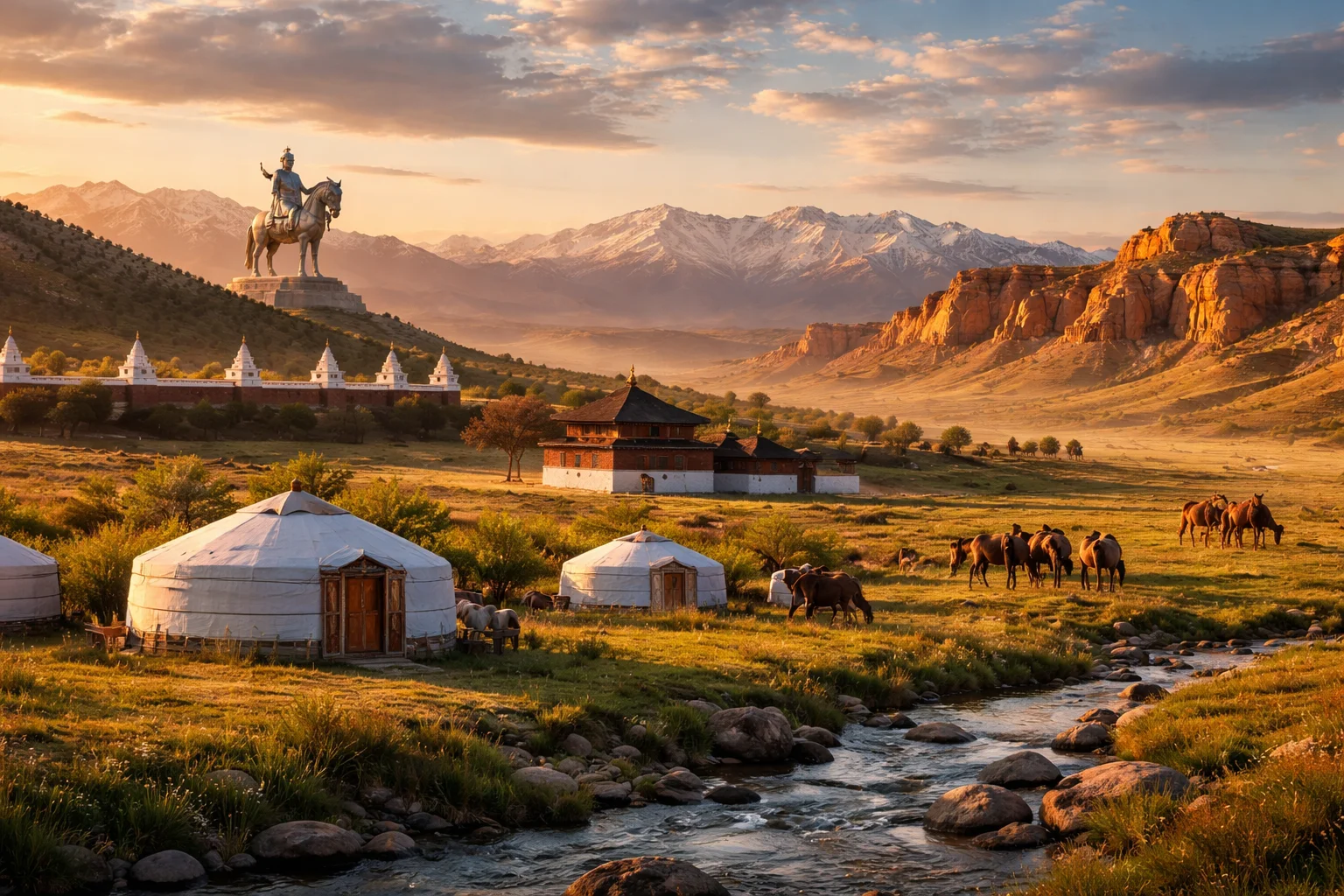
Mongolia is a landlocked East-Central Asian nation defined by its vast steppe, desert basins and a long nomadic heritage. Straddling the Mongolian Plateau between Russia and China, Mongolia combines sparse population density with a concentrated urban center: a large share of the country’s people live in the capital while much of the territory remains pastoral. Its significance rests on a distinctive pastoral economy, a strong historical identity tied to the Mongol Empire, and extreme continental climate conditions that shape daily life and settlement patterns. Mongolia’s cultural markers and natural openness make it a frequent subject of geographic and anthropological study.
Common Geography Questions About Mongolia
Where Mongolia is located
Mongolia lies in north-central Asia, roughly between 42°–52°N latitude and 87°–120°E longitude, occupying the interior of the Eurasian landmass. It is landlocked and borders exactly two states: Russia to the north and China to the south, east and west—an unusual bilateral border arrangement among large countries. There is no coastline; instead Mongolia’s location is defined by inland waters such as Lake Khövsgöl in the north and the Selenge River system that drains toward Lake Baikal. The country sits between the Siberian taiga and the Gobi Desert, forming a climatic and ecological transition zone.
Geography and landscape of Mongolia
The geography of Mongolia ranges from alpine Altai Mountains in the west to the hyper-arid Gobi Desert in the south; central provinces are dominated by rolling grassland steppe. Permafrost and sand dunes coexist within a few hundred kilometers of one another, a contrast uncommon at this scale. Major ranges include the Altai and Khangai; principal rivers are the Selenge and Onon; Lake Khövsgöl is a deep, glacial-fed freshwater reserve. Mongolia’s high average elevation and continentality produce hot summers, bitter winters and frequent dzud events that critically affect livestock—conditions that structure land use and human mobility across its geography.
Mongolia culture and society
Mongolia’s culture centers on the Mongolian language (Khalkha dialect) written primarily in Cyrillic since the 1940s, with renewed institutional support for the traditional vertical Mongolian script in schools—a revival unique in the region. Nomadic pastoralism, ger (yurt) dwellings, horse-centered practices and seasonal herd movements persist alongside urban lifestyles. Tibetan Buddhism and shamanic practices coexist, and a significant Kazakh minority in the far west maintains Turkic language and Islamic customs, including Kazakh eagle-hunting. Low population density and heavy urban concentration around the capital shape social policy and intergenerational ties in Mongolia’s communities.
History of Mongolia
Mongolia’s history pivots from steppe pastoral tribes to the 13th‑century expansion under Genghis Khan that forged the largest contiguous land empire in history, altering trade, diplomacy and warfare across Eurasia. After fragmentation into khanates and later incorporation into the Qing dynasty, the territory declared independence in 1911 and established a Soviet-aligned People’s Republic in the 20th century. A peaceful democratic transition around 1990 replaced single-party rule with a multiparty system, reshaping property, language policy and external economic orientation. Mongolia’s historical role uniquely links Central Asian steppe dynamics to both East Asian and European histories.
Mongolia economy and government
Mongolia is a parliamentary republic with a President as head of state and a Prime Minister leading the government, and a single‑chamber legislature known as the State Great Khural. The economy depends heavily on mineral extraction—notably large copper and coal deposits including the Oyu Tolgoi project—and on livestock herding; Mongolia uniquely has many tens of millions of animals, outnumbering human inhabitants by a wide margin. The national currency is the tögrög (tugrik). Political life balances resource-driven growth, rural livelihoods and frequent negotiations with major neighbors over trade and investment. Mongolia’s fiscal profile is therefore tightly linked to commodity cycles.
Regions and major cities of Mongolia
Administratively, Mongolia is divided into 21 aimags (provinces) plus the capital municipality. Ulaanbaatar is the capital and largest city; it functions as an economic, cultural and political hub and is notable for being the coldest national capital by average temperature. Other major cities include Erdenet, built around a large copper mine, and Darkhan, created as an industrial center; Bayan-Ölgii in the west is distinct for its Kazakh majority culture. Regional distinctions—Gobi Desert south, central steppe, Khangai highlands and Altai mountains—correspond to different livelihoods and demographic patterns across Mongolia.
Distinctive characteristics of Mongolia
Mongolia is widely associated with a set of concrete global signifiers: the historical legacy of the Mongol Empire and Genghis Khan, internationally recognized paleontological finds from the Gobi (including prolific dinosaur egg sites), throat-singing (khöömei) and equestrian traditions such as nomadic horse culture and mounted archery. The Soyombo symbol on the national flag and the ger as living architecture are visual identifiers. Economically, Mongolia is linked to large-scale copper and coal projects that draw multinational attention. Its combination of vast open landscapes, low population density and living nomadic practices is a distinctive global profile.
Places in Mongolia
Gobi Desert
Gobi Desert is a vast cold desert region in East Asia, occupying large areas of southern Mongolia and northern China. The Mongolian portion of the Gobi Desert covers diverse landscapes and includes dune systems, gravel plains, and mountain ranges. It extends across approximately 1.3 million square kilometres, making it one of the largest desert regions in Asia. The area holds major palaeontological, ecological, and cultural significance within Mongolia's geographic identity.
National Museum of Mongolia
National Museum of Mongolia is the state-designated national museum of Mongolia, located in the capital city of Ulaanbaatar. The institution serves as the central public repository for Mongolia’s archaeological, ethnographic, and historical collections and is formally recognized as the country’s principal museum institution. The museum maintains permanent exhibition halls, research and conservation facilities, and a national collection custody role that aligns with Mongolia’s cultural heritage governance.
National University of Mongolia
National University of Mongolia is a public national university in Mongolia and the country’s oldest modern higher education institution. It is located in the capital city of Ulaanbaatar and was founded in 1942 by government decree as a formal center for higher learning. The university serves as a principal institution for undergraduate and graduate education in the country and functions as a primary national research and teacher-training hub. Its formal status as a state university and its continuous operation since 1942 are measurable, verifiable facts that define its institutional role.
Ulaanbaatar
Ulaanbaatar is the capital and largest city of Mongolia, located in the north-central part of the country. It functions as Mongolia's political, cultural, and economic center, hosting national government institutions, universities, and research centers. The municipality covers approximately 4,704 square kilometers and lies at about 1,350 meters above sea level. The municipality contains the country's highest concentration of population, infrastructure, and institutional authority.