Monaco Guide
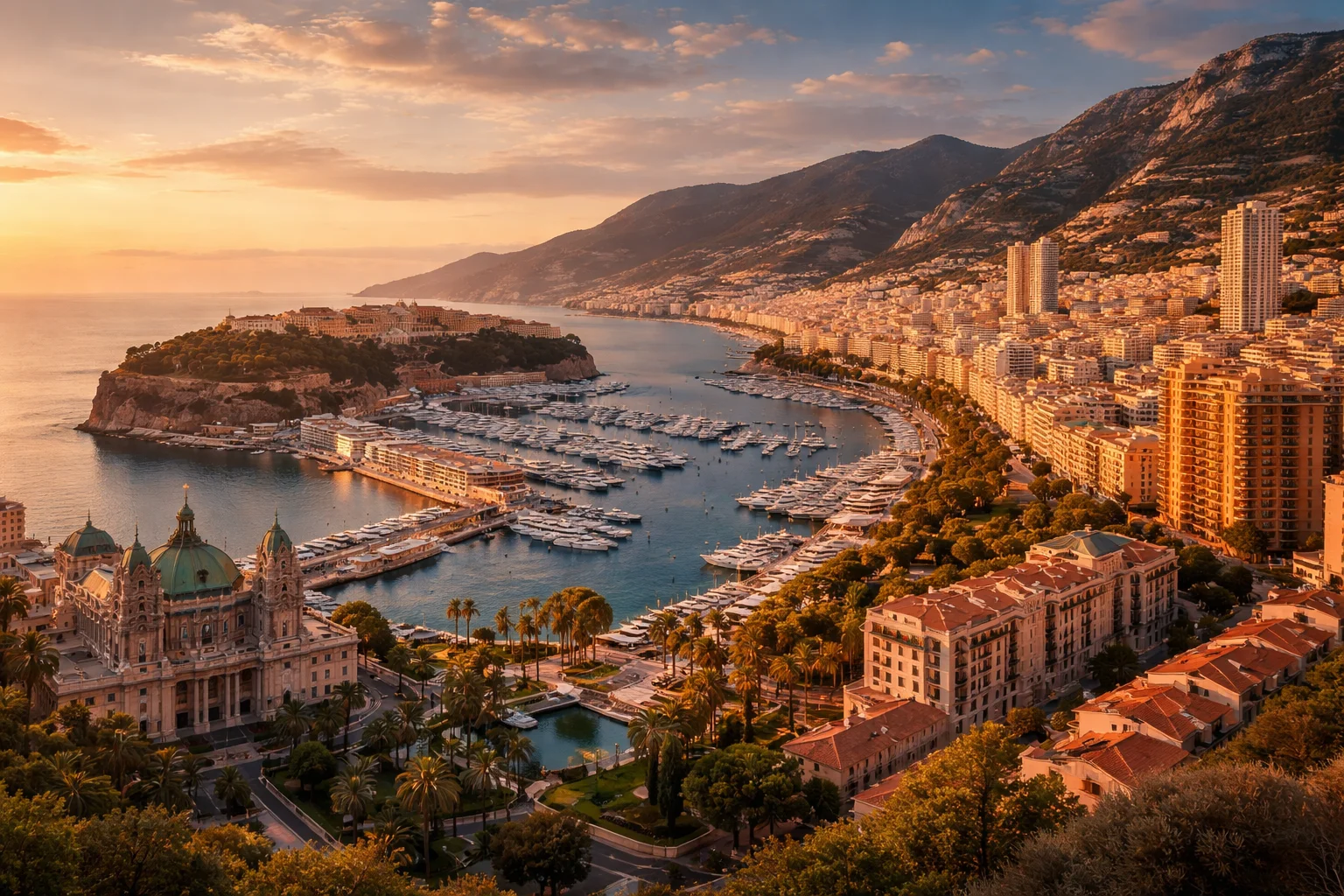
Monaco overview
Monaco is a sovereign city-state on the Mediterranean coast of Western Europe governed as a hereditary constitutional monarchy. Occupying under two square kilometers—making it the second-smallest independent state in the world—Monaco combines extremely dense urban development, a long-standing dynastic ruling family, and an economy oriented toward finance, luxury services and tourism. Its compact territory is largely built-up, with a distinctive mix of 19th-century casino architecture and modern reclaimed neighborhoods. For many searches about Monaco, the salient facts are its unique jurisdictional status, concentrated wealth, and concentration of international institutions in a tiny footprint.
Common Geography Questions About Monaco
Where Monaco is located
Monaco sits on the French Riviera (Côte d’Azur) in southern Europe at roughly 43.7384° N, 7.4246° E. The principality shares a land border only with France—no other country borders Monaco—and has a short coastline on the Mediterranean Sea facing the Ligurian Sea. Its immediate neighbors on land are the French Alpes-Maritimes department; Nice lies about 20 kilometers to the west. Monaco’s location at the mouth of the Var valley and its coastal position have historically determined its role as a maritime and leisure node rather than an agricultural hinterland, a contrast that explains much about Monaco’s urban geography and land-use choices.
Geography and landscape of Monaco
Monaco’s geography is dominated by steep, rocky terrain rising directly from the Mediterranean; the highest natural point, on the slopes of Mont Agel, reaches about 161 meters above sea level. There are no navigable rivers; drainage is handled by short seasonal streams and engineered channels. What distinguishes Monaco is the extent of artificial expansion: land reclamation projects, notably Fontvieille, created substantial new neighborhoods on former seabed. The urban fabric is organized in terraces and narrow coastal plains, producing microclimates across a few hundred meters—sunny seafront boulevards, shaded cliffside alleys, and elevated residential plateaus—rather than broad regional landscape zones common elsewhere.
Monaco culture and society
French is the official language of administration in Monaco, while Monégasque—a Ligurian dialect—is recognized, taught in schools and used in ceremonial contexts; Italian and English are also commonly heard. The resident population includes a distinct, small group of native Monégasque citizens with specific family names and citizenship traditions, but a majority of residents are foreign nationals, which shapes household structures and cultural life. Roman Catholicism has historically been dominant in rites and public celebrations, yet civic culture emphasizes multilingualism and elite leisure traditions. Local customs such as the annual National Day (Fête du Prince) and princely ceremonies continue to anchor a compact civic identity unique to Monaco.
History of Monaco
Monaco’s history centers on the Grimaldi family seizing the Rock of Monaco in 1297—an episodic origin often linked to François Grimaldi’s disguise as a monk—and establishing dynastic rule that endures. For centuries the territory oscillated between Genoese, Savoyard and French influence before 19th-century diplomatic arrangements secured its sovereignty. The mid-1800s saw a pivotal economic reorientation: the establishment of casino gaming and railway connections transformed a fishing community into a resort and financial hub. Constitutional reforms in the early 20th century limited princely powers while preserving the monarchy; through shifting regional politics, Monaco retained international recognition as a compact sovereign state.
Monaco economy and government
Monaco is a constitutional monarchy headed by a Prince; its political institutions combine the prerogatives of the sovereign with a legislature (the National Council) and an executive (the Council of Government). Administratively Monaco operates as a single commune, so national and municipal functions coincide. The economy is concentrated in services: private banking and wealth management, tourism anchored by luxury hotels and casinos, high-end real estate, and maritime services for yachts. Monetary practice is distinctive: Monaco uses the euro under formal arrangements and issues Monegasque euro coins with national designs. A long-standing policy absence of a general personal income tax has been central to Monaco’s economic model and resident attraction strategy.
Regions and major cities of Monaco
Monaco is not divided into independent cities but into wards and quarters; officially it is one commune and a single city-state. The historic administrative center is Monaco-Ville, the capital quarter perched on "the Rock" and home to the princely palace. Monte-Carlo is the entertainment and casino district, noted for casino architecture and cultural venues; La Condamine is the market and port area surrounding the old harbor; Fontvieille is a 20th-century neighborhood built on reclaimed land that hosts industrial, residential and sports facilities. These subdivisions function as neighborhoods for planning and services rather than separate municipalities, a structure uncommon among sovereign states.
Distinctive characteristics of Monaco
Several concrete features define Monaco’s global profile: the Monaco Grand Prix, a Formula One street race laid out through city streets; the Casino de Monte-Carlo, which catalyzed the principality’s modern economy; and Port Hercules, a deep-water harbor renowned for hosting superyachts. Monaco also issues its own euro coins and philatelic stamps, and its fiscal and financial arrangements have given it a prominent role in private banking and wealth management. Cultural exports include associations with the Monte Carlo method in statistics—named after the casino’s gambling—an unusual interplay of scientific vocabulary and a small-state leisure economy.