Moldova Guide
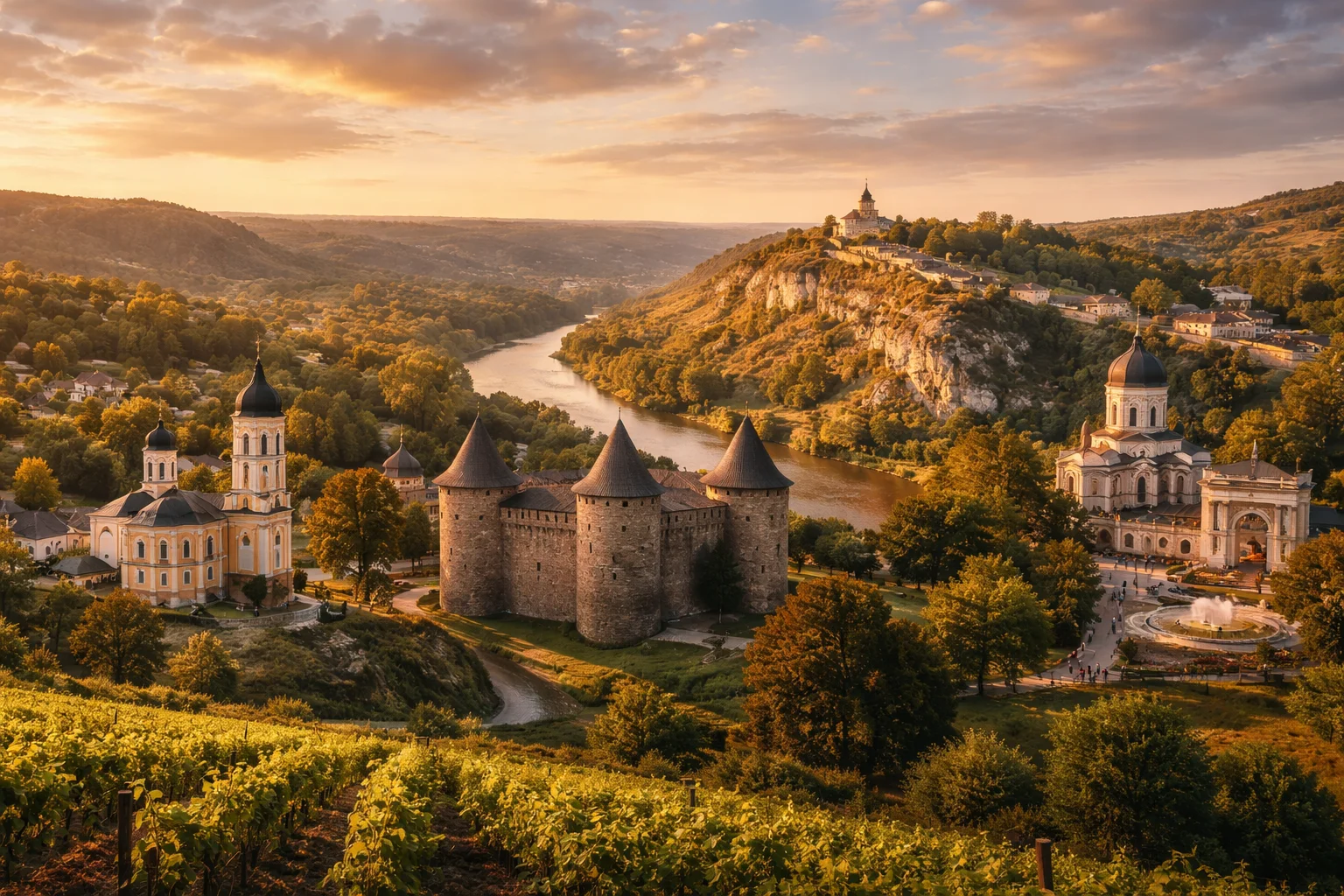
Moldova overview
Moldova is a small, landlocked country in Eastern Europe known for its intensive viticulture and a complex post-Soviet political geography. Straddling the historical region of Bessarabia, Moldova combines rolling agricultural plains, the Dniester River boundary, and a notable legacy of Soviet-era institutions that shaped its language policy and administration. The country’s global profile is disproportionately tied to two concrete facts: the Mileștii Mici underground wine cellars—recognized for their vast labeled collection—and the presence of the breakaway territory of Transnistria along the eastern bank of the Dniester.
Common Geography Questions About Moldova
Where Moldova is located
Moldova lies in southeastern Europe between roughly 45° and 49° north latitude and 26° to 30° east longitude, positioned on the western edge of the Pontic–Caspian steppe. Bordered to the west by Romania and to the north, east and south by Ukraine, Moldova is entirely landlocked despite being within a short overland distance of the Black Sea. The Prut River forms much of its western boundary with Romania while the Dniester (Nistru) runs along the country's eastern flank; the de facto border with Transnistria follows that river in places, marking Moldova’s distinctive cross-border geography.
Geography and landscape of Moldova
Moldova’s terrain is dominated by rolling plateaus, river valleys and forested hills rather than high mountains; its highest point is Bălănești Hill at about 430 meters above sea level. The country’s soils—deep chernozems on the central plateau—support dense vineyards and cereal cultivation, a geographical trait that concentrated viticulture on gentle slopes and terraces unique to Moldova’s small area. Climatically it has a temperate continental pattern with warm summers and cold winters, and regional variation runs north-to-south: the north is more forested and fragmented, while the south exhibits steppe-like open plains adjoining the Bugeac region.
Moldova culture and society
Romanian is the official language of Moldova, but Russian remains a widespread lingua franca, and Gagauz (a Turkic language) is officially used within the autonomous region of Gagauzia—a linguistic and administrative arrangement rare among European states. Eastern Orthodoxy shapes many social rhythms, yet local practice blends Romanian liturgical traditions with Soviet-era secular customs. Folk music, hora dances and household wine-making persist alongside strong patterns of labor migration; Moldova’s culture is distinctive for the institutional coexistence of Latin-script Romanian and the historical legacy of a Cyrillic “Moldovan” written form imposed under Soviet rule.
History of Moldova
Moldova’s story begins with the medieval Principality of Moldavia, which later balanced Ottoman suzerainty and regional powers. In the 19th century much of the area known as Bessarabia was annexed by the Russian Empire; after World War I parts united with Romania, only to be reconfigured into the Moldavian Soviet Socialist Republic in 1940. The dissolution of the USSR produced independence in 1991 and a violent 1992 conflict in Transnistria that led to a frozen, internationally unresolved territorial division. These shifts explain why Moldova’s contemporary institutions mix Romanian cultural continuity with Soviet administrative legacies.
Moldova economy and government
Moldova is a parliamentary republic with a president, a parliament (Legislative), and a prime minister who heads the government; the constitutional structure emphasizes legislative supremacy over executive power. The economy relies heavily on agriculture—particularly grapes and wine—alongside food processing, light manufacturing and an expanding information-technology services sector. The national currency is the Moldovan leu. Two features shape fiscal dynamics: historically significant remittances from migrants working abroad and the commercial importance of large underground wine cellars such as Mileștii Mici, which underpin a specialized export niche in the country’s economy.
Regions and major cities of Moldova
Administratively Moldova is divided into raions (districts), three municipalities with special status, and two territorial anomalies: the autonomous territorial unit of Gagauzia in the south and the self-proclaimed Transnistrian Moldovan Republic along the Dniester. The capital, Chișinău, is the political and cultural center and sits on the Bîc River. Other major cities include Tiraspol—the de facto capital of Transnistria—and Bălți, a northern urban center; each city reflects different historical orientations: Chișinău a Romanian-Soviet mix, Tiraspol a Soviet-built administrative hub, and Bălți a trade node for the north.
Distinctive characteristics of Moldova
Moldova is globally associated with wine at scale: the Mileștii Mici and Cricova underground cellars are internationally known for their size and visitor programs. The country is also notable for the unresolved Transnistria separation, an uncommon example in Europe of a frozen territorial dispute with a de facto administration. Additionally, Moldova’s Gagauz autonomous region—where a Turkic-speaking Orthodox community exercises official self-rule—stands as an unusual combination of ethnicity, language and religion for the continent. Archaeological and monastic sites such as Orheiul Vechi give Moldova a concentrated cultural-heritage profile despite its small size.
Places in Moldova
Chișinău
Chișinău is the capital city of the Republic of Moldova, serving as the country's principal political and administrative center. It lies in central Moldova and has a municipal population of approximately 500,000 residents. The city is significant for its concentration of national institutions, cultural venues, and research collections. Chișinău also attracts attention in studies of urban transformation and architectural features that reflect layered imperial, interwar, and Soviet influences.
Moldova State University
Moldova State University is a public national university in the Republic of Moldova and the country’s principal institution of higher education. Founded in 1946, Moldova State University holds formal status as a state university established by government decree and occupies a multi-building campus in central Chișinău. The university combines undergraduate and graduate instruction with organized research units and a university library that functions as a major scholarly collection for Moldova’s academic community.
Orheiul Vechi
Orheiul Vechi is an archaeological and cultural landscape in central Moldova, defined by a limestone gorge carved by the Răut River. The site combines rock-cut monastic structures and surface settlements with approximate coordinates 47.33°N, 28.82°E. Orheiul Vechi is significant for its long sequence of human occupation preserved in stratified archaeological deposits and for a visually prominent cliff face rising roughly 40 meters above the riverbed. The location informs studies of regional settlement patterns and monastic architecture.