Luxembourg Geography, Location, Rivers & Regions
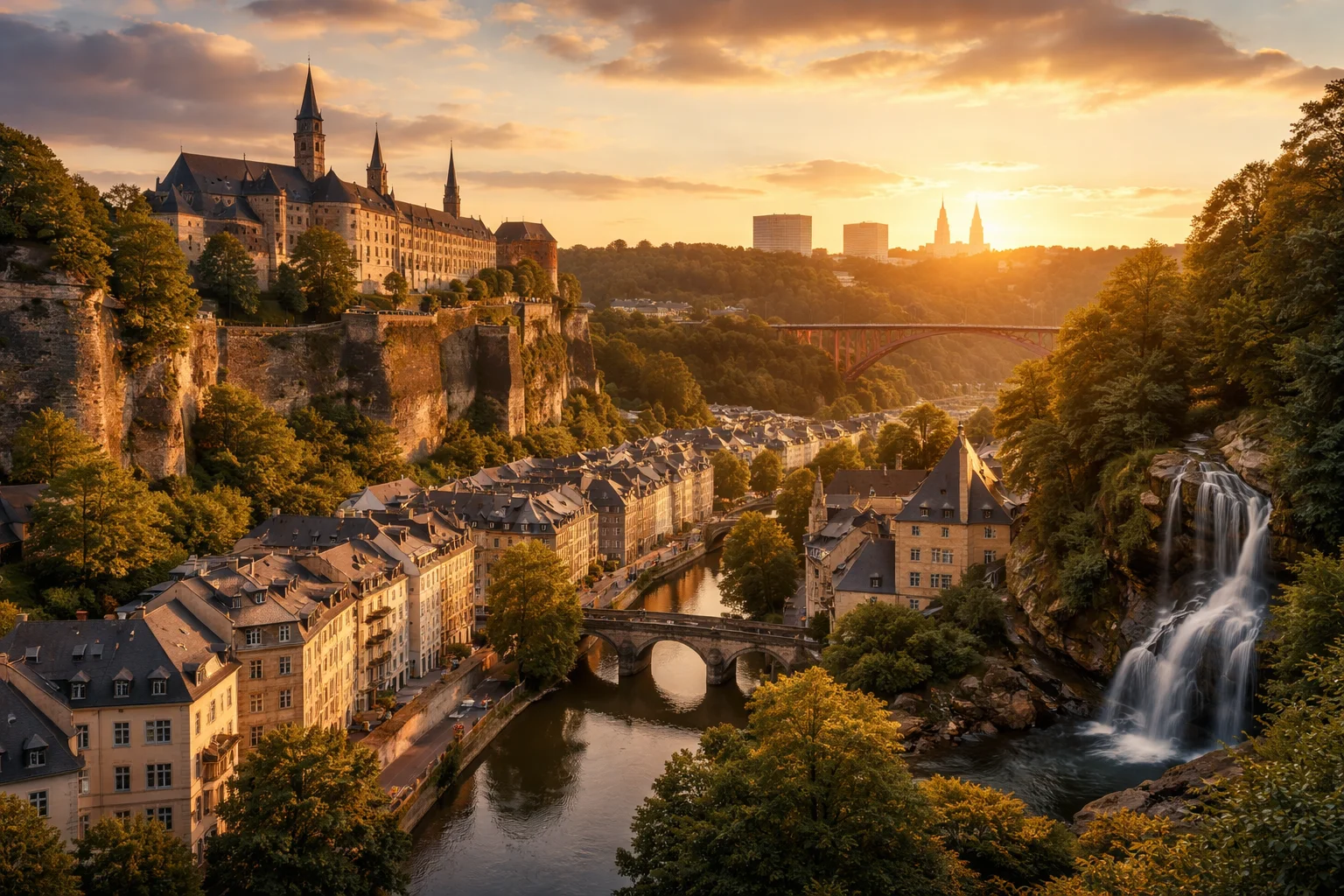
Short answer
Quick answer about Luxembourg
Luxembourg is a small landlocked country in Western Europe.
Its geography is commonly divided between the forested Ardennes uplands in the north and the lower Gutland region in the south.
Location: Western Europe
Capital: Luxembourg City
Regions: Oesling/Ardennes in the north and Gutland in the south
Rivers: Moselle, Alzette, Sauer, and Our
Borders: Belgium, France, and Germany
Luxembourg overview
Luxembourg is a small, landlocked sovereign grand duchy in Western Europe and the only country in the world with a grand duke as its head of state. Located at the crossroads of Germanic and Romance Europe, Luxembourg combines a compact territory with outsized institutional and financial influence. The country’s multilingual public life—where Luxembourgish, French and German coexist—shapes education, law and everyday commerce. Despite a population under a million, Luxembourg punches above its weight as an EU seat, a major investment-fund domicile and a historical crossroads between Belgium, France and Germany.
Common Geography Questions About Luxembourg
Where Luxembourg is located
Luxembourg sits in northwestern Europe, roughly between 49.5° and 50.5°N latitude and 5.7° and 6.5°E longitude, making it one of the continent’s most compact sovereign states. It is bordered by Belgium to the west and north, Germany to the east, and France to the south. The Moselle River traces a portion of the eastern boundary with Germany, and the Sûre (Sauer) also crosses from the north toward the east. Because it is landlocked and centrally placed among Benelux and Rhine-Ruhr transport corridors, Luxembourg’s location defines its role as a transnational hub for finance and cross-border commuting.
Geography and landscape of Luxembourg
Topographically, Luxembourg divides into the Oesling in the north—part of the Ardennes—and the more densely settled Gutland to the south; the two regions differ sharply in elevation and land use. The country’s high point, Kneiff, reaches about 560 metres, while the lowlands near the Moselle valley drop to around 130 metres. The southern "Terres Rouges" feature iron-rich red soils that historically powered a concentrated steel belt around Esch-sur-Alzette. The Müllerthal, nicknamed “Little Switzerland,” presents sandstone rock formations and narrow hiking paths that contrast with the rolling farmland and vineyards of the Moselle corridor.
Luxembourg culture and society
Luxembourg’s public culture is defined by institutional multilingualism: Luxembourgish serves as the national language of everyday life, while French and German are used in administration, media and courts. The country runs a trilingual education system that shifts instruction between German and French and elevates Luxembourgish socially. Religious heritage is predominantly Roman Catholic, expressed in long-standing fairs such as the Schueberfouer, founded in 1340. Demographically, Luxembourg has a high share of foreign-born residents and a daily influx of cross-border commuters from Belgium, France and Germany, producing a distinctive cosmopolitan social mix uncommon in comparably sized states.
History of Luxembourg
Luxembourg’s history centers on a fortified medieval county that rose to ducal status and provided emperors for the Holy Roman Empire; the House of Luxembourg produced figures such as Charles IV. Over centuries the territory passed between Burgundian, Spanish and Austrian Habsburg control before its 19th-century repositioning as a constitutional Grand Duchy. The 19th-century treaties—especially the 1839 and 1867 agreements—partitioned territory and demanded dismantling of the city’s fortress, a process that left UNESCO-recognized fortifications as heritage. Luxembourg later transitioned from a regional steel producer to a financial and institutional hub within Benelux and the European integration project.
Luxembourg economy and government
Luxembourg is a constitutional monarchy headed by a grand duke, with executive power exercised by a prime minister and collegiate cabinet and legislative authority vested in a unicameral Chamber of Deputies. Administratively it relies on communes and a compact national bureaucracy. Economically, the country uses the euro and is notable for a dominant financial sector: it is one of Europe’s largest domiciles for investment funds and international private banking. The economy also retains industrial legacies in steel and hosts global firms such as the satellite operator SES. Luxembourg’s small domestic market is balanced by a workforce that is cosmopolitan and highly mobile across borders.
Regions and major cities of Luxembourg
Administratively, Luxembourg is divided into twelve cantons and a network of communes that manage local services; former larger districts were abolished as part of modern reforms. The capital, Luxembourg City, doubles as the country’s political core and a judicial seat for European institutions. Esch-sur-Alzette, in the southern “Terres Rouges,” represents the post-industrial evolution of the steel region. Other important towns include Differdange, historically tied to blast-furnace operations, and Dudelange, which sits along major north–south transit routes. Regional identities in Luxembourg hinge on the Oesling’s uplands, Gutland’s agricultural plains, and the Moselle’s vineyards.
Distinctive characteristics of Luxembourg
Luxembourg is singularly associated with its status as the world’s only sovereign grand duchy and with a concentration of European institutions in Luxembourg City, notably the Court of Justice of the European Union and parts of the European Investment Bank. The country is a leading global domicile for investment funds and a center for satellite services through SES, linking it to international finance and space communications. Its listed fortress and old quarters, the iron-rich Terres Rouges that shaped modern industry, and an entrenched trilingual system together create concrete features that make Luxembourg easily identifiable on the global stage.
Places in Luxembourg
Luxembourg
Luxembourg is a sovereign, landlocked country in Western Europe that functions as a compact political and economic center. It covers approximately 2,586 square kilometers and has a population near 645,000 residents. Luxembourg’s significance stems from its role hosting major international institutions and from a diversified, high-income economy with a substantial financial sector. The country’s governance combines constitutional monarchy elements with parliamentary institutions, giving it distinct legal and diplomatic standing within Europe.
Luxembourg Old Town
Luxembourg Old Town is the historic core of Luxembourg City and a conserved ensemble of urban fabric and fortifications. It lies on a rocky promontory that shaped its defensive and administrative role. The area forms part of the Old Quarters and Fortifications UNESCO World Heritage property, a formal international designation. The preserved urban plan includes narrow streets, public squares, and conserved military structures covering an identifiable historic footprint.
University of Luxembourg
University of Luxembourg is a public research university in the Grand Duchy of Luxembourg. It was established by law in 2003 and serves as the country’s only public university, combining teaching and research across multiple campuses. The institution is governed as a public establishment of higher education and research and hosts several national research units, including interdisciplinary centres in systems biomedicine and security. The university’s formal remit includes degree education, doctoral training, and applied research aligned with Luxembourg’s economic and public-policy priorities.
Frequently Asked Questions
What is Luxembourg's geography like?
Luxembourg has uplands and forests in the north and lower, more urban and agricultural landscapes in the south.
Where is Luxembourg located?
Luxembourg is located in Western Europe.
What countries border Luxembourg?
Luxembourg borders Belgium, France, and Germany.