Lithuania Guide
Lithuania overview
Lithuania is a Northern European state on the eastern shore of the Baltic Sea, the largest and most populous of the three Baltic countries. It combines lowland coasts and inland moraine hills, a capital with one of Europe’s largest preserved Baroque old towns, and a language that preserves unusually archaic Indo-European features. Strategically positioned between Nordic, Slavic and Central European spheres, Lithuania has historically acted as a regional crossroads and state-builder. The country’s mix of medieval state legacy and modern EU integration defines its contemporary significance.
Common Geography Questions About Lithuania
Where Lithuania is located
Lithuania sits in northeastern Europe, in the southern part of the Baltic region approximately between 53° and 56° north and 20° and 27° east. It borders Latvia to the north, Belarus to the east and south, Poland to the south, and the Kaliningrad exclave of Russia to the southwest; the Baltic Sea lies to the west. A distinctive geographic fact is its direct land border with the Russian exclave of Kaliningrad—an unusual arrangement that concentrates multiple international frontiers into a compact area. Lithuania’s western margin is defined by its short but strategically important Baltic coastline and port access.
Geography and landscape of Lithuania
Lithuania’s terrain is predominantly lowland with rolling glacial moraines, interspersed wetlands and a network of rivers; there are no high mountain ranges. The Nemunas (Neman) River is the dominant watercourse, carving wide floodplains in the southwest. A uniquely Lithuanian landscape feature is the Curonian Spit, a narrow sand-dune peninsula shared with Kaliningrad and recognized for shifting dunes and fishing villages. Inland differences are pronounced: the hillier, forested north-eastern highlands contrast with flat agricultural plains in the central lowlands, producing micro-regional variations in soils and land use uncommon in many European states.
Lithuania culture and society
Lithuania’s official language is Lithuanian, a Baltic language that retains exceptionally archaic grammatical features distinct from most modern Indo-European tongues. Roman Catholicism is the dominant faith and has shaped visible public customs—seasonal processions, pilgrimage traditions and village festivals—that coexist with folkloric survivals such as polyphonic sutartinės singing. Ethnographic regions like Samogitia maintain distinct dialects and customs, and significant Polish and Russian-speaking minorities give urban areas a multilingual character. Demographically, Lithuania has a relatively small population concentrated in a few cities, and migration patterns have produced a notable diaspora in Western Europe and North America.
History of Lithuania
Lithuania emerged as a major medieval polity in the 13th century as the Grand Duchy of Lithuania, at one point the largest state in Europe by territory, ruling over lands now in Belarus and Ukraine. The dynastic union with Poland created the Polish–Lithuanian Commonwealth, a distinctive political experiment in noble democracy and religious tolerance for its time. Partition and imperial rule erased the independent state in the late 18th century; modern Lithuanian statehood reappeared after World War I. In the 20th century Lithuania endured occupation and Soviet incorporation, and it notably restored its independence through a 1990 parliamentary act, reasserting national institutions and reorienting toward European integration.
Lithuania economy and government
Lithuania is a parliamentary republic with a directly elected president and a unicameral parliament (Seimas) that appoints the government; its constitutional framework combines a ceremonial head of state and a politically empowered legislature. The economy mixes services, manufacturing (notably food processing, furniture and machinery), port logistics and a growing information and financial technology sector; the Bank of Lithuania has been regionally proactive in licensing fintech firms. Lithuania adopted the euro as its currency after joining the European Union, which shaped monetary and trade integration. Public administration is decentralised through municipalities that handle most local services.
Regions and major cities of Lithuania
Administratively Lithuania is divided into municipalities grouped within ten counties, but cultural and historical regions remain salient: Aukštaitija, Žemaitija (Samogitia), Dzūkija and Suvalkija each preserve specific dialects and folk traditions. The capital, Vilnius, is known for its compact Old Town and baroque skyline; Kaunas served as interwar capital and remains the country’s second-largest urban center with an industrial legacy; Klaipėda is Lithuania’s principal seaport on the Baltic coast with a ferry link to Scandinavia and a unique Germanic architectural layer. Regional distinctions often follow older ethnographic boundaries rather than modern administrative lines.
Distinctive characteristics of Lithuania
Lithuania is widely associated with several concrete, recognizable traits: Vilnius Old Town and the Curonian Spit are UNESCO-listed cultural landscapes; the Hill of Crosses near Šiauliai is an unusual and highly visible pilgrimage site created by private devotion; amber craftsmanship and a long Baltic amber trade tradition connect the country to ancient maritime routes. On the global stage Lithuania is noted for its basketball culture and international successes in the sport, and for a fintech-friendly regulatory approach that has made its capital a magnet for digital banking startups. These specific ties anchor Lithuania’s international profile.
Places in Lithuania
Lithuanian Zoo
Lithuanian Zoo is a zoological institution in Kaunas, Lithuania, and the country's principal curated zoo. It is sited within Kaunas city limits and is formally organized as a municipal zoological garden under local institutional management. The facility functions as a scientific and conservation-focused collection with defined accession records and on-site curatorial staff. The property includes managed enclosures and documented collection holdings held as part of the city's cultural and scientific assets.
MO Museum
MO Museum is a contemporary art museum in Lithuania, located in the city of Vilnius. It is a purpose-built institution that holds a public collection focused on modern and contemporary Lithuanian art and stage rotating exhibitions and research activities. The institution functions as a registered cultural museum under Lithuanian museum practice and serves as a center for preservation, curatorship, and public scholarship on twentieth- and twenty-first-century Lithuanian visual art.
Trakai Castle
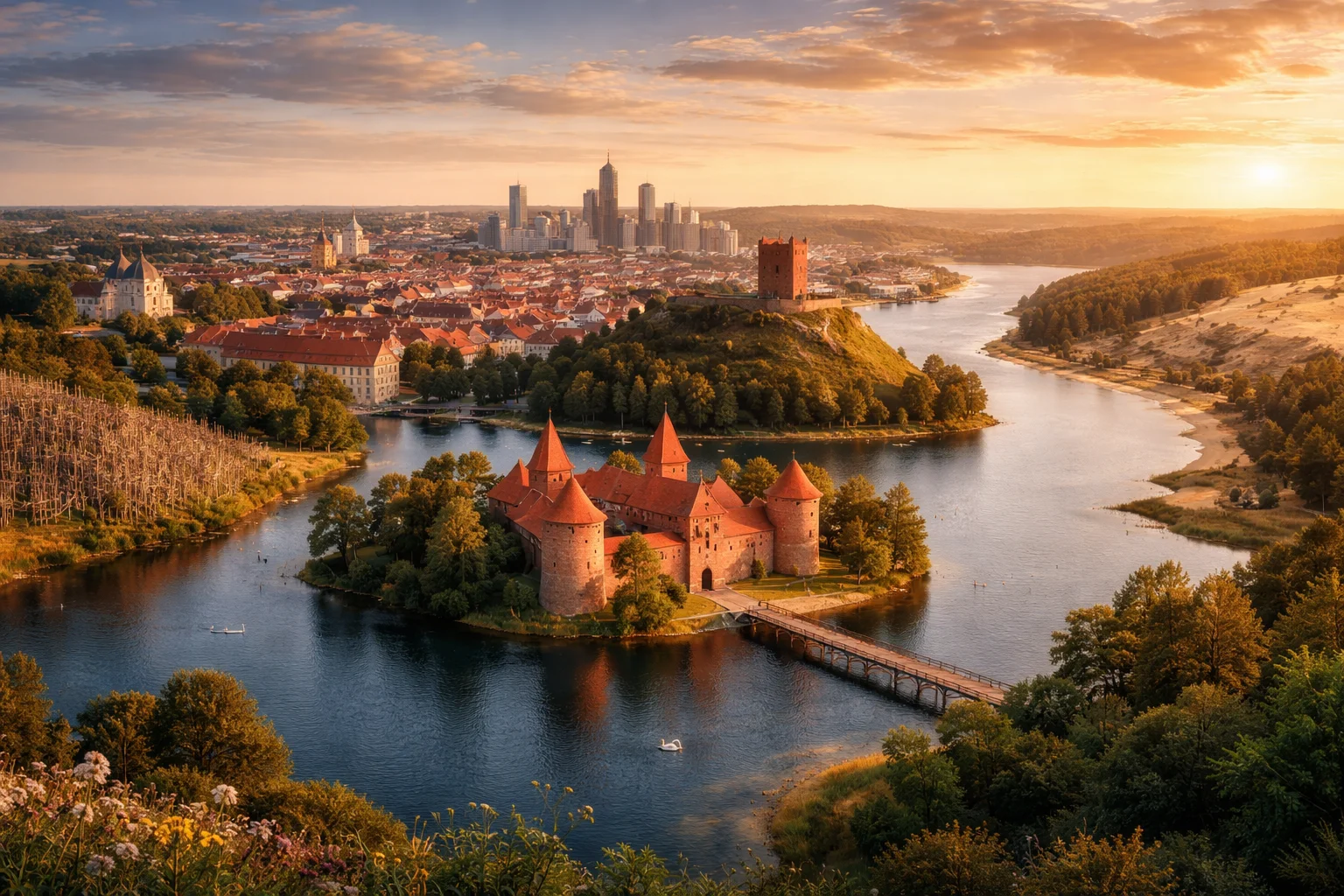
Trakai Castle is a medieval island fortress in Lithuania located on an island in Lake Galvė near the town of Trakai. It is a prominent example of northern European brick Gothic architecture and served historically as a ducal residence and defensive center. The complex includes surviving curtain walls and a reconstructed palace area, and it is formally recognized as one of Lithuania’s principal cultural monuments. The site presents measurable archaeological layers that document sequential construction phases.
Vilnius
Vilnius is the capital and largest city of Lithuania, located in the country’s southeastern quadrant and functioning as its political and cultural centre. The Vilnius City Municipality covers about 401 square kilometres, making it Lithuania’s most extensive city administration by area. Vilnius is significant for concentrating national institutions, major higher-education establishments, and a historic urban core whose dense architectural variety illustrates layers of regional history and urban development.
Vilnius University
Vilnius University is a public research university in Lithuania. Founded in 1579 by King Stephen Báthory, it is the oldest higher education institution in Lithuania and was chartered under the Polish–Lithuanian Commonwealth. The university's main historic campus occupies a connected ensemble of medieval, Renaissance and Baroque buildings in central Vilnius. Vilnius University serves as a national center for higher education, scholarship, and preservation of extensive historic collections.