Liechtenstein Guide
Liechtenstein overview
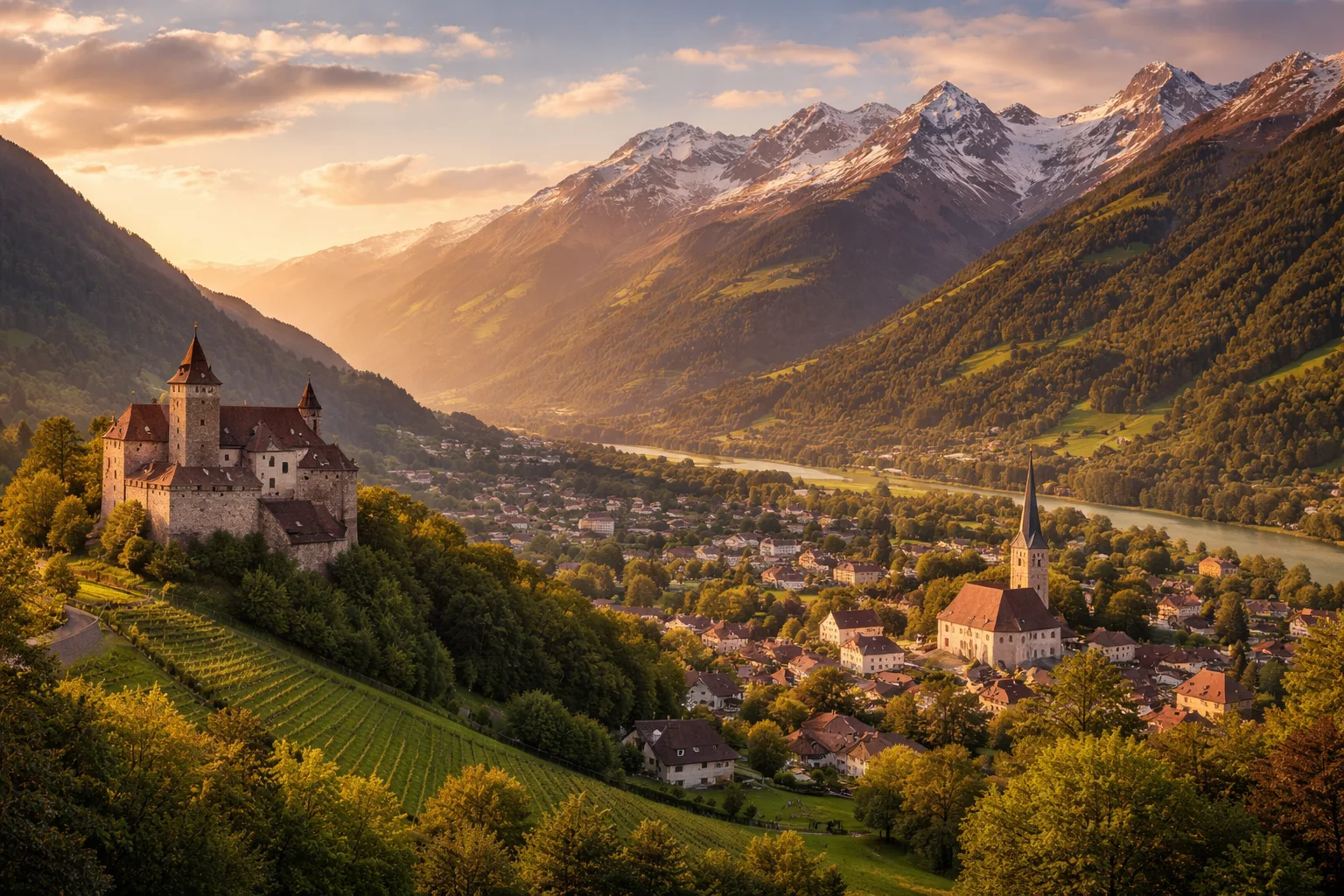
Liechtenstein is a small, landlocked principality in central Europe ruled as a hereditary constitutional monarchy. Nestled in the Alps between Switzerland and Austria, Liechtenstein covers roughly 160 square kilometres and is one of only two doubly landlocked countries worldwide. Its importance stems less from size than from concentrated economic specialization: international financial services, precision manufacturing, and a princely cultural patronage give the state an outsized profile. The country’s compact administrative footprint, visible princely residence above the capital and cross-border commuter economy make Liechtenstein a unique microstate in European affairs.
Common Geography Questions About Liechtenstein
Where Liechtenstein is located
Liechtenstein sits in the eastern Swiss Alps of continental Europe, roughly centered near 47.17° N, 9.53° E. It shares a 35-kilometre border with Switzerland to the west and south-west and a shorter border with Austria to the east and north-east. The Rhine River forms most of the low-lying western boundary; the country’s eastern flank rises directly into the Rätikon range. Because both neighboring states are themselves landlocked, Liechtenstein is doubly landlocked—a spatial rarity that affects logistics and trade arrangements with maritime markets.
Geography and landscape of Liechtenstein
Steep alpine relief dominates Liechtenstein: elevations range from about 430 metres on the Rhine floodplain to Grauspitz at 2,599 metres, producing a dramatic vertical gradient within a 25-kilometre span. The Rätikon subrange of the Central Eastern Alps covers the eastern half, with karst limestone ridges and narrow valleys; the Rhine Valley in the west provides a ribbon of arable land and vineyards. Small tributaries such as the Samina cut wooded gorges in the east. Microclimatic zones shift rapidly across short distances, giving vineyards at low elevation and alpine tundra above 2,000 metres within the same municipality.
Liechtenstein culture and society
German is the official language, but an Alemannic dialect—often called Liechtensteiner German—remains the everyday vernacular, distinguishing local speech from standard German. The population is small and concentrated: civic life centers on village clubs, volunteer fire brigades and parish festivals; National Day on 15 August is the major public celebration tied to the princely family. Roman Catholicism historically shapes ritual calendars and many secular customs. Demographically, the state has a high share of cross-border commuters and a notable proportion of residents who are naturalized only after stringent residency and integration steps, a pattern that shapes local social cohesion.
History of Liechtenstein
Liechtenstein’s political identity dates to 1719, when the Liechtenstein family acquired the territories that now constitute the principality and saw them elevated within the Holy Roman Empire. It preserved formal sovereignty after the Empire’s dissolution and gradually assumed full independent status as 19th-century German confederations reconfigured. A modern constitution in 1921 codified the princely monarchy and parliamentary institutions. Across the 20th century, Liechtenstein remained neutral, shifted economically from agriculture to industry and finance, and used careful international agreements to link its currency and customs practices to Switzerland while retaining sovereign institutions.
Liechtenstein economy and government
Liechtenstein is a hereditary constitutional monarchy with a prince as head of state and a unicameral Landtag; the legislature’s modest size reflects the country’s small population. Politically, power-sharing between the princely house and elected bodies produces a compact governance system tailored to close civic networks. Economically, the Swiss franc serves as legal tender through an arrangement with Switzerland; Liechtenstein has developed a concentrated economy: financial services and holding-company domiciliation, high-value manufacturing (precision instruments, dental products, metal components) and a disproportionate number of registered companies per resident. Customs and monetary alignment with Switzerland simplifies trade, while the state maintains targeted industrial clusters.
Regions and major cities of Liechtenstein
Administratively Liechtenstein is composed of 11 municipalities clustered into two electoral regions: Oberland (Upper Country) in the south and Unterland (Lower Country) in the north. Vaduz is the capital and seat of the princely house; Schaan is the largest municipality by population and an industrial hub. Balzers anchors the southern end with a historic tower and manufacturing activity. Regional differences are stark: Unterland contains the Rhine plain and denser settlement, while Oberland comprises higher villages, alpine pastures and the principality’s highest peaks, producing distinct local economies and identities within the tiny state.
Distinctive characteristics of Liechtenstein
Liechtenstein is widely associated with several concrete and unusual features: it is one of two doubly landlocked states globally; its clubs play practical roles in civic life; and its football clubs compete in the Swiss league system because the country lacks a national league. The princely family’s art collection and Vaduz Castle give the state cultural visibility disproportionate to its size. In international finance, Liechtenstein is known for corporate domiciliation and a dense network of holding companies relative to population. Philately also elevates its profile—Liechtenstein stamps are sought by collectors for distinctive designs and limited runs.