Lebanon Geography, Location, Mountains & Coast
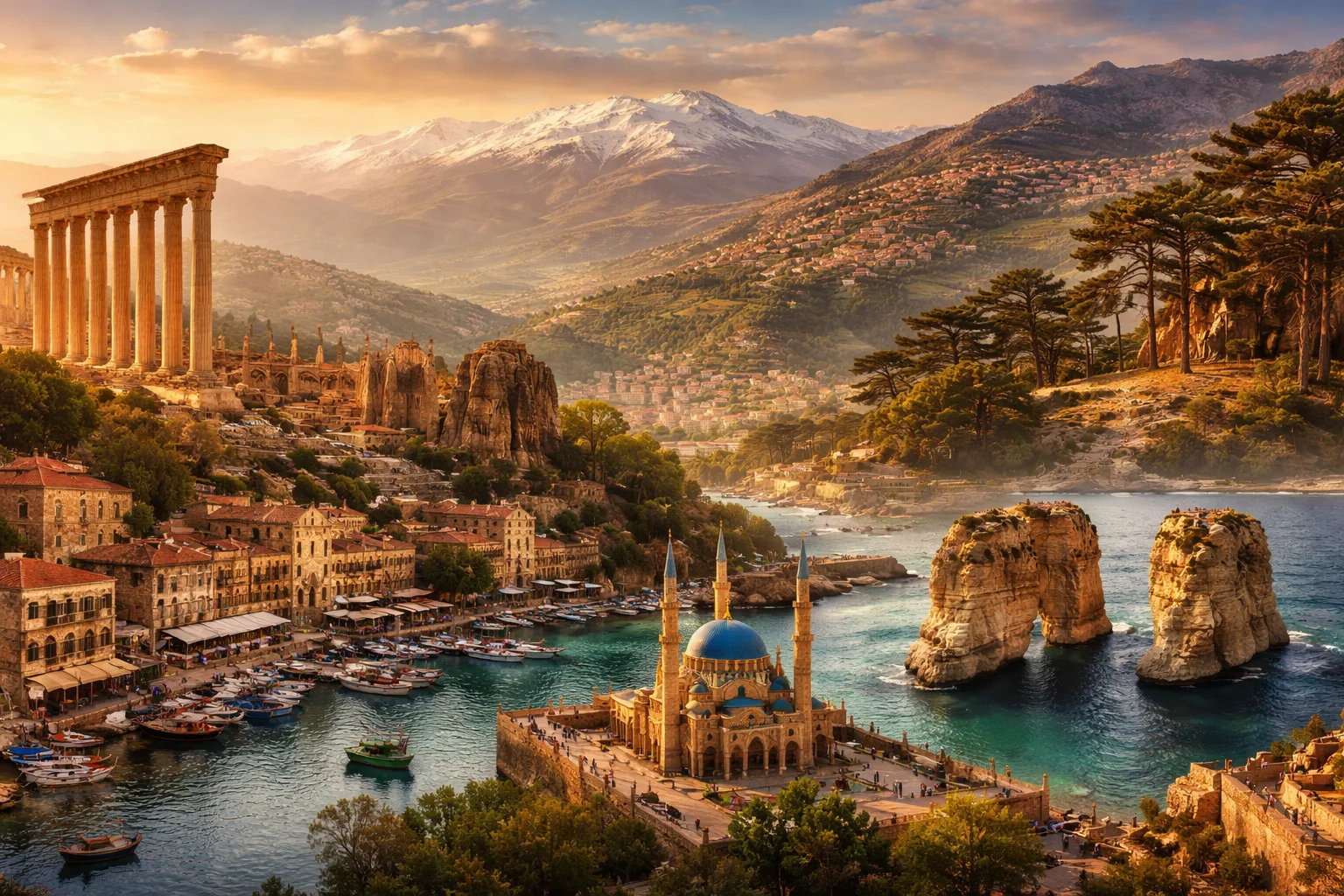
Short answer
Quick answer about Lebanon
Lebanon is a small country in Western Asia on the eastern Mediterranean coast.
Its geography is defined by a narrow coastal plain, the Lebanon and Anti-Lebanon mountain ranges, and the Bekaa Valley between them.
Location: Eastern Mediterranean, Western Asia
Capital: Beirut
Coast: Mediterranean Sea
Major landforms: Lebanon Mountains, Anti-Lebanon Mountains, Bekaa Valley
Borders: Syria and Israel
Lebanon overview
Lebanon is a small Mediterranean country on the eastern shore of the Mediterranean Sea characterized by a steep elevation gain from the coast into high mountains within a short distance. Sitting at the crossroads of trade routes between Anatolia, the Levant, and the Arabian hinterland, Lebanon combines dense urban settlement, pronounced religious pluralism, and a history of mercantile cities. Its compact territory concentrates agricultural valleys, skiable peaks and a historic port city that have shaped its role as a regional commercial and cultural node.
Common Geography Questions About Lebanon
Where Lebanon is located
Lebanon lies on the Asian continent’s eastern Mediterranean margin, immediately east of the sea that gives the Levant its maritime corridor. The country is bordered to the north and east by Syria and to the south by Israel; its western boundary is the Mediterranean coastline in which the port of Beirut sits at approximately 33.9° N, 35.5° E. The coastal plain is unusually narrow: in many places the western slopes of Mount Lebanon rise within a few kilometres of the shore, compressing settlement and transport corridors along a long, slender footprint.
Geography and landscape of Lebanon
Lebanon’s terrain is defined by two parallel limestone ranges: the Mount Lebanon range that runs along the coast and the Anti-Lebanon chain along the border with Syria, with the fertile Bekaa Valley between them. The country’s highest point, Qurnat as Sawdaʿ, reaches about 3,088 metres, and the Litani River is the most significant river wholly within its borders. Climatic zones shift rapidly from Mediterranean on the coast to snowy alpine conditions inland, producing the notable phenomenon of ski resorts operating within an hour’s drive of beaches.
Lebanon culture and society
Lebanon’s social fabric is multilingual and multi-confessional: Arabic is the official language, while French and English are widely used in education, media and commerce; Armenian communities maintain their own linguistic and ecclesiastical institutions. Religious identity—Maronite, Sunni, Shia, Druze, Orthodox and smaller groups—remains socially salient, reflected in personal-status law and communal institutions. A distinctive feature is the large transnational Lebanese diaspora with long-established merchant communities in Brazil, West Africa and North America that link family networks, business practices and cultural exchange back to the homeland.
History of Lebanon
Lebanon’s history begins with the coastal Phoenician city-states that pioneered maritime trade and alphabetic writing, later incorporated into Hellenistic and Roman polities. Over centuries the region was governed by successive empires and local feudal arrangements; Ottoman rule from the early modern period shaped sectarian administrative patterns. Twentieth-century transition under a French mandate gave way to an independent republic, whose post-independence consociational arrangements and a mid-century commercial boom were followed by a prolonged civil war and a negotiated political settlement in the late twentieth century that reconfigured power-sharing structures.
Lebanon economy and government
Lebanon is organized as a parliamentary republic in which executive and legislative offices are distributed by a long-standing confessional arrangement: the presidency has been reserved for a Maronite Christian, the prime ministership for a Sunni Muslim and the parliamentary speaker for a Shia Muslim. The economy is service-oriented with long-standing strengths in banking, trade and tourism, supported by agriculture in the Bekaa Valley and an export-oriented small industrial sector. The national currency is the Lebanese pound, and remittances and a historically exportable banking sector have been prominent components of national receipts.
Regions and major cities of Lebanon
Administratively Lebanon is divided into governorates (muhafazat) such as Beirut, Mount Lebanon, North, South and the Bekaa region; municipal government often sits alongside strong sectarian local institutions. Beirut, the capital, functions as the commercial and cultural hub; Tripoli in the north is a historic port and commercial centre; Sidon (Saida) to the south is a coastal city with continuous habitation since antiquity. Local geography produces distinct subregions: the narrow coastal plain, the Mount Lebanon highlands and the agriculturally productive Bekaa basin each sustain different settlement patterns and economies.
Distinctive characteristics of Lebanon
Lebanon is widely associated with a handful of concrete features: the cedar tree, explicitly depicted on its national flag and protected in highland groves; the Phoenician legacy of seafaring and the alphabet that influenced Mediterranean scripts; the American University of Beirut as a long-standing regional center of higher education; and the global cultural reach of Lebanese literature and entrepreneurship exemplified by figures such as Khalil Gibran. These elements, combined with a dense diaspora network, give Lebanon recognisable international profiles in culture, education and commerce.
Places in Lebanon
American University of Beirut
American University of Beirut is a private, independent university in Lebanon founded in 1866 that functions as a regional centre for higher education and research. The institution was established as the Syrian Protestant College and later adopted the name American University of Beirut; it operates an American-style curriculum and is governed by an independent Board of Trustees. The university includes the American University of Beirut Medical Center and the Jafet Library, both formal, measurable components of its campus infrastructure that support professional education and archival research. The campus hosts faculties in arts and sciences, engineering, medicine, and business.
Baalbek
Baalbek is an archaeological site and town in the Beqaa Valley of eastern Lebanon, notable for its extensive Roman temple complex and long cultural continuity. It sits within the Baalbek-Hermel Governorate and represents one of the largest concentrations of Roman monumental architecture in the Levant. The site contains megalithic foundation stones and several monumental temples, and some individual stones are estimated to weigh over eight hundred tonnes. Its historical significance and architectural features make it a primary subject of Mediterranean archaeology.
Beirut
Beirut is the capital and largest city of Lebanon, located on the eastern Mediterranean coast and serving as the country's political, cultural, and economic center. The municipal area covers about 20 square kilometres, and Beirut functions as the administrative core of the Beirut Governorate. Its significance stems from a continuous urban presence for millennia, a major port facility, and a concentration of national institutions that shape Lebanon's public life.
Gemmayzeh
Gemmayzeh is an urban district of Beirut in Lebanon. It is a defined neighborhood within the municipality of Beirut and is significant for its concentration of late Ottoman and early modern urban fabric adjoining the city’s central district. The district includes a recognized mix of residential and commercial blocks, and it falls under Beirut municipal administration and national antiquities oversight, which provides a formal status for its built heritage.
National Museum of Beirut
National Museum of Beirut is Lebanon's principal national archaeological museum and cultural repository. It is operated by the Directorate General of Antiquities and functions as the state institution responsible for conserving, cataloguing, and exhibiting archaeological material recovered from across Lebanese territory. The museum houses a national collection that spans prehistoric through medieval artefacts and includes major stone sarcophagi and mosaic ensembles as part of its permanent holdings.
Frequently Asked Questions
What is Lebanon's geography like?
Lebanon has a Mediterranean coast, parallel mountain ranges, and the Bekaa Valley, giving it varied terrain in a small area.
Where is Lebanon located?
Lebanon is located on the eastern Mediterranean coast in Western Asia.
What countries border Lebanon?
Lebanon borders Syria and Israel.