Latvia Guide
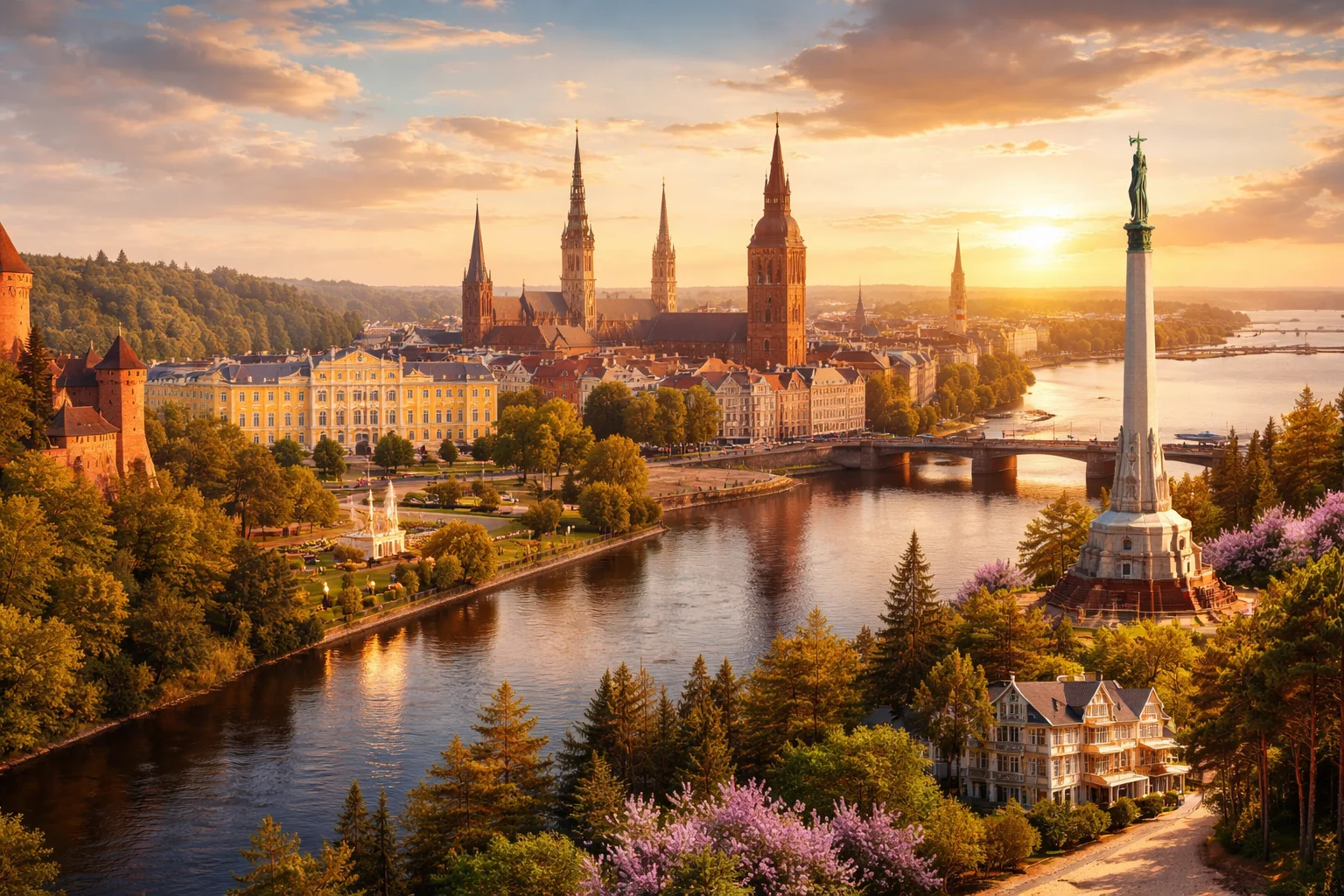
Latvia overview
Latvia is a Northern European country on the eastern shore of the Baltic Sea and one of the three Baltic states. Sitting at the junction of Scandinavian, Slavic and Germanic historical spheres, Latvia functions as a regional transport and cultural bridge. Its compact territory combines a low-lying coastline, extensive forest and peatland cover, and a capital—Riga—that has served as a major Hanseatic and modern trading port. Latvia’s profile rests on a mix of Baltic-language heritage, a dispersed rural landscape, and a modern economy oriented toward ports, timber and services.
Common Geography Questions About Latvia
Where Latvia is located
Latvia lies in northeastern Europe between roughly 55.7° and 58.1° north latitude and 20.9° to 28.2° east longitude. It borders Estonia to the north and Lithuania to the south, with land frontiers to Russia in the east and Belarus in the southeast. The country fronts the Baltic Sea and contains the semi-enclosed Gulf of Riga; Cape Kolka is a notable point where waters of the Gulf meet the open Baltic. Latvia’s position on the northern edge of the European Plain places it along historic overland and maritime corridors connecting Scandinavia, Russia and central Europe.
Geography and landscape of Latvia
Latvia’s terrain is predominantly lowland with a pattern of glacial moraines, broad plains and a dissected coastline featuring dunes and sandy spits. There are no mountain ranges; the highest elevation is Gaiziņkalns at 312 metres, a detail few countries of Europe share at such modest maximum height. Major rivers such as the Daugava and Gauja carve inland routes to the sea, and inland lakes and raised bogs (for example, extensive peat bogs in the Kemeri area) are characteristic. Roughly half the land is forested, and regionally the landscape shifts from coastal dunes in Kurzeme to the clay plains of Zemgale and the looser soils and lakes of Latgale.
Latvia culture and society
Latvia’s official language is Latvian, a member of the Baltic branch of Indo-European languages; Latgalian persists as a recognized regional variety in the east, and Russian remains widely used in urban and eastern areas. Cultural markers include the midsummer Jāņi celebrations with oak and birch symbolism and large-scale choral gatherings that have historically reinforced national identity. Religiously, Lutheranism is traditionally strong in the north, Roman Catholicism in Latgale and Orthodoxy among Russian communities. Demographically, Latvia experienced population decline after the late 20th century with urban concentration in Riga and notable Russian-speaking enclaves, shaping bilingual public services and social policy.
History of Latvia
Latvia’s history follows a sequence of Baltic tribal settlement, conquest in the 13th-century Northern Crusades, and integration into wider medieval trade networks through Riga’s Hanseatic role. Over subsequent centuries control shifted between Polish-Lithuanian, Swedish and Russian rulers, imprinting administrative and cultural layers. The twentieth century brought a brief independent republic after 1918, traumatic occupations, deportations and collectivization under Soviet rule, and the re-establishment of state sovereignty in 1991. Since then Latvia has reoriented toward European institutions and markets, reshaping its legal and economic structures after decades of empire and occupation.
Latvia economy and government
Latvia is a parliamentary republic whose legislature, the Saeima, is unicameral; the president serves as head of state with mostly ceremonial powers while government is formed by parliamentary coalitions. The currency is the euro, reflecting Latvia’s integration with the eurozone. Economically, Latvia operates a small, open market with a heavy emphasis on services, logistics and port activity—Riga and Ventspils anchor maritime trade—alongside forestry, wood processing and food production. A growing IT and fintech sector has emerged in recent decades, but timber exports, transit corridors and port throughput remain distinctive pillars of the national economy.
Regions and major cities of Latvia
Latvia’s identity is strongly regionalized into Vidzeme, Latgale, Kurzeme and Zemgale, with the capital and its surrounding area functioning as a distinct metropolitan region. Riga is the political and economic center and hosts much of the country’s population and institutions. Daugavpils, in the southeast, is notable for its 19th-century fortress and a large Russian-speaking community; Liepāja on the western coast is an industrial and port city with a separate maritime tradition; Jelgava serves as an agricultural and educational hub. Each region preserves different dialects, folk crafts and religious balances that distinguish local administration and cultural life.
Distinctive characteristics of Latvia
Latvia is widely associated with a set of concrete, recognizable traits: Riga’s exceptionally rich collection of Art Nouveau architecture and a UNESCO-listed Old Town; a long-standing amber-working tradition tied to the Baltic “amber road”; extensive bog and peatland ecosystems that appear in ecological research and conservation; and a mass choral culture exemplified by recurring Song and Dance festivals. Internationally, Latvia is identified with Euro-Atlantic integration (EU and NATO membership), a .lv internet domain, and a role as a Baltic transit and timber-export gateway that links northern and eastern Europe.
Places in Latvia
Latvian National Museum of Art
Latvian National Museum of Art is the state museum for visual arts in Latvia. It is located in central Riga on Krišjāņa Valdemāra Street and serves as the principal custodian of the country's national art collection. The institution combines long-term conservation, curatorial research, and public exhibition responsibilities within a purpose-built historic building. The museum's holdings emphasize Latvian and Baltic visual arts across painting, sculpture, and graphic media.
Old Riga
Old Riga is the historic core of Riga, Latvia, known locally as Vecrīga. It is the city's principal concentration of medieval and early modern buildings and public squares. The district's built fabric includes major civic and religious structures that shape Riga's urban identity. Its formal name and preserved urban pattern make it a central subject in studies of Baltic urban history and heritage.
Riga
Riga is the capital and largest city of Latvia. It lies in northern Latvia on the eastern shore of the Baltic Sea, at the mouth of the Daugava River where it enters the Gulf of Riga. The city occupies about 307 square kilometers and serves as the country's political, economic, and cultural center, with administrative institutions, universities, and major transport infrastructure concentrated across its metropolitan area.
Riga Zoo
Riga Zoo is a municipal zoological garden in Latvia. It is the capital’s primary curated animal collection, located within a forested urban park and formally organised as a city-run institution. The site combines outdoor enclosures and indoor pavilions to house living collections of mammals, birds, reptiles, and amphibians, and it serves formal roles in captive breeding, species exchange, and public scientific collection stewardship. This institutional status defines its long-term significance.
University of Latvia
University of Latvia is a public research university located in the Republic of Latvia. It was founded in 1919 and serves as a national higher education institution centered in the capital city of Riga. The university combines teaching, research, and public scholarship across multiple faculties and research institutes while maintaining a central administration and a principal campus concentrated along Raiņa Boulevard. Its formal status as a state university and its continuous operation since the early twentieth century provide a measurable institutional fact that anchors its role in Latvian education and national development.