Ivory Coast Guide
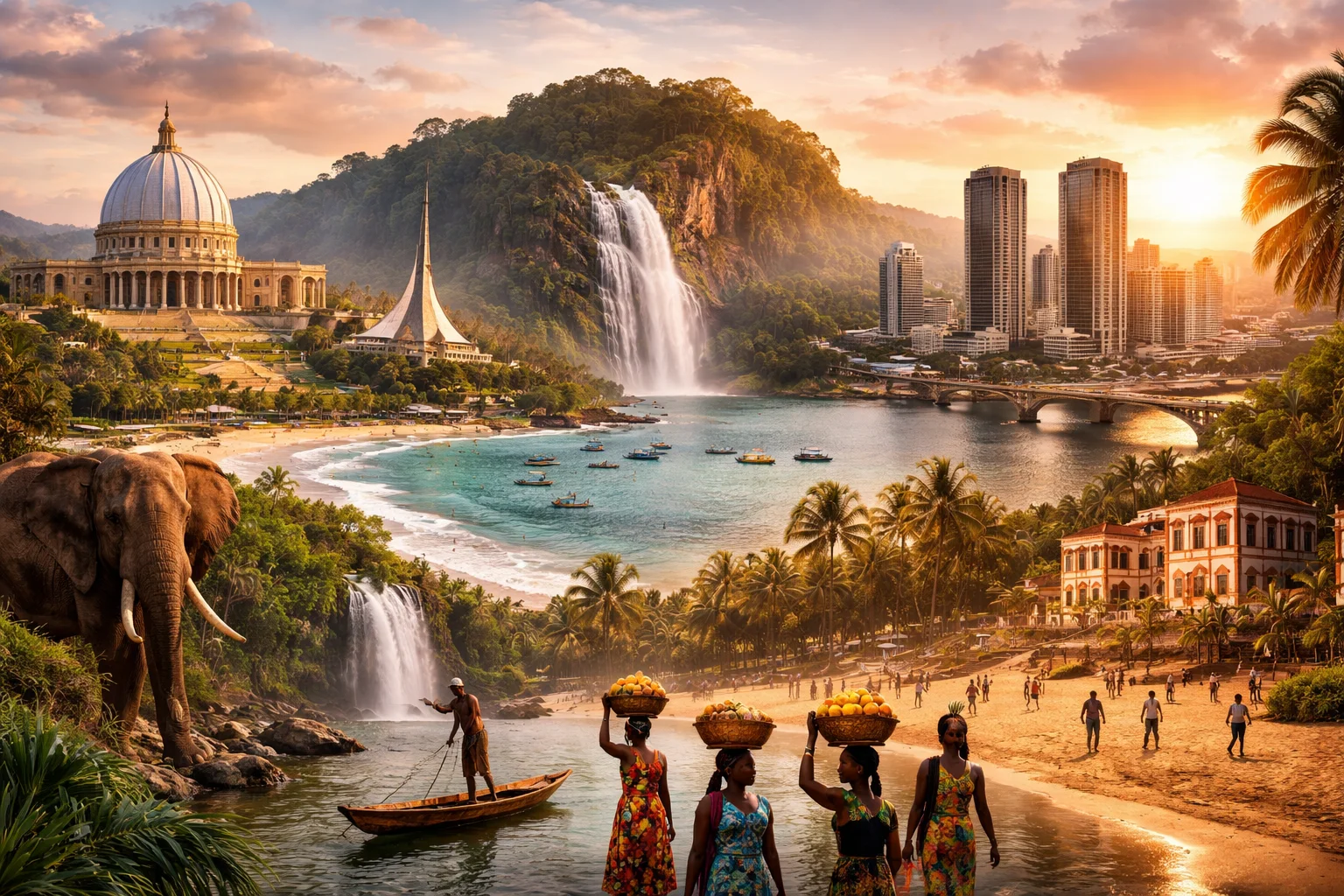
Ivory Coast overview
Ivory Coast is a West African nation formally known in French as République de Côte d’Ivoire and widely recognized for its outsized role in global cocoa markets. Straddling the Gulf of Guinea, the country combines coastal lagoons and rainforest with northern savannah, and has a distinctive administrative separation between its political capital, Yamoussoukro, and its economic hub, Abidjan. Ivory Coast’s modern identity was shaped by a long post‑colonial era of agricultural export growth, large-scale state infrastructure projects, and later political realignments; its economy remains tightly linked to commodity exports and regional commerce.
Common Geography Questions About Ivory Coast
Where Ivory Coast is located
Ivory Coast sits on the southern edge of West Africa between roughly 4°N and 10°N latitude and about 8°W to 2°W longitude. It borders Liberia and Guinea to the west, Mali and Burkina Faso to the north, and Ghana to the east; the southern boundary faces the Gulf of Guinea. The Ébrié Lagoon runs alongside Abidjan and forms a pivotal coastal barrier, while the Comoé and Bandama rivers bisect interior corridors. Its strategic Gulf of Guinea coastline and location between francophone Sahelian states and anglophone Ghana give Ivory Coast a distinctive transit and trade position in the region.
Geography and landscape of Ivory Coast
Ivory Coast’s geography is a mosaic: a humid, evergreen rainforest band in the southwest; a transition zone of gallery forest and agricultural plains through the center; and semi‑arid savannah in the north. Taï National Park in the southwest preserves one of West Africa’s last primary rainforests and populations of pygmy hippos and forest chimpanzees—an ecological feature uncommon in many countries. Coastal lagoons and mangroves, notably the Ébrié and Aby lagoons, shape settlement patterns and commerce. The Mount Nimba massif rises on the western border and the Comoé River basin supports savannah biodiversity unique to Ivory Coast’s landscape.
Ivory Coast culture and society
Ivory Coast’s culture blends a French administrative framework with more than sixty indigenous languages and strong regional identities; French serves as the official lingua franca in government and education. The country is notable for the Akan‑linked Baoulé cultural influence in the center‑south, the Dan and Baule masked ceremonial traditions, and the Senufo artisan heritage in the north—each with distinct rites and woodcarving styles. Religiously, Islam, Christianity and traditional spiritual systems coexist with regionally specific practices. Urban popular culture has exported musical genres such as zouglou and coupé‑décalé, which trace their origins to Ivorian students and diaspora communities and distinguish Ivory Coast’s contemporary cultural reach.
History of Ivory Coast
Ivory Coast’s history moves from coastal trade in ivory and kola to incorporation into French West Africa, and then to a post‑colonial era dominated by the long presidency of Félix Houphouët‑Boigny, who prioritized agricultural exports and state‑led development. Independence in 1960 led to rapid growth centered on cocoa and coffee plantations, followed by economic diversification and later political fragmentation as rural‑urban migration and uneven wealth distribution produced tensions. The deliberate relocation of the political capital to Yamoussoukro and the construction of monumental state projects were pivotal turns: they mark a national narrative that balances agrarian foundations with ambitious state architecture and evolving identity within West Africa.
Ivory Coast economy and government
Ivory Coast is a unitary presidential republic with decentralization into districts and regions; two autonomous districts—Abidjan and Yamoussoukro—carry special administrative status. The economy is export‑oriented and agriculturally anchored: Ivory Coast is the world’s largest cocoa producer, with complementary sectors in cashew, coffee, and offshore oil and gas. Mining (gold and manganese) and timber are significant regional earners. The national currency is the West African CFA franc (XOF), issued under the BCEAO system shared with neighboring francophone states. State regulation of commodity chains, large port volumes through Abidjan, and agrarian export logistics shape the country’s economic profile.
Regions and major cities of Ivory Coast
Administratively, Ivory Coast is divided into districts that were created to coordinate decentralization; two are autonomous. The political capital is Yamoussoukro, known for its planned‑city layout and a monumental basilica, while Abidjan remains the country’s major economic center and primary port on the Ébrié Lagoon. Other principal cities include Bouaké, a commercial and transport hub in the central region, and San Pedro, a deep‑water port critical to cocoa exports. The country’s regions correspond to distinct ecological‑cultural zones—forest south, transitional center, and savannah north—each with unique economic activities and social structures.
Distinctive characteristics of Ivory Coast
Concrete associations instantly linked to Ivory Coast include its dominant role in global cocoa supply, the basilica of Our Lady of Peace in Yamoussoukro (one of the largest churches worldwide), and internationally influential music scenes—zouglou and coupé‑décalé—that originated in Ivorian social contexts. Conservation sites such as Taï National Park underscore the country’s rare primary rainforest biodiversity in West Africa. In sport and diaspora networks, Ivory Coast has produced internationally renowned footballers whose profiles have amplified the country’s visibility. These tangible elements—commodity leadership, monumental architecture, unique ecosystems, and cultural exports—define Ivory Coast’s global imprint.