Italy Guide
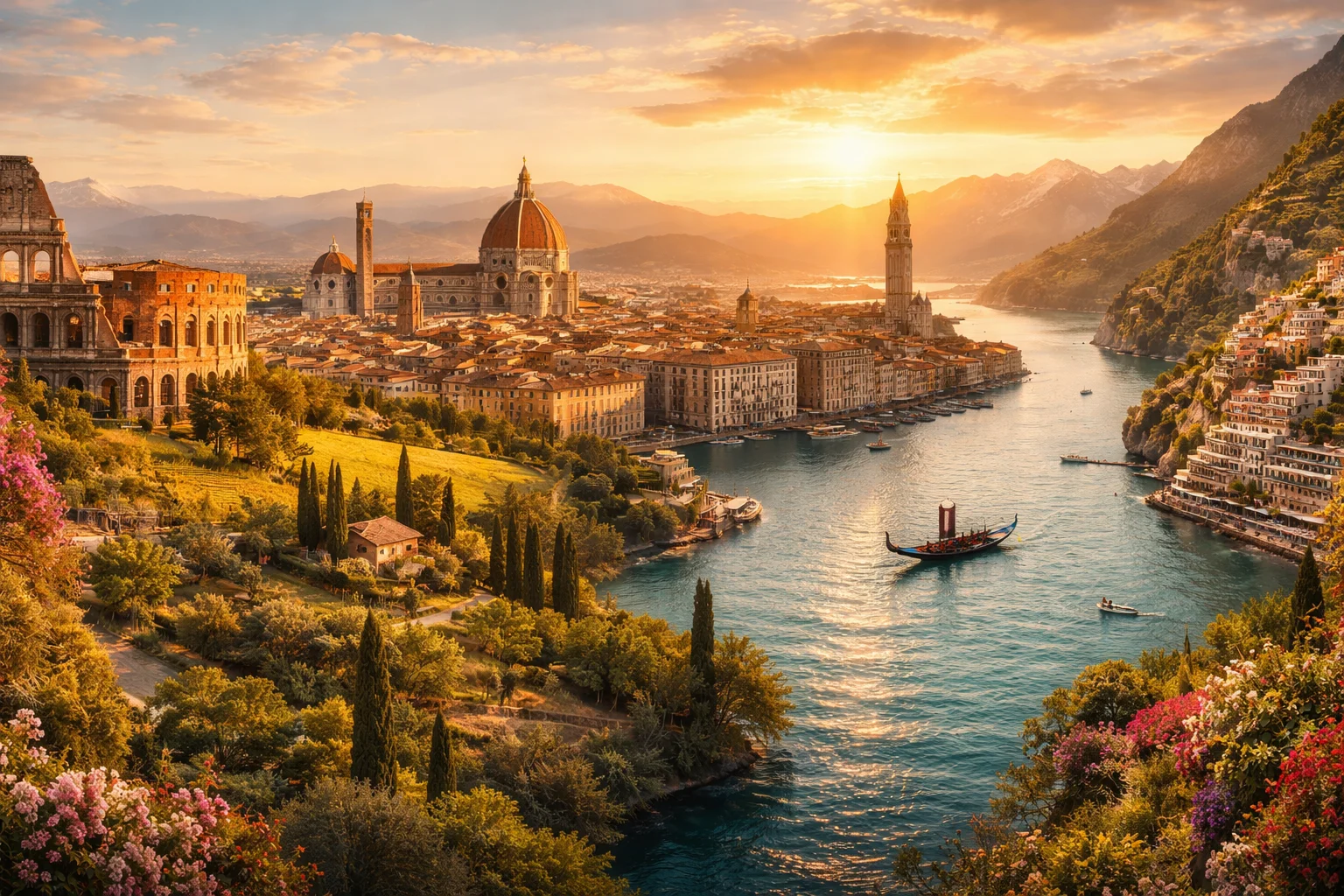
Italy overview
Italy is a sovereign state in Southern Europe occupying a boot-shaped peninsula that projects into the central Mediterranean Sea. It is widely significant for its outsized historical influence—home to the Roman Empire and the Renaissance—and for concentrated cultural exports in art, cuisine, and design. The country’s economy mixes advanced manufacturing and artisanal small firms clustered in the north with agriculture and tourism anchored in historically layered landscapes. Italy’s combination of dense urban archaeology, living medieval towns and island territories gives it an unusual overlap of ancient and modern infrastructures.
Common Geography Questions About Italy
Where Italy is located
Italy sits in southern Europe on the Mediterranean basin, roughly between latitudes 36° and 47° N and longitudes 6° and 18° E, forming the central link between Western Europe and North Africa. It shares land borders with France, Switzerland, Austria and Slovenia, and uniquely contains two independent enclaved states: Vatican City and the Republic of San Marino. Maritime boundaries extend into the Tyrrhenian, Ionian and Adriatic Seas; Sicily and Sardinia are large island regions that position Italy astride key central Mediterranean sea lanes. This geography shapes Mediterranean climate corridors and trade routes.
Geography and landscape of Italy
Italy’s geography is defined by a north–south spine of the Apennine Mountains and an alpine arc along its northern frontier; the Po Valley between those features is the country’s primary agricultural and industrial plain. Distinctive to Italy are coexisting active volcanic systems—Mount Etna on Sicily and Vesuvius near Naples—that influence local soils and settlement patterns. The country’s coastline exceeds 7,000 km when including islands, producing numerous gulfs and peninsulas. Climatic variation ranges from alpine conditions in the Alps to semi-arid pockets in southern coastal plains, producing sharply regionalized landscapes and microclimates.
Italy culture and society
Italian culture revolves around regional identity as much as a national language: standard Italian coexists with recognized minority languages and dialects such as Sardinian, Friulian, Ladin and German in South Tyrol, with legal protections in several autonomous regions. Religious customs are influenced by a predominantly Roman Catholic heritage, but communal festivals (for example, medieval horse races like Siena’s Palio) and secular civic rituals remain locally focused. Demographically, Italy displays pronounced regional contrasts in age structure and migration patterns; family networks and small-scale craft production continue to shape social organization in urban neighborhoods and hill towns.
History of Italy
Italy’s history is notable for producing the Roman state that established legal and infrastructural templates across Europe and the Mediterranean; the Roman legacy fed subsequent medieval city-states such as Venice and Florence, which in turn incubated Renaissance artistic and scientific breakthroughs. For centuries the peninsula was politically fragmented into duchies, republics and kingdoms, a fragmentation that persisted until the 19th-century Risorgimento consolidated the modern Italian state. Twentieth-century trajectories transformed Italy from a largely agrarian society into a major industrial economy while its cultural and legal heritage remained central to European development.
Italy economy and government
Italy is a parliamentary republic with a bicameral legislature and a head of government accountable to Parliament; regional autonomy is institutionalized through twenty regions, five of which hold special statutory powers. Economically, the country combines export-oriented manufacturing clusters—precision machinery, automotive design and fashion—with a pervasive network of small and medium-sized enterprises, particularly in the industrial districts of Lombardy and Veneto. Agriculture produces world-leading wine and olive oil varieties. The national currency is the euro; Italy’s mixed economy relies on industrial exports, services (notably tourism and design), and widespread family-owned firms.
Regions and major cities of Italy
Administratively Italy is divided into twenty regions, including five autonomous regions (Sicily, Sardinia, Trentino-Alto Adige/Südtirol, Aosta Valley, Friuli Venezia Giulia) with special legislative powers. Italy capital is Rome, a metropolitan area that combines ancient archaeological cores with national institutions. Other major cities include Milan, an international financial and fashion hub; Naples, a dense urban port with deep historical layers; and Venice, a lagoon city whose urban form is globally distinctive. Regional distinctions—Northern industrial zones, Central cultural heartlands, Southern agricultural and island territories—frame internal economic and cultural contrasts.
Distinctive characteristics of Italy
Italy is globally associated with a high concentration of tangible cultural heritage: it holds the largest number of UNESCO World Heritage Sites of any country, reflecting layers from Roman ruins to Renaissance urban planning. The nation’s global profile also rests on internationally recognized design and luxury industries—fashion houses based in Milan and high-performance automotive marques born in Emilia-Romagna and Turin. Italy’s culinary techniques and products (regional pasta styles, olive oil, and wine appellations) and its influence on Western legal and artistic canons constitute concrete, internationally recognized associations that distinguish the country on multiple fields.
Places in Italy
Amalfi Coast
Amalfi Coast is a coastal stretch in southern Italy defined by steep limestone cliffs and clustered towns along the sea. The area runs for approximately 50 kilometres along the Sorrentine Peninsula between Positano and Vietri sul Mare. Amalfi Coast holds significance as a concentrated landscape of maritime commerce heritage and distinctive coastal settlement patterns. Its combination of natural topography and historic urban fabric creates measurable criteria used in formal heritage assessments.
Bioparco di Roma
Bioparco di Roma is a zoological garden in Italy located within the urban fabric of Rome. It is sited inside Villa Borghese park and occupies roughly 17 hectares, giving a measurable footprint within the city’s principal historic green space. The institution functions as a curated collection of living species, combining animal husbandry, ex-situ conservation work, and scientific outreach under a formal zoological garden designation.
Brera
Brera is a district in Milan, Italy. It is a centrally located historic quarter that functions as a cultural and academic ensemble centered on Palazzo Brera, and it lies within Milan's Municipio 1 administrative area. The district contains the Pinacoteca di Brera, a public art gallery formally housed in Palazzo Brera, and an academy of fine arts that shares the same complex. Brera's significance derives from the co-location of civic art collections, scientific institutions, and a historic botanical garden.
Cannaregio
Cannaregio is a district (sestiere) of the city of Venice in Italy. It is formally one of Venice’s six sestieri and occupies the northern portion of the historic island group, containing the linear watercourse known as the Cannaregio Canal as a principal urban axis. The district is significant for its mix of dense residential quarters and historic urban infrastructure that shaped Venice’s northern approach and inner-lagoon neighbourhoods.
Capitoline Museums
Capitoline Museums is a museum complex in Italy located on Rome's Capitoline Hill and administered as a civic museum. It occupies three principal palaces clustered around Michelangelo's Piazza del Campidoglio, forming a defined campus of exhibition halls and courtyards. The complex holds a formal municipal role in preserving and displaying Roman antiquities and later artworks, and its collections include emblematic ancient bronzes and monumental sculpture that define its institutional identity.
Capri
Capri is an island and comune in Italy in the Tyrrhenian Sea noted for concentrated cultural and geological significance. The island covers about 10.4 square kilometres and forms part of the archipelago between the Gulf of Naples and the Gulf of Salerno. Capri's significance arises from well-preserved Roman imperial residences, distinctive coastal landforms, and a prolonged role in Mediterranean arts and leisure that has influenced architecture and culture beyond the island itself.
Cinque Terre
Cinque Terre is a cluster of five historic coastal villages on the Ligurian coast of northwestern Italy, notable for terraced agriculture and medieval settlement patterns. It lies within a compact coastal zone spanning roughly ten kilometers of shoreline and steep hillside, and its five named villages—Monterosso al Mare, Vernazza, Corniglia, Manarola, and Riomaggiore—form the definable unit that gives the area its name. The site is recognized for combined cultural and landscape values.
Colosseum
Colosseum is an ancient Roman amphitheatre located in the historic centre of Rome, Italy, and it is one of the most recognized monuments of ancient architecture. It served as a large public arena and could accommodate roughly 50,000 spectators in its original configuration. The Colosseum's scale, surviving fabric, and role in Roman urban life give it lasting architectural and cultural significance in studies of antiquity and urban heritage.
Dorsoduro
Dorsoduro is a district of the city of Venice, Italy. It is one of Venice’s six sestieri and occupies the southern shore of the central islands, forming the southern bank of the Grand Canal. The area contains major public art institutions and a notable seafront embankment called the Zattere, and its formal status as a sestiere is a defined municipal subdivision of the Comune di Venezia. This article emphasizes civic history and urban role.
Egyptian Museum Turin
Egyptian Museum Turin is a museum in Italy formally dedicated to the study and display of ancient Egyptian antiquities. The institution, known in Italian as Museo Egizio, is a specialist museum whose collections and research program define its significance for Egyptology. The museum is formally designated as an institutional repository for Egyptian archaeological material and maintains curatorial and conservation functions tied to its collection. This emphasis on specialised holdings shapes the museum's scholarly role and public profile.
Ferrari Museum
Ferrari Museum is a corporate museum in Italy that documents the history and technology of the Ferrari marque. The museum is located in Maranello and sits adjacent to Ferrari's manufacturing campus, forming an institutional link between production and heritage. Its permanent exhibitions present a curated collection of road cars, competition cars, and powertrains assembled from the company's archives. The institution functions as both an archive and an exhibition complex supporting research, restoration, and public interpretation of Ferrari engineering and motorsport heritage.
Florence Cathedral
Florence Cathedral is the cathedral church of Florence, Italy, formally named Santa Maria del Fiore, and a landmark of Renaissance architecture. It stands in the city's historic centre and dominates the Piazza del Duomo, representing civic and religious significance for Florence. The cathedral's dome spans 45.5 meters in diameter, making it one of the largest masonry domes constructed in the pre-modern era.
Explore Natural Landmarks in Italy
Browse islands and mountains connected with Italy to keep exploring related geography clusters.