Iraq Guide
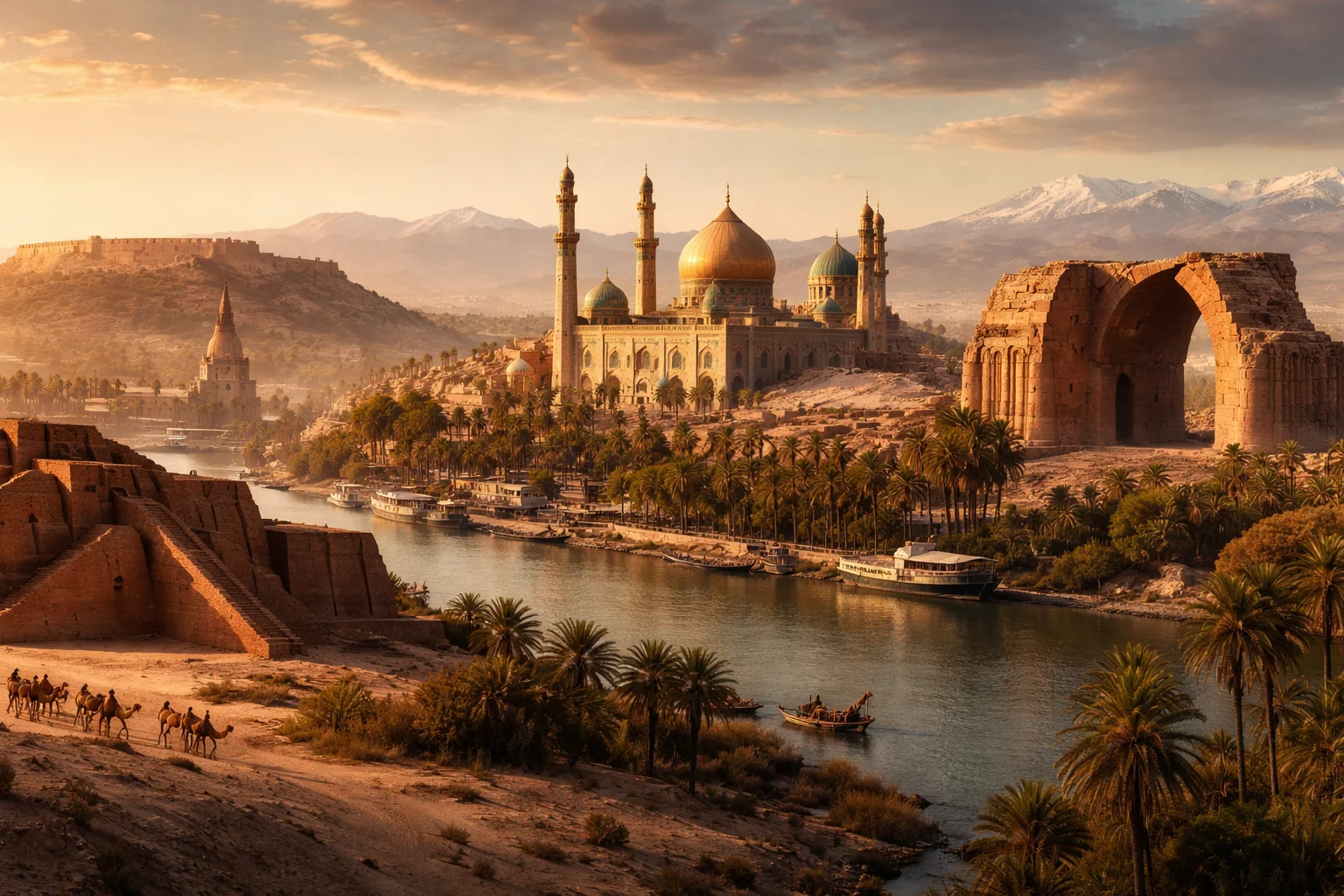
Iraq overview
Iraq is a sovereign state on the Mesopotamian plain where the Tigris and Euphrates rivers converge, a geography that shaped early urban civilization. Located at the head of the Persian Gulf and straddling the Fertile Crescent, Iraq combines ancient archaeological heritage with modern oil-based economic importance. Its population is ethnically and linguistically diverse, with distinct Kurdish governance in the north and a string of historic cities along the rivers. The country’s defining tensions and capacities arise from its layered history, riverine landscapes, and large hydrocarbon reserves.
Common Geography Questions About Iraq
Where Iraq is located
Iraq sits in Southwest Asia, roughly between 29°–37°N latitude and 39°–48°E longitude, placing it at the northwestern end of the Persian Gulf. It borders Turkey to the north, Iran to the east, Kuwait to the southeast, Saudi Arabia to the south, Jordan to the southwest and Syria to the west. The Tigris and Euphrates bisect the country from northwest to southeast, joining near Basra to form the Shatt al-Arab waterway that reaches the Gulf. That river junction and the southern marsh network singularly locate Iraq as the historical gateway from inland Mesopotamia to the Gulf.
Geography and landscape of Iraq
Iraq’s geography ranges from alluvial plains to rugged highlands. The central Mesopotamian plain formed by millennia of Tigris and Euphrates flooding hosts Iraq’s most productive agricultural land; to the northeast the Zagros Mountains rise to peaks such as Cheekha Dar near the Iran border, exceeding 3,000 meters. Southern Iraq contains the Mesopotamian Marshes, one of the Middle East’s few extensive wetland systems historically supporting marsh-dwelling Ma’dan communities. Western Iraq transitions into the Syrian Desert. Climatically, Iraq spans arid lowlands, semi-arid basins and cooler, wetter montane zones in the north.
Iraq culture and society
Iraq’s modern society weaves Arabic and Kurdish linguistic spheres together with smaller Turkmen, Syriac, and Mandaic-speaking communities; Arabic and Kurdish have official status in different regions. Religious life is distinctively shaped by Shi’a pilgrimage culture centered on Karbala and Najaf, while Sunni, Christian, Yazidi and Mandaean traditions persist in localized communities. Iraqi maqam music, marsh-reed house architecture, and culinary specialties such as masgouf (Tigris grilled fish) mark regional identity. Urban-rural divides follow river corridors and uplands, producing localized kinship networks and patterns of tribal and clan affiliation uncommon elsewhere.
History of Iraq
Iraq’s history begins with Elamite, Sumerian and Akkadian city-states that pioneered urbanization and cuneiform writing in the third millennium BCE; later Assyrian and Babylonian empires extended administrative, legal and astronomical innovations across the region. The area became an Islamic civilization core under the Abbasid caliphate when Baghdad was founded as a planned capital in 762. Ottoman rule integrated the territory into a frontier of empire until British mandate and the 20th-century creation of a modern Iraqi state reshaped borders and institutions. These successive layers make Iraq a rare case of continuous urban and administrative importance from antiquity into the modern era.
Iraq economy and government
Iraq is organized as a federal parliamentary republic under a constitution that provides for a presidency, a Council of Representatives and provincial administrations; the Kurdistan Region exercises constitutionally recognized regional autonomy with its own parliament. Economically, hydrocarbons dominate: oil extraction, large southern export terminals at Basra and long-standing fields such as Rumaila and Kirkuk underpin public revenues. Agriculture persists along river plains producing dates and other crops; petrochemicals, refining and port services in the south are significant industries. The national currency is the Iraqi dinar; the economy’s structure reflects a high degree of oil dependency and a substantial public sector presence.
Regions and major cities of Iraq
Administratively, Iraq is divided into governorates with distinct geographic and cultural profiles: the Kurdistan Region in the north, the central riverine plain, and the southern marsh-and-coast zone. The capital, Baghdad, began as an 8th-century circular Abbasid city and remains the political and cultural core. Other major cities include Basra, Iraq’s principal Gulf port and historic trade hub, Mosul near the Nineveh archaeological region, and Erbil, whose Citadel is one of the world’s oldest continuously inhabited sites. These urban centers sit on different ecological bases—highland, alluvial and coastal—shaping local economies and identities.
Distinctive characteristics of Iraq
Iraq is globally associated with Mesopotamia’s pioneering urban civilization: cuneiform writing, ziggurat architecture and early codified law (Hammurabi’s tradition) originate from sites within its modern borders. Its marshland Ma’dan culture and reed-crafted settlements represent one of the few surviving riverine wetland societies. In contemporary terms, Iraq is widely known for large sedimentary hydrocarbon basins and major export infrastructure at Basra and the Shatt al-Arab. UNESCO-registered archaeological complexes (Ur, Hatra, Samarra) and enduring musical, culinary and pilgrimage practices tie the country’s identity to both ancient innovation and present-day cultural continuities.
Places in Iraq
Baghdad
Baghdad is the capital city of Iraq, situated on the Tigris River and serving as the country's principal political and cultural hub. The metropolitan area commonly exceeds six million residents, making it one of the largest urban concentrations in the Arab world. The city's formal status includes hosting national institutions and administrative headquarters. Baghdad's long-standing urban role and demographic scale underpin its significance within Iraq and the wider Middle Eastern region.
Erbil Citadel
Erbil Citadel is a fortified archaeological mound at the center of Erbil, the capital of Iraqi Kurdistan in northern Iraq. It is one of the oldest continuously occupied urban sites in the region and serves as the historic nucleus of the modern city. The citadel was inscribed on the UNESCO World Heritage List in 2014, a formally defined recognition of its outstanding universal value. Its preservation provides a measurable focus for scholarship into urban continuity and the longue durée of Near Eastern history.
Iraq Museum
Iraq Museum is the national museum of Iraq, located in Baghdad and responsible for the country's archaeological heritage. It serves as the principal public repository for objects from ancient Mesopotamia and adjacent periods, and it holds a collection comprising thousands of archaeological objects spanning prehistoric, Sumerian, Akkadian, Babylonian, Assyrian, and Islamic material. The museum functions as a national institution for conservation, research, and public display of Iraq's material history.
University of Baghdad
University of Baghdad is a public university located in Baghdad, Iraq, and serves as a principal state institution for higher education in the country. The university was established in 1957 through the consolidation of existing professional colleges and operates multiple campuses within the city; it is administered under Iraq’s national higher-education framework and houses faculties in medicine, engineering, law, and the arts. This institutional role and founding year form a measurable foundation for its status as a central academic organization in Iraq.