Iran Guide
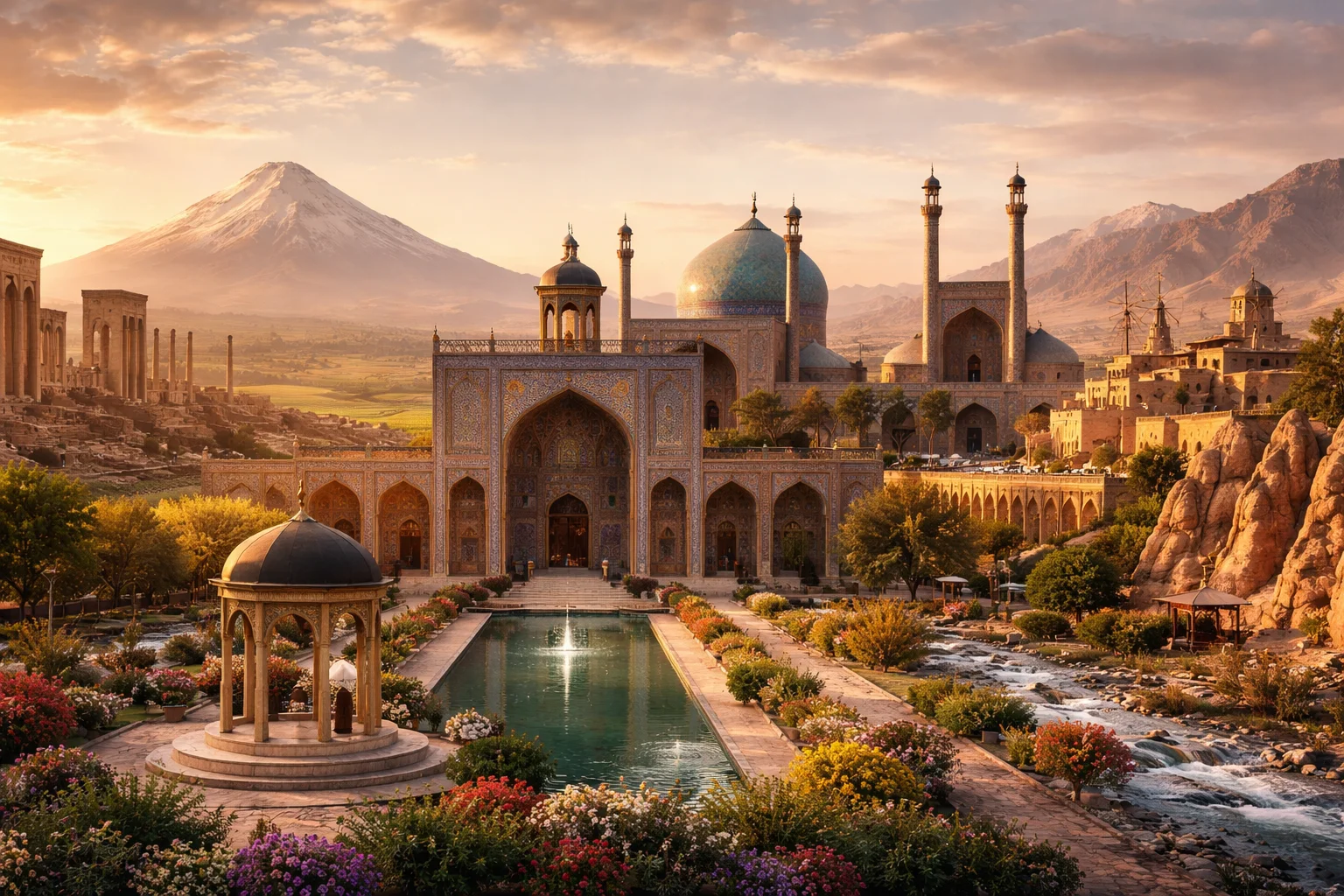
Iran overview
Iran is a country in West Asia whose modern political identity as the Islamic Republic overlays a civilization that traces statecraft and literature back millennia. Located on the Iranian Plateau, Iran has served as a crossroads between Central Asia, the Caucasus and the Persian Gulf trade routes. The nation is distinguished by a fusion of pre-Islamic imperial institutions and a Shiʿi theocratic republic form of government, producing unique legal and cultural blends. Iran’s significance derives from its demographic weight in the region, large hydrocarbon reserves, and a concentrated urban network anchored by Tehran.
Common Geography Questions About Iran
Where Iran is located
Iran lies in western Asia on the eastern edge of the Mediterranean–Indian Ocean landmass, roughly between 25°N and 40°N latitude and 44°E and 63°E longitude. It shares land borders with Iraq, Turkey, Armenia, Azerbaijan (including an exclave, Nakhchivan), Turkmenistan, Afghanistan and Pakistan. The country’s coastline fronts the Caspian Sea to the north and the Persian Gulf and Gulf of Oman to the south; the Strait of Hormuz at Iran’s southern approaches controls a strategic maritime choke point. Iran’s placement on the Iranian Plateau makes it a continental bridge linking the Caucasus and South Asia.
Geography and landscape of Iran
Iran’s landscape is dominated by two principal mountain systems: the northwest–southeast Zagros range and the narrow Alborz belt along the Caspian coast. Mount Damavand on the Alborz is the highest peak and a potentially active stratovolcano, a geographic landmark that anchors Persian cultural imagery. Eastward lies the Lut Desert (Dasht-e Lut), a record-holding wind-sculpted salt basin, while the central plateau hosts salt flats and endorheic basins. Climatic variation is stark: humid, forested Caspian slopes contrast with arid interiors and subtropical coastal plains on the Persian Gulf. Major rivers are short, seasonal, and often captured in ancient qanat irrigation networks.
Iran culture and society
Persian (Farsi) is the official language and literary medium, but Iran’s social fabric includes Azerbaijani Turkic, Kurdish, Luri, Balochi and Arabic-speaking communities, each with regional cultural institutions. The majority religion is Twelver Shiʿa Islam, a distinctive marker: Iran is the largest Shiʿa-majority state with religious legal structures embedded in governance. Cultural continuities include Nowruz (vernal-equinox new year) rooted in pre-Islamic Zoroastrianism and a living tradition of Persian poetry—Hafez and Ferdowsi remain reference points in daily life. Urbanization patterns show dense metropolitan centers paired with strong tribal and rural identities in provinces such as Sistan and Baluchestan.
History of Iran
Iran’s historical arc moves from the Achaemenid empire—when Cyrus the Great established an administratively innovative satrap system—to the Sassanian state that formed the last pre-Islamic imperial polity in the region. The 7th-century Arab conquests introduced Islam, after which Persian language and culture reasserted themselves under successive dynasties. In the early modern era the Safavid dynasty institutionalized Twelver Shiʿism as the state creed, a turning point that shaped regional religious geopolitics. Nineteenth- and twentieth-century encounters with imperial powers led to constitutional reform in 1906 and culminated politically in the 1979 Islamic Revolution, which replaced a monarchy with clerically mediated republican institutions.
Iran economy and government
Iran’s political system combines an elected presidency and parliament with non-elective oversight by clerical institutions; the office of the Supreme Leader holds ultimate authority, and the Guardian Council vets electoral candidates and legislation. Economically, hydrocarbons dominate: state-linked oil and gas extraction and refining underpin exports and public finance through large entities such as the national oil company. Agriculture and mining remain important regionally, while industrial clusters focus on petrochemicals, automobile assembly and heavy manufacturing. The national currency is the rial (commonly accounted in colloquial “toman”), and the economy features a mix of state-owned enterprises, semi-public foundations (bonyads) and private firms.
Regions and major cities of Iran
Administratively Iran is divided into provinces (ostan), currently organized into thirty-one units that reflect geographic and ethno-linguistic variation. Tehran, the capital, occupies a sprawling basin at the foot of the Alborz and functions as the political and economic center. Mashhad in the northeast is a major religious-pilgrimage city centered on the Imam Reza shrine; Isfahan in the interior plateau is renowned for Safavid-era civic planning and bridges; Tabriz in the northwest anchors the Azerbaijani-speaking region. Distinct cultural regions include Iranian Azerbaijan, Persian heartland on the central plateau, Kurdish highlands in the west, and the coastal Khuzestan oil province with an Arab minority.
Distinctive characteristics of Iran
Iran is globally associated with several concrete, recognizable features: Persian carpet weaving with region-specific knotting and design traditions, which produce identifiable regional rugs; a long-standing classical poetry and calligraphy tradition embodied by figures like Hafez and Rumi; and archaeological legacies such as the Cyrus Cylinder and Persepolis ruins tied to the Achaemenid state. In natural science and industry, Iran’s Damavand volcanic peak, the Lut Desert’s geomorphology, and concentrated petrochemical complexes mark its international profile. Iran is also one of the world’s leading producers of saffron and traditional pistachio cultivars, commodities closely linked to its agricultural identity.
Places in Iran
Eram Zoo
Eram Zoo is a zoological institution in Iran located in the city of Tehran. It is designated as an urban zoological garden that maintains a curated collection of vertebrate and select invertebrate taxa housed in purpose-built enclosures. The site functions as a permanent managed landscape within Tehran’s municipal estate and carries formal roles in animal husbandry, species record-keeping, and organized captive management programs. This institutional status is central to its identity within Iran’s network of zoos.
National Museum of Iran
National Museum of Iran is the principal state museum of Iran, located in the capital city of Tehran. The institution occupies a campus composed of two principal buildings, commonly described as the Museum of Ancient Iran and the Museum of the Islamic Era, and serves as the principal national repository for archaeological and historical collections. The complex holds permanent exhibition spaces, conservation facilities, and curatorial departments responsible for cataloging Iran's movable heritage.
Persepolis
Persepolis is the ceremonial capital of the Achaemenid Empire, located in present-day Iran and renowned for monumental ruins. The complex occupies a stone-built terrace of roughly 125,000 square meters and served as a center for royal ceremonies and state representation. Its carved reliefs and monumental architecture provide primary evidence for Achaemenid court protocol and imperial iconography. Persepolis remains significant as a preserved archaeological ensemble and as a benchmark for studies of ancient Persian imperial design.
Sharif University of Technology
Sharif University of Technology is a public research university in Iran specializing in engineering and physical sciences. The institution was founded in 1966 as Aryamehr University of Technology and was later renamed following the 1979 revolution. Sharif University of Technology operates under formal national higher-education structures and maintains undergraduate and graduate degree programs across multiple engineering disciplines. The university is recognized for its concentrated focus on technical education, structured research centers, and a campus established during Iran’s mid-20th century modernization of scientific training.
Tehran
Tehran is the capital city of the Islamic Republic of Iran and the country's principal political and economic center. It sits at the southern foothills of the Alborz mountain range in northern central Iran. The municipality of Tehran covers approximately 730 square kilometers within a broader metropolitan region. Tehran is Iran's largest city by population, functioning as the country's chief administrative, commercial, and cultural nucleus with national government institutions and major economic sectors concentrated there.
University of Tehran
University of Tehran is a public research university in Iran that functions as a central institution for higher education and research. It was established in 1934 as Iran’s first modern, state-founded university and is formally governed under the national higher-education system. The university occupies a principal urban campus in Tehran and maintains a central library, multiple faculties, and research institutes that together define its role as a national academic and cultural hub. Its formal status as a comprehensive public university and the presence of a signature main gate are measurable institutional facts linked to the campus identity.
Explore Natural Landmarks in Iran
Browse islands and mountains connected with Iran to keep exploring related geography clusters.