Indonesia Guide
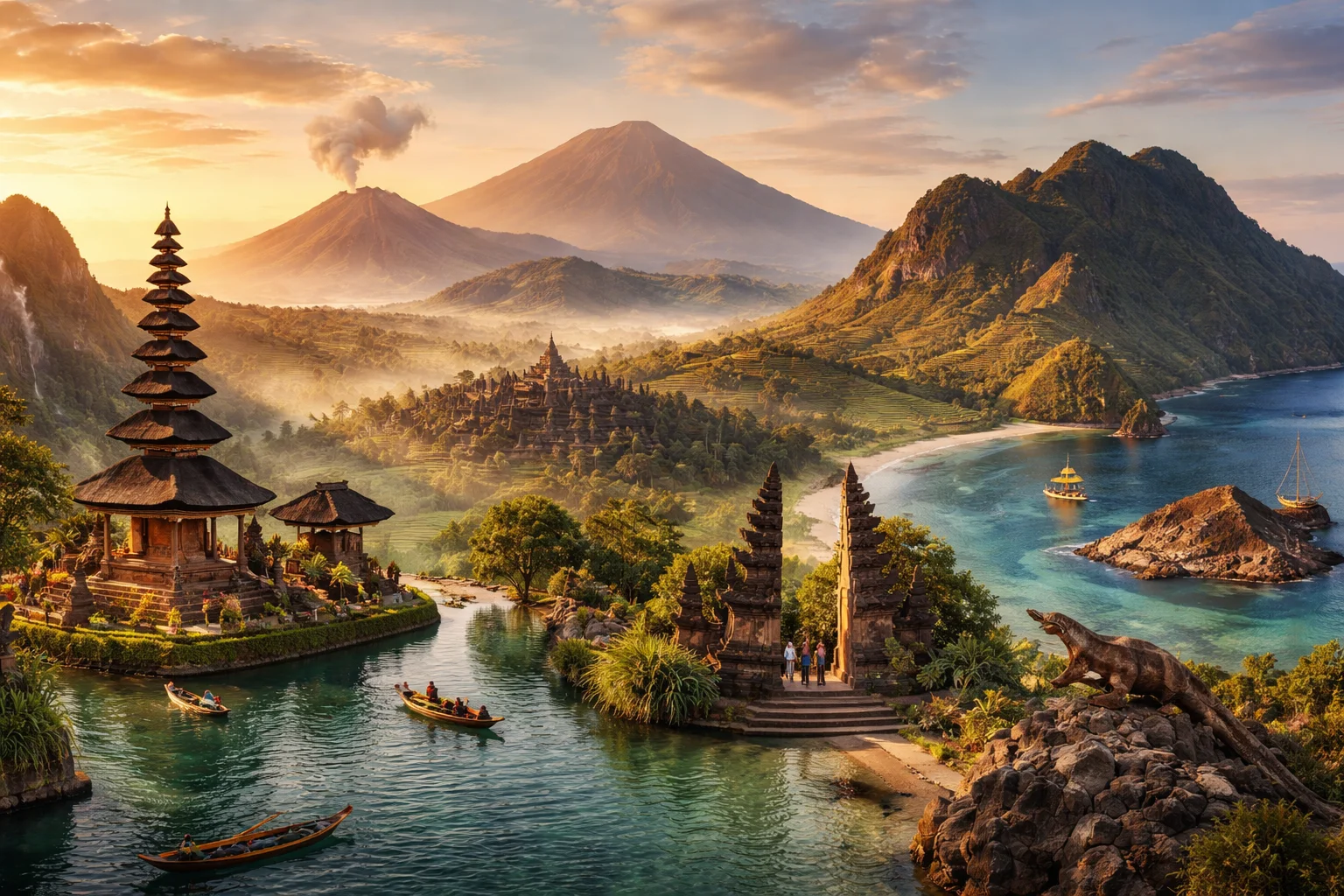
Indonesia overview
Indonesia is an archipelagic country across the equator in Southeast Asia and Oceania, between the Indian and Pacific oceans. Composed of thousands of islands, it is the world’s largest archipelago and the most populous country in Southeast Asia. Its national language functions as a unifying lingua franca across hundreds of local tongues, while its cultural and economic life blends Austronesian, Indian Ocean, Islamic and colonial Dutch legacies into distinctive national institutions and industries.
Common Geography Questions About Indonesia
Prepaid mobile data
Mobile data costs in Indonesia
Telkomsel's SIMPATI SERU Monthly 10 GB lists 10 GB for IDR 80,000 over 30 days. The derived unit cost is IDR 8,000 per GB.
Where Indonesia is located
Indonesia is geographically located primarily in Southeast Asia, with its easternmost islands in the western Pacific, across the equator between the Indian and Pacific oceans. Its territory extends roughly from about 95°E to 141°E longitude and from approximately 6°N to 11°S latitude. The country shares land boundaries on Borneo with Malaysia, on the island of New Guinea with Papua New Guinea, and with Timor-Leste on Timor; several other neighbors—Australia and the Philippines—lie across maritime borders. Indonesia occupies key maritime corridors including the Malacca, Sunda and Lombok straits, a position that defines its strategic maritime geography.
Geography and landscape of Indonesia
Indonesia’s terrain ranges from lowland peat swamps and extensive mangrove coastlines to high volcanic chains and alpine highlands. The Barisan Mountains run along western Sumatra, Java hosts dense volcanic complexes including stratovolcanoes that built the island’s fertile plains, and the Maoke range in Papua includes Puncak Jaya, the country’s highest summit on an island. Rivers such as the Kapuas (in Kalimantan) carve peatland basins, while Nusa Tenggara exhibits seasonally dry savanna unlike the equatorial rainforests of Sumatra and Borneo. That sharp island-by-island contrast—tropical rainforest next to savanna or highland tundra—is a specific hallmark of Indonesia’s physical geography.
Indonesia culture and society
Indonesia’s official language, Bahasa Indonesia, operates alongside more than 700 indigenous languages; Javanese and Sundanese are among the largest local vernaculars. The nation is distinctive for having the world’s largest Muslim-majority population coexisting with sizable Christian, Hindu (notably in Bali), Buddhist and animist communities. Cultural practices range from Javanese court rites and wayang kulit shadow theatre to the island-specific adat customary laws that regulate land and family life. Urban-rural contrasts are pronounced: Jakarta and other ports concentrate modern industry and migration, while many outer islands maintain communal, kin-based social structures tied to local ritual calendars.
History of Indonesia
Indonesia’s history fuses maritime kingdoms, religious trade networks and colonial exploitation into a narrative of regional integration and national formation. From Srivijaya’s control of maritime trade routes to Majapahit’s thalassocracy, the archipelago was an important node in Indian Ocean and Pacific commerce. Islam spread through trading ports before European powers, led by the Dutch East India Company, asserted control in the 17th–19th centuries. The 20th-century nationalist movement adopted a Malay-based lingua franca and declared independence in 1945; postwar diplomacy—exemplified by the 1955 Bandung Conference—positioned the country as a pivotal voice in the Non-Aligned movement and reshaped Southeast Asian politics.
Indonesia economy and government
Indonesia is a presidential republic with a separation of powers and a bicameral legislature: the House of Representatives (DPR) and an upper chamber (DPD) that represents regions. Decentralization reforms since the late 1990s transferred many powers to provinces and districts, and a few provinces hold special autonomy arrangements. The national currency is the Indonesian rupiah. Economically, Indonesia combines large agricultural sectors—rice and the world-leading palm oil industry—with substantial mining and metals exports (notably coal and nickel), developed manufacturing clusters on Java and growing logistics challenges from its archipelagic geography that shape investment and infrastructure priorities.
Regions and major cities of Indonesia
Administratively Indonesia is divided into provinces, some with special status—Aceh’s legal autonomy and Yogyakarta’s hereditary sultanate status are specific exceptions to the standard provincial model. Java remains the demographic and administrative core despite being a relatively small portion of land area; Jakarta, located on Java’s northwest coast, functions as the capital and principal economic hub. Other major cities include Surabaya (East Java), Medan (Sumatra) and Bandung (West Java). Distinct island regions—Sumatra, Kalimantan, Sulawesi, Nusa Tenggara and Papua—retain strong regional identities tied to different ecological zones and economic specializations.
Distinctive characteristics of Indonesia
Indonesia is widely associated with several concrete global features: it is the largest archipelagic state and hosts the Wallace Line, the biogeographic boundary separating Asian and Australasian flora and fauna. The Komodo dragon, native only to a few eastern islands, is an iconic endemic species. In world markets Indonesia is a leading exporter of palm oil and a major nickel supplier, while culturally it exports batik, gamelan music and a strong coffee heritage (Sumatran and Toraja beans). The country’s coral-rich seas form a core of the Coral Triangle, giving Indonesia outsized importance in marine biodiversity conservation.
Places in Indonesia
Bali
Bali is an Indonesian island and province in the Lesser Sunda archipelago, notable for its concentrated cultural heritage and distinctive landscapes. It serves as a regional administrative unit with Denpasar as its provincial capital and covers about 5,780 square kilometers. The island features Mount Agung, a stratovolcano rising to roughly 3,031 meters, and a pervasive Hindu cultural tradition that shapes agriculture, architecture, and ceremonial life across populated and rural areas of Bali.
Bali Rice Terraces
Bali Rice Terraces is a collective name for the stepped paddy landscapes on the island of Bali, Indonesia, formed by traditional wet-rice agriculture. These terraces occupy upland slopes and valleys and include large complexes such as Jatiluwih, which covers roughly 600 hectares of irrigated terraces. The terraces are significant for their long-standing subak irrigation system, their role in Balinese agrarian culture, and their representation of a working cultural landscape with measurable agricultural area.
Bali Zoo
Bali Zoo is a zoo in Indonesia located on the island of Bali. It is situated in Gianyar Regency and functions as a managed, curated zoological collection operating from a single landscaped campus with discrete enclosures for mammals, birds, and reptiles. The institution serves as a formal animal collection and maintains on-site husbandry and veterinary facilities that support breeding and long-term care programs within its property boundaries.
Bandung Institute of Technology
Bandung Institute of Technology is a public university in Indonesia specializing in science, engineering, and applied arts. The main institutional identity combines a national research mandate with a longstanding campus presence in the city of Bandung, and the university traces its institutional roots to a colonial-era technical school that provided formal engineering education. The Bandung Institute of Technology operates as a state-run higher-education institution with a defined campus core and a multi-faculty structure that formally ranks it among Indonesia’s major technical universities. The campus includes purpose-built laboratories, faculties for engineering and arts, and administrative headquarters that serve national research and educational functions.
Bandung Zoo
Bandung Zoo is a public zoological park in Indonesia situated within the city of Bandung, West Java. It functions as the municipal zoological collection for Bandung and maintains a curated assemblage that includes animals from at least three vertebrate classes—mammals, birds, and reptiles—organized as observable exhibit groups. The site is significant for urban biodiversity display and for holding a permanent, managed collection under local institutional oversight.
Borobudur
Borobudur is a ninth-century Mahayana Buddhist monument and architectural complex located on the island of Java, Indonesia. It stands as a large stupa-temple with nine stacked platforms and a central dome, achieving a height of approximately thirty-five metres. Borobudur is significant for its dense narrative stone reliefs and for being an important monument of Indonesian religious heritage. The complex contains 2,672 carved relief panels and 504 Buddha statues, a quantifiable measure of its sculptural program.
Canggu
Canggu is a district-level settlement on the island of Bali in Indonesia. Its central area lies at approximately 8.65° south latitude and 115.14° east longitude, providing a precise geographic anchor for official mapping and planning. The district is significant for its combination of coastal frontage and adjacent irrigated rice land, and it functions as a contiguous urban and rural zone within the administrative framework of southern Bali. Canggu is often referenced in provincial land-use records.
Gadjah Mada University
Gadjah Mada University is a public state university in Indonesia, formally known as Universitas Gadjah Mada. The institution is located in Yogyakarta on the island of Java and its main Bulaksumur campus occupies an established academic precinct north of the city center; the university was founded in 1949 and administers multiple faculties across undergraduate and postgraduate levels. Gadjah Mada University functions as a national research and teaching institution with formal status under Indonesian higher-education law and operates a teaching hospital and extensive academic libraries that serve its large student and research community.
Gembira Loka Zoo
Gembira Loka Zoo is a zoological park in Yogyakarta, Indonesia, functioning as the city’s principal managed wildlife collection. The site is a municipal institution within the Special Region of Yogyakarta administrative area and occupies urban parkland organized as enclosures, landscaping, and a central water feature. The zoo serves formal roles in public animal husbandry, species display, and institutional stewardship under municipal oversight, with a documented collection of native and non-native species.
Gili Islands
Gili Islands is an archipelago of three small islands off the northwest coast of Lombok, Indonesia, notable for its marine ecosystems and compact human settlements. The group comprises Gili Trawangan, Gili Meno, and Gili Air and lies roughly 2.5 kilometres from Lombok’s shoreline. The Gili Islands are significant for regional coral reef biodiversity and for serving as a long-term site for ecological studies and local coastal livelihoods. This entry summarizes location, history, significance, and features.
Jakarta
Jakarta is the capital of Indonesia and the country’s principal political and economic center. It occupies a low coastal plain on the northwest coast of Java, facing the Java Sea, and has more than ten million residents within its formal city limits. National government institutions, major financial organizations, and Indonesia’s principal container port infrastructure are concentrated here. Jakarta is administered at the provincial level as the Special Capital Region (Daerah Khusus Ibukota).
Karimunjawa Islands
Karimunjawa Islands is an Indonesian archipelago of 27 islands located in the Java Sea north of Central Java, Indonesia. The Karimunjawa Islands are significant for their extensive coral reef systems and their inclusion within a formally designated national park. This archipelago functions as a reference site for marine biodiversity and coastal conservation in central Indonesia. The location features both terrestrial vegetation and surrounding shallow marine habitats supporting diverse species.
Explore Natural Landmarks in Indonesia
Browse islands and mountains connected with Indonesia to keep exploring related geography clusters.