Grenada Guide
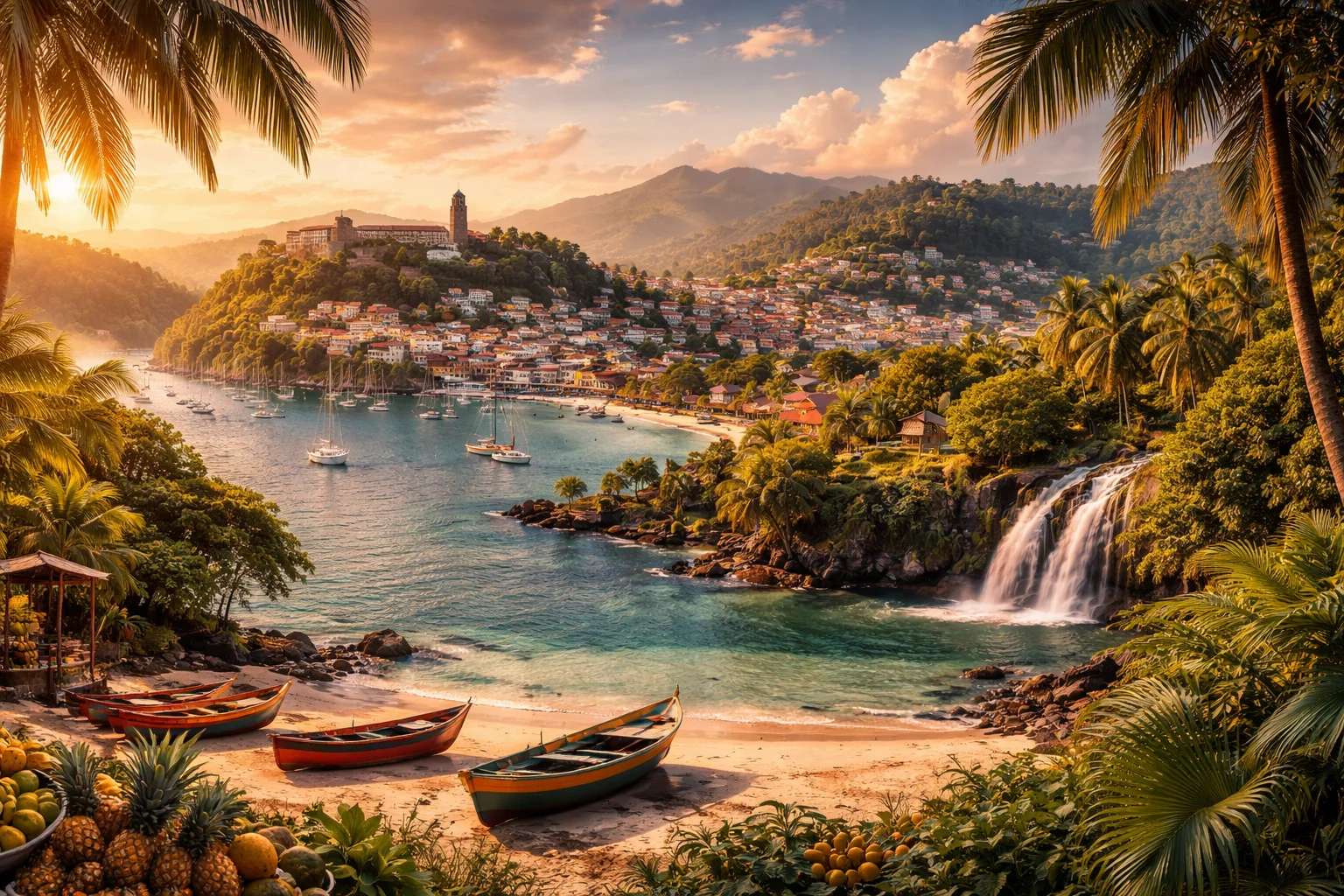
Grenada overview
Grenada is an island sovereign state in the southeastern Caribbean, often nicknamed the "Spice Isle" for its historic role in global nutmeg and mace production. Situated at the southern end of the Windward Islands, Grenada combines volcanic highlands, a crater lake, and a horseshoe-shaped capital harbor that have shaped its economy and identity. The country’s significance lies in a concentrated export profile—spices and tourism—and a distinctive cultural calendar anchored by the nation’s Spicemas carnival and boatbuilding traditions on nearby Carriacou.
Common Geography Questions About Grenada
Where Grenada is located
Grenada lies in the Caribbean Sea at roughly 12.12° N latitude and 61.68° W longitude, forming the southernmost part of the Windward Islands. It has no land borders; marine neighbors include Saint Vincent and the Grenadines to the north and Trinidad and Tobago to the south, with the Caribbean Sea to the west and the Atlantic Ocean to the east. Grenada’s territory includes the main island plus the dependencies of Carriacou and Petite Martinique, which sit northeast of the principal island and define a multi-island jurisdiction rather than a single contiguous landmass.
Geography and landscape of Grenada
Grenada’s geography is volcanic and compact: steep, rainforest‑clad mountains on the main island, a highest point at Mount Saint Catherine, and a notable crater lake, Grand Etang, in an extinct volcanic basin. Soils on the windward slopes support extensive nutmeg trees—an uncommon agricultural landscape for a country of its size. Carriacou and Petite Martinique contrast with the main island as low-lying limestone and coral islands with raised shelf reefs. Coastal features include mangrove fringes and a pronounced horseshoe harbor at St. George’s; short, fast rivers descend from the interior rather than long navigable waterways.
Grenada culture and society
The official language is English, but Grenadian Creole English and remnants of a French-based patois appear in speech, placenames, and idiom. Religious life is predominantly Christian—Anglican, Roman Catholic and Pentecostal—with syncretic practices visible in carnival rituals. Distinct customs include Spicemas, a national carnival held in August rather than during the pre‑Lenten season, and Big Drum performances that tie African-derived rhythms to communal ceremonies. Demographically, Grenada is a small, largely Afro‑descended population with strong transnational ties to diasporas in the UK, US and Canada, shaping remittance flows and cultural exchange.
History of Grenada
Grenada’s history moves from Indigenous Amerindian settlement through French colonization in the 17th century and formal transfer to Britain in 1763, which established plantation agriculture based on enslaved African labor. Emancipation reshaped social structures, while the 20th century brought nationalist movements culminating in independence in 1974. The 1979 revolution led by the New Jewel Movement and the subsequent 1983 military intervention are watershed moments that altered Grenada’s international posture and constitutional arrangements. These episodes link Grenada’s past to broader Cold War and post‑colonial dynamics in the Caribbean.
Grenada economy and government
Grenada operates as a parliamentary democracy and constitutional monarchy within the Commonwealth, with an elected parliament and an executive led by a prime minister; a governor‑general performs the ceremonial role of the monarch’s representative. The economy hinges on three pillars: agriculture (notably nutmeg and mace, for which Grenada is world‑famous relative to its size), tourism centered on beaches and yachting, and offshore services. The country uses the Eastern Caribbean dollar, a regional currency, and its narrow export base and small domestic market make the economy particularly sensitive to hurricane damage and single‑crop price shifts.
Regions and major cities of Grenada
Administratively, Grenada is divided into six parishes on the main island and two dependencies: Carriacou and Petite Martinique. The capital, St. George’s, is famed for its red‑roofed Georgian architecture and a natural harbor that concentrates commercial and tourist activity. Other notable towns include Gouyave, known for nutmeg processing and an annual Fishermen’s Festival, and Grenville on the east coast, a commercial hub for agricultural trade. Hillsborough serves as the principal settlement of Carriacou and preserves traditional boatbuilding and regatta customs.
Distinctive characteristics of Grenada
Grenada’s global profile rests on concrete, verifiable associations: it is widely known as the Spice Isle for its nutmeg production—so much that nutmeg appears on the national coat of arms—and it hosts Grand Etang, a rainforest crater lake unusual for such a small island. Its 1979 revolution and the 1983 international intervention remain reference points in diplomatic history. Grenada also projects a maritime identity through Carriacou’s annual regatta and a niche reputation in sailing and yachting circles, linking its cultural festivals and boatbuilding craft directly to international visitor flows.