Greece Guide
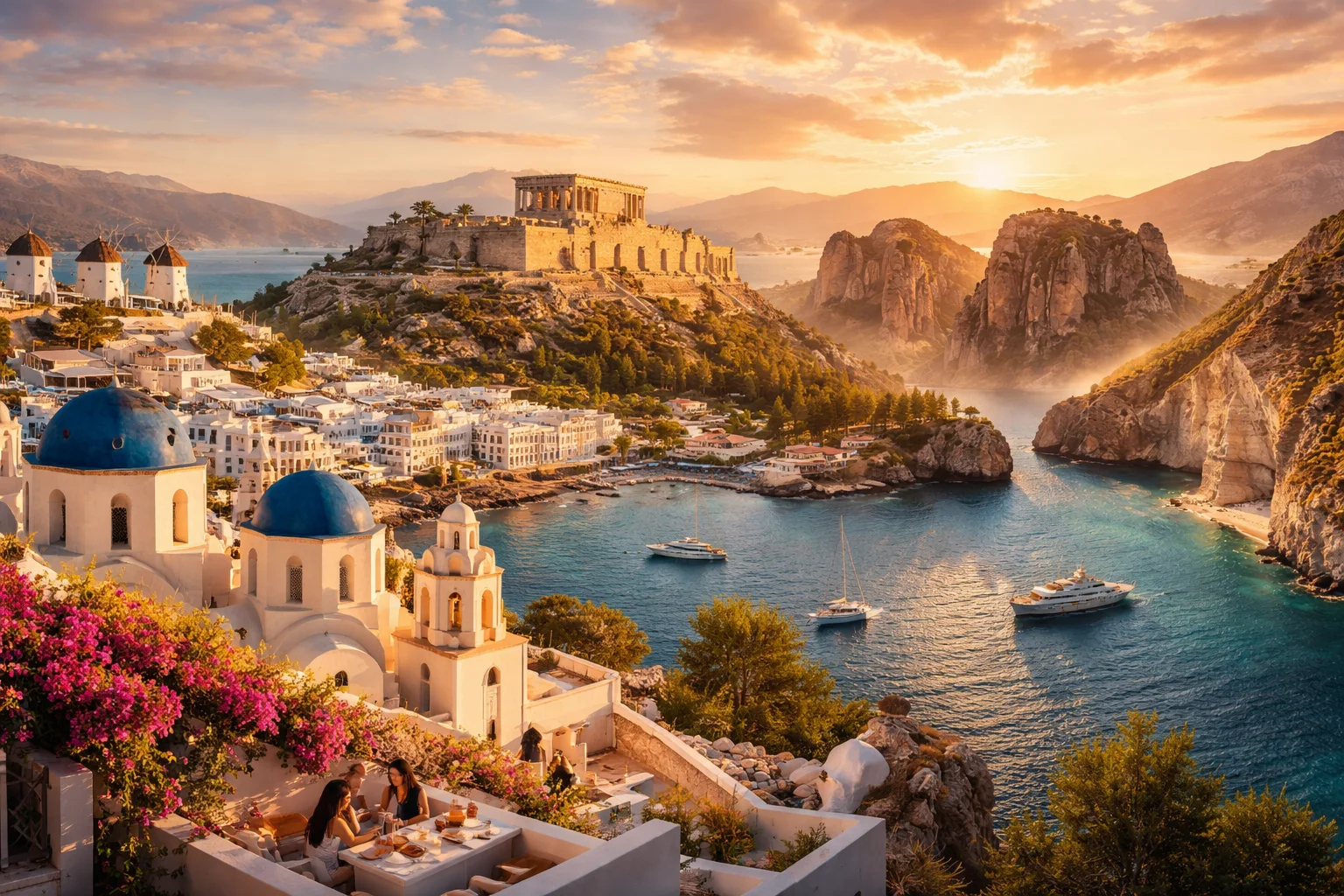
Greece overview
Greece is a sovereign state in southeastern Europe, defined by a long coastal margin, a contiguous mainland on the southern Balkans and an archipelago that has shaped its maritime identity. It is widely recognized as the historical cradle of Western political thought and drama; ancient Athenian institutions and classical literature continue to influence law and education globally. Modern Greece combines this intellectual legacy with a predominantly urban population clustered around Athens, a seafaring economy, and regional landscapes that range from alpine peaks to sun-baked islands.
Common Geography Questions About Greece
Where Greece is located
Greece sits on the southern tip of the Balkan Peninsula in Europe, roughly centered near 39°N latitude and 22°E longitude. It shares land borders with Albania to the northwest, North Macedonia and Bulgaria to the north, and Turkey to the northeast. The country is bounded seaward by three named basins—the Ionian Sea to the west, the Aegean Sea between mainland and Asia Minor, and the Cretan and broader Mediterranean Sea to the south—creating extensive maritime frontiers and legal claims distinct from many continental states.
Geography and landscape of Greece
Greece’s terrain is among the most mountainous in Europe: the Pindus range trenches the mainland, while Mount Olympus rises to the highest point at 2,918 meters. Rivers are typically short and seasonal; the Evros (Meriç) forms a notable natural border in the northeast. Karstic limestone creates dramatic gorges such as Samaria in Crete, one of Europe’s longest, and inland basins like the Thessaly plain provide the principal arable areas. A highly indented coastline and thousands of islands produce stark regional contrasts between alpine north, fertile lowlands, and arid Cycladic isles.
Greece culture and society
The Greek language, written in the Greek alphabet, is the state language and a continuous linguistic stream from antiquity to today—an uncommon cultural continuity. The Greek Orthodox Church is the predominant religious institution and historically intertwined with social life, producing customs such as prominent name-day celebrations that often outweigh birthdays in social importance. Social norms emphasize family networks and the cultural notion of filotimo, a locally specific ethic of honor and reciprocal obligation. Greece also sustains a large emigrant community whose cultural ties shape domestic society.
History of Greece
Greece’s recorded history begins with Bronze Age civilizations, including Mycenaeans who appear in archaeological strata and Homeric memory. Classical Greece saw the rise of independent city-states—Athens and Sparta—with Athens establishing institutions later labeled democracy and producing philosophers like Plato and Aristotle. Alexander’s Hellenistic successor states spread Greek culture across the eastern Mediterranean and Near East. Byzantium thereafter centered Greek-speaking Christianity for a millennium, followed by Ottoman rule; the 19th-century War of Independence created the modern Greek state that gradually expanded to include many historically Greek regions.
Greece economy and government
Greece is a parliamentary republic: a single-chamber Hellenic Parliament selects a prime minister who leads the government, while the president has a largely ceremonial role. Administratively, the country is organized into decentralized regions established by modern reforms (notably Kallikratis), which redistributed powers from old prefectures. The economy mixes services, agriculture, and industry; it is internationally notable for a merchant fleet that ranks among the world’s largest by tonnage, a dominant tourism sector focused on islands and antiquities, and long-established olive oil and wine production. The official currency is the euro.
Regions and major cities of Greece
Greece is divided into 13 administrative regions (peripheries) that reflect both geographic divisions and policy jurisdictions. The capital is Athens, the country’s primary economic and cultural center; Thessaloniki is the principal northern metropolis and regional hub; Patras serves the western Peloponnese and port linkages. Distinct historic regions persist in identity: Macedonia and Thrace in the north, Epirus and Thessaly inland, the Peloponnese peninsula, and island groups such as the Cyclades, Dodecanese, Ionian Islands and Crete—the latter being the largest island with its own strong regional traditions.
Distinctive characteristics of Greece
Greece is globally associated with specific, verifiable legacies: it is the origin point of the ancient Olympic Games at Olympia; the Greek alphabet contributed letters and a structural model that influenced Latin and Cyrillic scripts; and classical philosophy and historiography trace foundational texts to Greek city-states. In modern economic geography, Greek shipowners operate a disproportionately large merchant fleet relative to national population, giving the country an outsized presence in global shipping. Tangible sites such as the Acropolis and Meteora provide widely recognized cultural anchors that connect its ancient heritage to contemporary tourism and scholarship.
Places in Greece
Acropolis
Acropolis is an ancient fortified citadel located on a limestone outcrop in central Athens, Greece. It functions as a focal archaeological complex containing major classical monuments and civic architecture. The site rises approximately 156 meters above sea level and covers roughly three hectares of exposed bedrock and constructed area. This location's significance derives from concentrated fifth-century BCE architecture, enduring artistic achievements, and its central role in Athenian civic and religious identity.
Acropolis Museum
Acropolis Museum is a modern archaeological museum in Greece that houses finds from the Acropolis of Athens. The museum is sited at the foot of the Acropolis rock and its principal role is to preserve, study, and exhibit original sculpture and architectural fragments from the Acropolis archaeological site. The collection includes original marble sculptures from the Parthenon and other Acropolis monuments, and the building incorporates exhibition spaces aligned with the monuments they represent.
Aristotle University of Thessaloniki
Aristotle University of Thessaloniki is a public university in Greece and a central institution of higher education for the country’s northern region. The university was established in 1925 and serves as a multidisciplinary research and teaching institution with formal status under the Greek state higher-education system. Aristotle University of Thessaloniki holds a significant role in national academic governance, operates major teaching hospitals and research centres, and maintains institutional collections such as a central university library and museum holdings.
Athens
Athens is the capital city of Greece and its principal political and cultural center. It occupies a central role in the modern Greek state and in broader Mediterranean history. The metropolitan area contains roughly 3.1 million inhabitants, making it the country's largest urban agglomeration by population. Athens is significant for its concentration of national institutions, extensive archaeological heritage, and enduring influence on Western intellectual and artistic traditions.
Athens International Airport
Athens International Airport is the principal international airport serving Greece and the Athens metropolitan area. The airport is a civil aviation facility with two parallel runways and a modern international terminal complex, and it serves as the primary air gateway for Attica. Athens International Airport is operated through a corporate entity responsible for terminal management and airfield infrastructure, and it functions as a national transport hub linking Greece to international and domestic air networks.
Attica Zoological Park
Attica Zoological Park is a zoological collection and managed wildlife facility in Greece, serving the Athens metropolitan area. The park occupies a defined site on the eastern urban periphery near Athens International Airport, roughly at coordinates 37.94°N, 23.95°E, and combines terrestrial exhibits with dedicated sea-mammal pools. Its significance derives from its role as a curated collection for education, captive breeding, and public scientific display within the Greek institutional landscape.
Benaki Museum
Benaki Museum is a museum in Greece that preserves and exhibits breadths of Greek and related material culture. Its principal campus sits in central Athens and the institution is administered by the Benaki Museum Foundation, a formal cultural foundation responsible for collections stewardship. The museum holds collections spanning ancient, Byzantine, and modern Greek art alongside substantial holdings of Islamic and Asian objects. The institution functions as a collecting, research, conservation, and publication centre for material culture studies.
Elafonissi Beach
Elafonissi Beach is a coastal beach on the island of Crete in Greece. It is located on a shallow sandbar that connects a small islet called Elafonissi to the southwestern mainland and creates an extensive intertidal lagoon and exposed shoal system. The beach’s sand contains a notable proportion of pink-tinted shell and coralline-algae fragments, a measurable compositional characteristic that distinguishes its surface sediments from adjacent Cretan shores.
Heraklion Archaeological Museum
Heraklion Archaeological Museum is an archaeological museum in Heraklion, Greece, with collections focused on prehistoric Crete. The museum holds key Minoan artifacts, including the Phaistos Disc and characteristic Minoan figurines, and presents material ranging from Neolithic contexts through Roman-period deposits. Its institutional role is to preserve, study, and display primary archaeological material recovered across Crete, functioning as a central repository and research reference for Cretan prehistory.
Meteora
Meteora is a complex of immense natural rock pillars and Eastern Orthodox monastic foundations in central Greece, notable for its dramatic vertical cliffs. It sits above the Peneios valley near the town of Kalambaka and contains six functioning cliff-top monasteries. The rock pillars rise to roughly 400 meters above the valley floor, making the site a measurable geomorphological landmark. The site is significant for its combined natural and cultural importance at national and international scales.
Monastiraki
Monastiraki is a district in Athens, Greece, centered on Monastiraki Square and forming part of the city’s historic urban core. It is significant as a junction between surviving ancient remains and modern commercial streets, and it contains a named metro station and a central open square that serve as formally recognized urban elements. The district’s built area is compact and defined by the square, adjoining streets, and visible archaeological fragments.
Myrtos Beach
Myrtos Beach is a coastal pebble beach on the island of Kefalonia in Greece. It occupies a steep, curved bay on Kefalonia’s northwest shore and the shoreline is composed predominantly of rounded white carbonate pebbles derived from the surrounding limestone slopes. The beach’s profile is defined by a narrow foreshore backed directly by steep talus and cliff faces, making its sediment composition and bay curvature measurable characteristics used in regional coastal descriptions.
Explore Natural Landmarks in Greece
Browse islands and mountains connected with Greece to keep exploring related geography clusters.