Ghana Guide
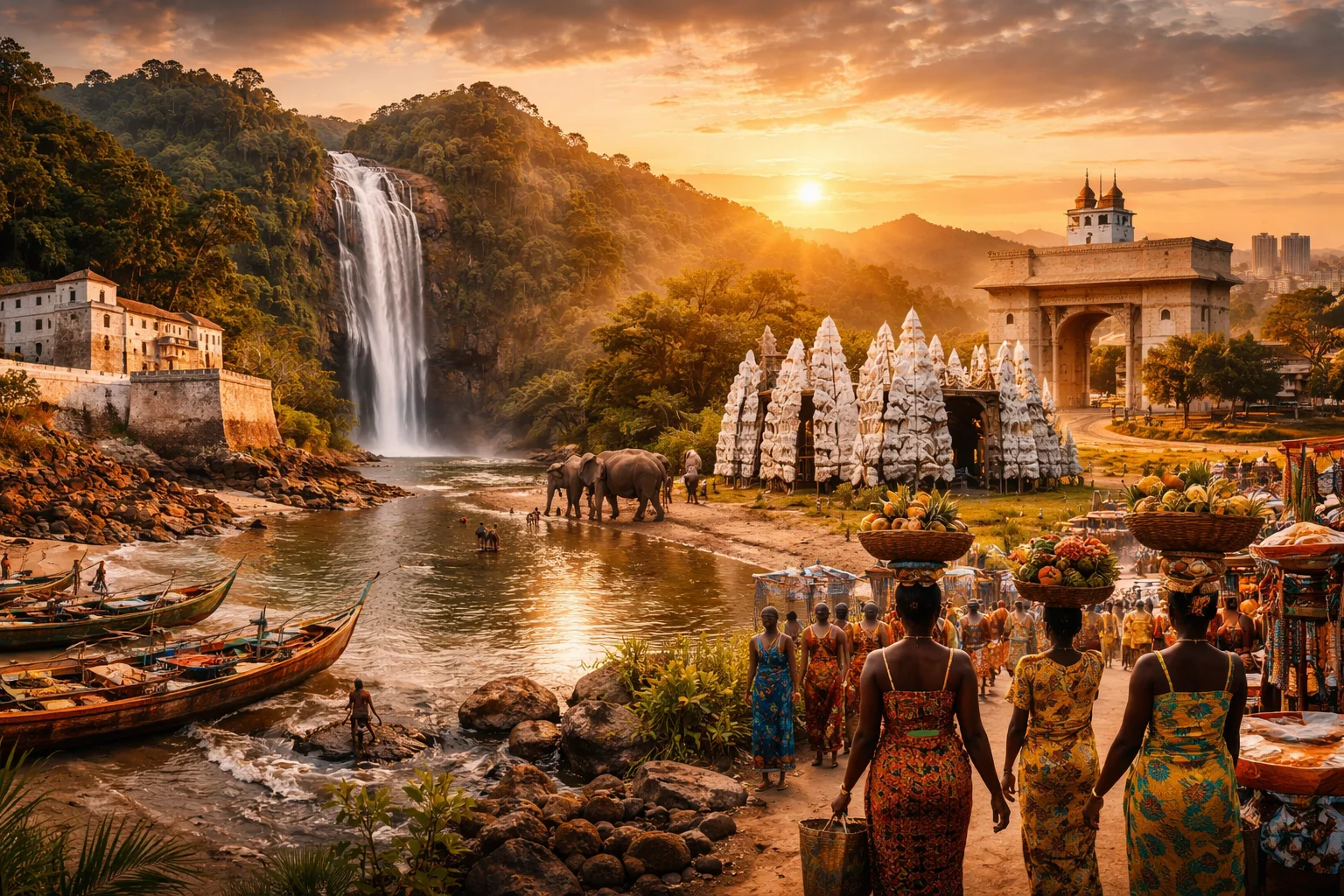
Ghana overview
Ghana is a West African republic on the Gulf of Guinea, known for its historical role in African decolonization, a mix of tropical landscapes, and a modern economy built on agriculture, minerals and services. The country combines coastal plains, rainforest, and a broad savanna, while political traditions blend elected democracy with institutionalised chieftaincy. Ghana’s identity is shaped by specific landmarks—Elmina and Cape Coast castles, the Akosombo hydroelectric project that formed Lake Volta, and distinctive textile traditions like kente—that anchor its regional importance in history, culture and economy.
Common Geography Questions About Ghana
Where Ghana is located
Ghana sits on the western side of the Gulf of Guinea in coastal West Africa, approximately between latitudes 4°N and 11°N and longitudes 3°W and 1°E. It borders Côte d’Ivoire to the west, Burkina Faso to the north and Togo to the east, with a southern coastline on the Atlantic. Ghana’s shoreline and the Volta River basin define much of its orientation: Lake Volta, one of the world’s largest artificial reservoirs, lies inland and shapes transport and power distribution in the country’s center-east.
Geography and landscape of Ghana
Ghana’s geography ranges from narrow coastal savanna and sandy beaches in the south to tropical rainforest in the southwest and semi-arid guinea savanna in the north. The Akwapim–Togo Range and the Kwahu Plateau are notable uplands; they are not continuous high mountains but create local rainfall gradients. The Volta River system drains much of the country into Lake Volta before reaching the Gulf of Guinea. Ghana’s position on the Dahomey Gap—an interruption of West African rainforest by savanna—is a geographic anomaly that affects regional biodiversity and agricultural zones.
Ghana culture and society
Ghana’s cultural fabric is multilingual and ethnically varied: English is the official language, while Akan dialects (Twi and Fante), Ewe, Ga, and Mole-Dagbon languages are widely spoken. Social life intertwines Christian and Muslim majorities with indigenous belief systems; public chieftaincy institutions—stools and stools’ councils—retain legal recognition alongside elected government. Distinctive cultural markers include kente weaving rooted to Akan and Ewe communities, the Ga Homowo and Ashanti Adae festivals, and naming practices tied to day-names; these customs, reinforced by matrilineal lineages in several Akan groups, set Ghanaian social organization apart in West Africa.
History of Ghana
Ghana’s history encompasses precolonial states, coastal trade, European fortifications and modern independence. Atlantic-century trade centered ports such as Elmina and Cape Coast, where stone castles served as trading hubs. The Akan polities, notably the Asante (Ashanti), established centralized states in the interior. Colonial consolidation under Britain produced the Gold Coast colony; in 1957 Kwame Nkrumah led a nonviolent push to independence, making Ghana the first sub-Saharan British colony to gain sovereign status in the modern decolonization era. Post-independence periods of coups and civil rule gave way to a constitutional democracy that reconfigured governance and economic policy.
Ghana economy and government
Ghana operates as a unitary presidential constitutional republic with a separation of powers between an elected president, a unicameral parliament and an independent judiciary; customary chiefs exist within a parallel system recognised by law. The economy combines mineral exports—historic gold mining—agro-exports such as cocoa, and energy production that includes hydroelectric generation from the Akosombo Dam and offshore oil fields discovered in recent decades. The national currency is the Ghanaian cedi. Ghana’s economic profile features a sizeable informal sector and formal institutions like the Ghana Stock Exchange concentrated in Accra, with state and private actors shaping fiscal and development policy.
Regions and major cities of Ghana
Administratively, Ghana is divided into sixteen regions that reflect geographic and political diversity, from the forested Western Region to the savanna Northern Region. The capital, Accra, is the administrative and commercial hub on the coast. Kumasi in the Ashanti Region is a historical and cultural heartland associated with Akan polity and trade; Tamale serves as the principal city of the north and a logistics center for the interior. Sekondi–Takoradi functions as a coastal port and energy-industry node. Each city sits within distinct cultural zones that influence language, architecture and economic specialization.
Distinctive characteristics of Ghana
Concrete features associated with Ghana include the Black Star symbol—adopted from Marcus Garvey’s pan-Africanist imagery—visible on the national flag and in football team names, and Lake Volta, created by the Akosombo Dam, which uniquely shapes inland navigation and energy. Ghanaian kente cloth and the Elmina/Cape Coast UNESCO-recognised castle complex link the country to global cultural and historical narratives of textile arts and the transatlantic slave trade. On the international stage, Ghana has been distinctive as an early beacon of African independence, a consistent contributor to UN peacekeeping, and a major source of high-quality cocoa and gold in global commodity networks.
Places in Ghana
Accra
Accra is the capital city of Ghana and the country’s principal urban center on the Atlantic coast. It functions as the national seat of government and as the main concentration of administrative, commercial, and diplomatic institutions. The city is the largest urban area in Ghana by population and serves as a focal point for national media and higher education. Accra’s formal municipal structure comprises multiple metropolitan and municipal assemblies within the Greater Accra administrative area.
Cape Coast Castle
Cape Coast Castle is a fortified colonial complex on the Gulf of Guinea shoreline in Cape Coast, Central Region, Ghana. The site functioned as a major holding and embarkation point in the trans‑Atlantic slave trade and later served colonial administrative purposes. The complex contains subterranean dungeons beneath a central courtyard and stone ramparts that define its footprint. It was inscribed on the UNESCO World Heritage List in 1979 as part of Ghana’s forts and castles ensemble.
Elmina Castle
Elmina Castle is a coastal fortification in Ghana that functioned as a major European trading post and colonial stronghold. The structure was completed in 1482 by Portuguese builders and originally bore the name São Jorge da Mina. Its significance derives from preserved built fabric and documentary evidence linking the site to Atlantic commercial networks. The complex remains one of the oldest surviving European-built structures in sub-Saharan Africa and exemplifies early global trade infrastructure.
Jamestown
Jamestown is a coastal district of the city of Accra in the Republic of Ghana. The district is significant as a historic port quarter that occupies a narrow headland projecting into the Gulf of Guinea and includes a colonial-era lighthouse as a landmark. Its formal status is as an urban district within the Accra metropolitan area, and it is commonly identified in municipal records by its dense residential compounds and maritime infrastructure.
Kakum National Park
Kakum National Park is a protected tropical rainforest reserve in southern Ghana that conserves lowland evergreen forest and biodiversity. Located north of the coastal city of Cape Coast, it preserves a significant stretch of primary and regenerating rainforest in the region. The park covers approximately 375 square kilometers, providing measurable habitat area for wildlife and plant communities. It functions as an ecological reference site for West African rainforest studies and long-term conservation planning.
Kumasi Zoo
Kumasi Zoo is a municipal zoological park in Ghana located within the city of Kumasi in the Ashanti Region. The site functions as the principal urban zoological collection in Kumasi, formally administered within the Kumasi metropolitan park system and situated on land managed for public green space. Its significance derives from serving as a regional collection of West African fauna, a municipal scientific resource, and an institutional node for education and species care.
Lake Bosumtwi
Lake Bosumtwi is a natural, bowl-shaped crater lake in Ghana's Ashanti Region that occupies an ancient impact structure. It is the country’s best-known natural lake and fills a roughly 10.5-kilometre diameter crater with a surface area near 49 square kilometres. The lake reaches substantial depth in its central basin, and it holds significance for regional culture, freshwater ecology, and scientific studies of impact processes and paleoclimate records.
Mole National Park
Mole National Park is Ghana's largest protected wildlife area situated in the north of the country and notable for savanna biodiversity. The park covers approximately 4,577 square kilometers, a formally defined conservation unit by Ghanaian authorities. Mole National Park is significant for sustaining large mammal populations, extensive woodland-grassland mosaics, and important avian communities that contribute to regional biodiversity conservation and ecological research.
National Museum of Ghana
National Museum of Ghana is the state museum of Ghana, based in the capital city of Accra. The institution functions as the national repository for archaeology, ethnography and historical material and is administered under the Ghana Museums and Monuments Board, a formal heritage authority. The museum maintains a permanent exhibition program and scientific collections that represent the material cultures and historical archaeology of the territory now known as Ghana.
Nzulezo Stilt Village
Nzulezo Stilt Village is a settlement of timber houses built on wooden stilts above a shallow lake in the Western Region of Ghana. The community comprises about 600 residents living in clustered elevated dwellings connected by plank walkways. The settlement functions as a continuous residential lakeside community that sustains local Nzema cultural traditions and communal governance. Nzulezo Stilt Village draws attention for its sustained pattern of stilted habitation within a freshwater wetland environment.
University of Ghana
University of Ghana is a public research university in Ghana, located on the Legon campus in the national capital region. It is Ghana’s oldest and largest public university, established in 1948 as the University College of the Gold Coast and later reorganized into an autonomous university. The institution serves as a national center for higher education and research, maintains a multi-campus structure with a central Legon campus, and hosts major academic libraries and research institutes that support undergraduate and postgraduate programs.
Wli Waterfalls
Wli Waterfalls is a twin-tiered waterfall complex in Ghana's Volta Region, noted for its vertical drop and biological diversity. The falls lie on tributaries of the Agumatsa River near the village of Wli and form a prominent freshwater feature in eastern Ghana. The combined vertical descent measures approximately 80 metres, providing a measurable geomorphological attribute. Wli Waterfalls is significant for its combination of scenic vertical relief and the surrounding moist forest that supports diverse species.