Germany Guide
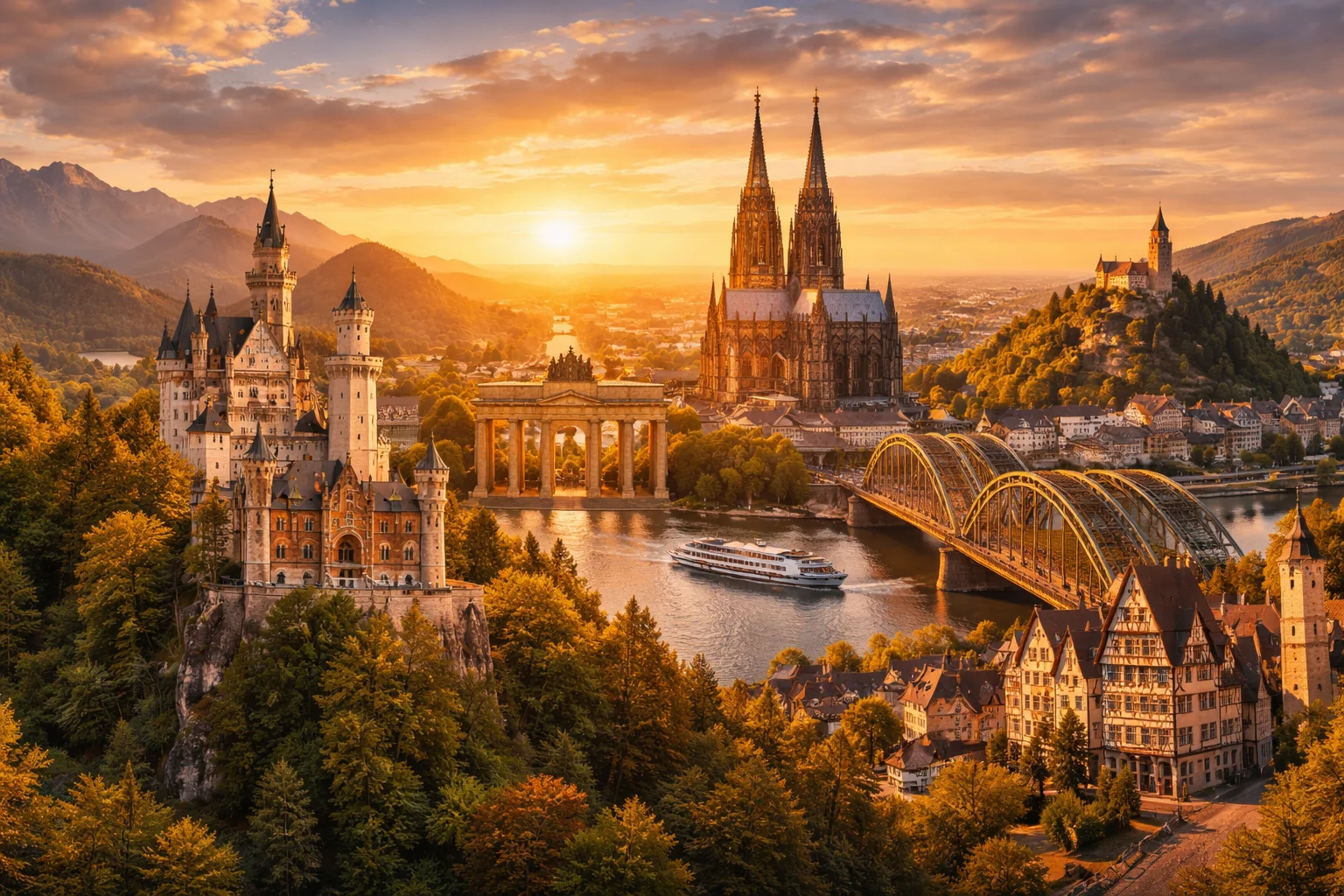
Germany overview
Germany is a federal parliamentary republic in Central Europe and a primary economic and cultural hub on the continent. Straddling the North Sea and the Bavarian Alps, it combines dense industrial corridors, major river systems and a network of medieval towns with modern metropolitan centers. The country’s structure of 16 Länder distributes legislative authority across regional governments, and a strong apprenticeship tradition links education to industry. Germany’s influence is visible in engineering exports, classical music heritage and legal-institutional contributions to European governance.
Common Geography Questions About Germany
Where Germany is located
Germany lies in central Europe, extending roughly from about 47°N in the Bavarian Alps to around 55°N on the Baltic coast; a representative central coordinate is near 51°N, 10°E. It shares land borders with nine countries—Denmark, Poland, the Czech Republic, Austria, Switzerland, France, Luxembourg, Belgium and the Netherlands—a geopolitical arrangement that facilitates dense cross-border economic and transport links. Germany’s maritime edges touch the North Sea and the Baltic Sea, and the Wadden Sea tidal flats on the North Sea coast form a distinctive coastal ecosystem and protected zone.
Geography and landscape of Germany
Germany’s geography presents a clear north–south progression: the low-lying North German Plain, a band of Central Uplands (Mittelgebirge) and the Alpine foothills rising to the Bavarian Alps. The Zugspitze, at 2,962 meters, is the country’s highest peak. Major rivers—the Rhine, Elbe and the Danube, which originates in the Black Forest—create long transport and industrial corridors. The North Sea coast includes UNESCO-protected tidal flats, while northeastern glacial lake districts and densely forested western uplands provide marked regional contrasts that define settlement, agriculture and industrial patterns.
Germany culture and society
Germany’s culture blends a standardized High German (Hochdeutsch) with a dense patchwork of regional dialects—Bavarian, Alemannic and Low German—and recognized minority languages such as Sorbian and Frisian. Social institutions that are unusual elsewhere include the dual vocational training system (apprenticeships) that channels skilled labor into the Mittelstand, and the church-tax (Kirchensteuer) mechanism linking religious affiliation to public funding. Religious geography is regionally divided, festive life features Karneval in Cologne and Munich’s Oktoberfest, and the German-rooted tradition of Christmas markets has become internationally recognized.
History of Germany
Germany’s history moves from a medieval mosaic within the Holy Roman Empire to political unification under Prussian leadership in 1871, a transformation that altered European power dynamics. The 20th century delivered abrupt ruptures: the collapse of imperial rule after 1918, the frailty of the Weimar Republic, the Nazi dictatorship and the devastation of World War II—followed by the Nuremberg Trials, which set important legal precedents. In 1949 the Basic Law established a federal democratic order in the Federal Republic of Germany while another German state existed in the east until reunification in 1990.
Germany economy and government
Germany’s political system is a federal parliamentary republic where the Bundestag legislates and the Bundesrat represents the 16 Länder with a formal say on laws affecting state competencies. Executive power rests with the chancellor, while the president holds largely ceremonial functions under the Basic Law. The economy is a social-market model characterized by export-oriented manufacturing, a strong Mittelstand, and global clusters in automotive engineering (e.g., Volkswagen, Daimler, BMW) and chemicals (e.g., BASF). Currency is the euro; energy policy dialogues have centered on the long-term Energiewende transition and industrial competitiveness tied to vocational training.
Regions and major cities of Germany
Germany is administratively divided into 16 Länder; three of them—Berlin, Hamburg and Bremen—are city-states that combine municipal and state responsibilities. The capital, Berlin, functions as both a federal state and the country’s political center. Other major cities include Munich (München) in Bavaria, a hub for industry and culture; Hamburg, Europe’s significant port and media center; and Cologne (Köln), noted for its cathedral and Rhine-side industry. Regions vary markedly, from Bavaria’s Alpine landscapes to the heavily urbanized Ruhr area in North Rhine-Westphalia.
Distinctive characteristics of Germany
Germany is associated with concrete, traceable contributions: Johannes Gutenberg’s movable-type press in Mainz that pioneered mass printing; composers such as Bach and Beethoven rooted in German-speaking territories; and a globally visible automotive and engineering sector headquartered in Germany. Legal and institutional legacies include the influence of the Nuremberg Trials on international criminal law and the historical development of the social-market economy. Culinary and social customs linked to Germany encompass the centuries-old Reinheitsgebot beer regulation and the spread of Christmas tree traditions from German provinces.
Places in Germany
Allianz Arena
Allianz Arena is a football stadium in Germany that functions as a principal match venue for professional football in Munich. The stadium has a seating capacity of roughly 75,000 and is notable for an illuminated, air-inflated outer shell that is a measurable, designed element of its architecture. The facility combines a formal sporting function with a distinctive exterior that signals team affiliation through controlled lighting and color changes.
Allwetterzoo Munster
Allwetterzoo Munster is a zoo in Germany. It is situated in the city of Münster in the state of North Rhine-Westphalia and functions as a curated zoological collection with a defined emphasis on year-round, sheltered exhibits. The site includes purpose-built indoor halls alongside outdoor enclosures, a measurable design approach intended to display tropical and aquatic species under controlled conditions. The institution serves as a local center for species management and public scientific collection stewardship within the municipality.
Alte Nationalgalerie
Alte Nationalgalerie is a museum in Germany that houses a specialized collection of nineteenth-century art. It stands on Berlin’s Museum Island and functions as part of the Staatliche Museen zu Berlin, the federal museum network responsible for its management. The building’s formal role is to present painting and sculpture from the nineteenth century within a purpose-built historic gallery, and its institutional status links it to national cultural collections and heritage conservation programs.
Alte Pinakothek
Alte Pinakothek is a museum in Germany that houses a public collection of European Old Master paintings. It stands in Munich and serves as a state-owned curatorial institution within Bavaria's cultural administration. The building was constructed to exhibit the Wittelsbach picture collection and contains long, top-lit galleries intended for painting display from the later medieval and early modern periods. The institution operates under the Bavarian State Painting Collections as part of the state's museum system.
Belgian Quarter
Belgian Quarter is an urban district in the city of Cologne, Germany. The district is centered on Brüsseler Platz and comprises a compact mix of residential blocks, small commercial streets, and named public squares as a measurable urban unit within Cologne’s municipal boundaries. Belgian Quarter is notable for its concentration of late historicist apartment buildings, a dense street grid served by Ehrenstraße, and a locally recognized identity tied to Belgian place names used for streets and plazas.
Berlin
Berlin is the capital city of Germany and one of its sixteen federal states. It is in northeastern Germany, surrounded by the state of Brandenburg, and serves as the national political centre, hosting federal institutions and diplomatic missions. The city covers 891.8 square kilometres and is divided into administrative boroughs with delegated local governments. It is also a major European centre for culture, higher education and scientific research, influencing the arts, scholarship and public policy beyond Germany.
Berlin Zoological Garden
Berlin Zoological Garden is a zoological garden in Germany. It sits inside Berlin and is formally registered as a zoological institution with an on-site aquarium and a documented living animal collection. The site functions as a managed scientific collection, combining historic enclosures and modern facilities on an urban campus that preserves both exhibited species and institutional records. The institution is notable for maintaining both public displays and structured breeding and research programs under official zoo regulations.
Black Forest
Black Forest is a densely wooded highland region in southwestern Germany, occupying approximately 6,000 square kilometres and rising to 1,493 metres at its highest point, the Feldberg. It is located in the state of Baden-Württemberg and is significant for its distinctive mixed forests and its role as a major source region for several European rivers. The area combines geological prominence with long-standing cultural traditions and measurable contributions to regional hydrology and biodiversity.
Cologne Zoo
Cologne Zoo is a zoological garden in Germany and an institutional collection of living animals and aquatic exhibits. It is situated within the urban boundary of Cologne and includes an on-site aquarium complex as a component of its campus. The institution combines historic masonry animal houses with purpose-built modern enclosures and functions as a public scientific collection oriented toward husbandry, species maintenance, and formal education. The site occupies a contiguous landscaped parcel dedicated to zoological display.
Deutsches Museum
Deutsches Museum is a museum of science and technology in Germany, based in the city of Munich. Its principal site occupies an island in the Isar River within Munich and functions as a major institutional centre for the preservation and presentation of technical collections. The museum comprises a contiguous complex of large exhibition halls and specialized off-site branches, and it maintains conservation laboratories and a research library as part of its institutional structure.
Dresden Zoo
Dresden Zoo is a municipal zoological garden in Germany that maintains a permanent collection of live vertebrates and invertebrates for display, study, and conservation. The institution is located in the city of Dresden and is formally registered as a zoological garden under German regulatory frameworks, giving it a defined role in regional ex‑situ conservation and species management. Its significance derives from combining a historic urban site with ongoing participation in coordinated breeding and research programs.
Duisburg Zoo
Duisburg Zoo is a zoological garden in Germany. It is located in the city of Duisburg in the state of North Rhine-Westphalia and functions as the city's municipal zoo, formally designated as a public zoological institution. The site is notable for its dolphinarium building and for maintaining a mixed collection of aquatic and terrestrial species across a managed parkland of enclosures and ponds. This article addresses location, history, significance, and features.