Gabon Guide
Gabon overview
Gabon is a Central African republic on the Gulf of Guinea, notable for a small population, extensive rainforests and an economy historically driven by oil and timber. The country combines an equatorial coastline, an inland river network dominated by the Ogooué, and a national park system created to protect Congo Basin biodiversity. Gabon’s political life has been shaped by long presidential tenures and by efforts to balance extractive-industry wealth with conservation priorities. This article outlines Gabon’s geography, culture, history, economy and major cities.
Common Geography Questions About Gabon
Where Gabon is located
Gabon sits on the west coast of Central Africa, straddling the equator between roughly 3° N and 4° S latitude and centered near longitude 11° E. It borders Cameroon to the north, the Republic of the Congo to the east and south, and the Gulf of Guinea to the west; there is no land border with Equatorial Guinea but maritime neighbors include São Tomé and Príncipe. The Ogooué River basin and a narrow Atlantic coastal plain define Gabon’s position, and the country’s coastline of estuaries and islands marks its geography as both forested interior and maritime façade.
Geography and landscape of Gabon
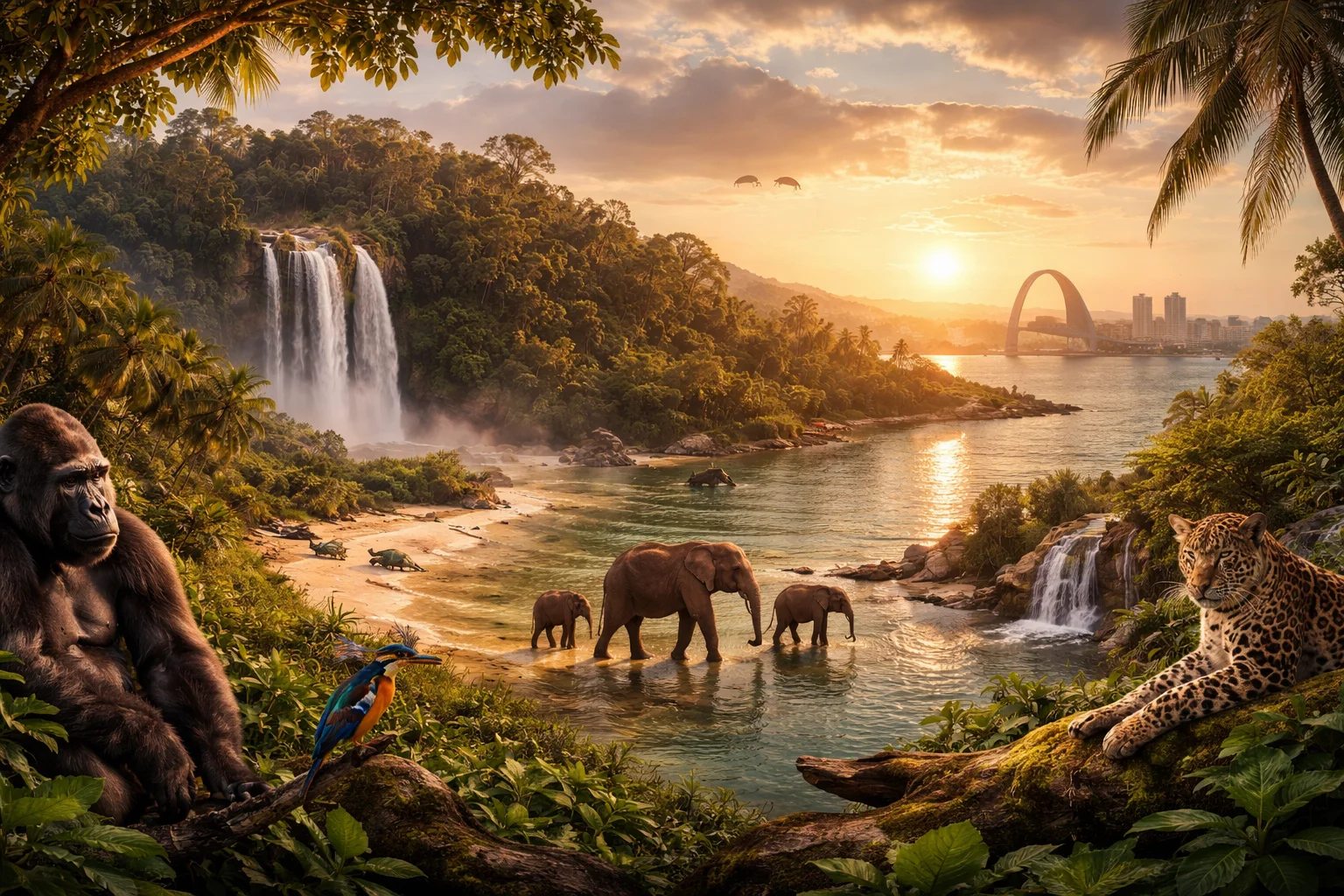
Gabon’s geography mixes low coastal plains, a central plateau, and scattered hills rather than high mountain chains; the Monts de Cristal (Crystal Mountains) form a humid, biodiverse ridge close to the coast. The Ogooué River is the principal drainage artery, with extensive tributaries feeding inland wetlands and floodplains. Climatically, Gabon is equatorial along the coast and becomes slightly drier inland; almost three-quarters of the country is covered by closed-canopy tropical rainforest. Unique to Gabon is the coastal-surfing hippo phenomenon observed in Loango National Park, where hippos enter ocean surf—an ecological oddity rare at global scale.
Gabon culture and society
French is the official language used in government and education, while a plurality of indigenous languages—Fang, Myènè, Punu, Kota and others—shape daily life; bilingualism is common in urban areas. Gabonese culture features masked traditions (Fang masks and Kota reliquaries) central to initiation and ancestor veneration, and the Bwiti spiritual system, which uses the iboga plant in sacramental rites uncommon outside the region. Demographically, Gabon has a low population density concentrated in coastal cities; cultural distinctiveness comes from the persistence of rainforest-based ritual arts and the prevalence of urbanized, oil-era social structures.
History of Gabon
Gabon’s history moves from precolonial coastal trading polities and forest societies into becoming part of French Equatorial Africa in the late 19th century. The Atlantic slave trade and later palm oil and timber commerce reoriented coastal communities; France consolidated administration and infrastructure before Gabon achieved independence in 1960. A major turning point was the mid-20th-century discovery of offshore oil, which reshaped demography and governance by concentrating wealth in Libreville and Port-Gentil. Another defining moment was the creation of a network of national parks in 2002, reflecting a shift toward conservation within postcolonial state policy.
Gabon economy and government
Gabon is formally a presidential republic with a strong executive branch and administrative subdivisions organized under provincial authorities; its political life has been marked by extended presidential incumbencies that influenced institutional continuity. Economically, the country depends on hydrocarbons, manganese mining and timber exports, with oil historically accounting for a large share of export revenue and state income. The national currency is the Central African CFA franc, shared with neighboring states and fixed to a European currency arrangement. Economically distinctive is Gabon’s high per-capita income relative to many neighbors, driven by small population and resource rents rather than diversified domestic industry.
Regions and major cities of Gabon
Administratively, Gabon is divided into nine provinces—Estuaire, Haut-Ogooué, Moyen-Ogooué, Ngounié, Nyanga, Ogooué-Ivindo, Ogooué-Lolo, Ogooué-Maritime and Woleu-Ntem—each with different ecological and economic profiles. The capital, Libreville, serves as the political and service hub and began as a settlement for freed slaves; Port-Gentil is the oil-and-industry port on an offshore lagoon, while Franceville anchors mining and southeastern plateau activity. Regional contrasts are stark: Estuaire province is urban and coastal, Haut-Ogooué is mineral-rich and savanna-fringed, and Ogooué-Ivindo remains one of the most forested, sparsely populated provinces.
Distinctive characteristics of Gabon
Gabon is internationally associated with Congo Basin conservation: in 2002 the state designated thirteen national parks to protect tropical biodiversity, a concrete conservation policy rare for a small petrostate. Its cultural artifacts—Fang masks and Kota reliquaries—are prominently represented in major museum collections and have influenced modernist art studies. Economically, Gabon is recognized for offshore oil production and significant manganese deposits; fiscally, its small population combined with resource exports gives it a high per-capita GNI profile among sub-Saharan countries. The Bwiti-iboga ritual and Loango’s ocean-going hippos are two specific global curiosities uniquely tied to Gabon.